Botanical species
Cerastium apuanum
Parl.
Peverina delle Apuane
Description
Morphological description
Perennial herbaceous plant, the peverina of the Apuan Alps appears as a small shrub 15 to 20 cm tall. It has a scapose habit, with erect or ascending stems, green or brown-reddish in color, covered with dense pubescence composed of long articulated hairs and, in the upper part, also glandular hairs. The stem is often leafless along the elongated floral axis.
The leaves are arranged oppositely along the stem, patent and reflexed, with a shape ranging from ovate-lanceolate to elliptical, acute at the apex. Both leaf surfaces are covered with a rough pubescence and have a well-marked central vein that divides them longitudinally. The lower leaves are smaller and closer together than the upper ones.
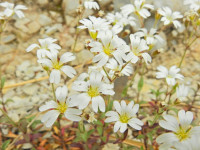
The inflorescence is cymose and composed of few flowers (between 3 and 6) located at the apex of the stems. The flowers are borne on erect, cylindrical, hairy peduncles of reddish-brown color, shorter than the flowers but lengthening during fruiting. The calyx has lanceolate sepals, green or reddish, covered with rough pubescence, with scarious margins and apex.
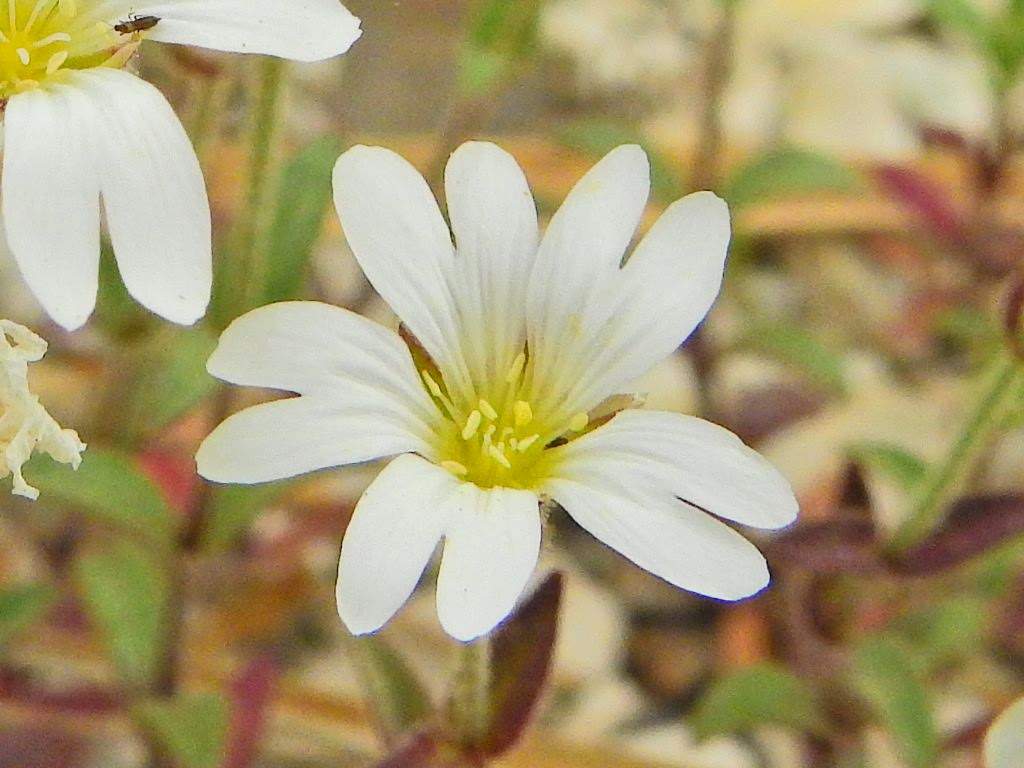
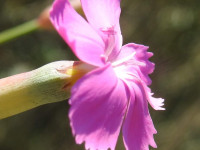
The corolla is white, with numerous petals, obcordate, bilobed and rounded at the apex, more than twice as long as the calyx. The petals are characterized by delicate longitudinal stripes and yellowish shades at the base. The flower symmetry is actinomorphic. The stamens are arranged in two series: five outer opposite the petals and five inner opposite the sepals; the filaments are glabrous and the anthers are oval, dorsifixed, bilocular and yellowish in color.
The gynoecium is shorter than the stamens, with a subspherical ovary of yellow-greenish color. Five divergent styles, slightly longer than the ovary, end in five stigmas.
The fruit is an ovate two-lobed capsule, which opens apically by means of 10 small teeth to release the seeds. The seeds are reniform and verrucose, a characteristic that contributes to their dispersal.
The root system is rhizomatous, allowing the plant to overwinter with buds located at ground level.
Habitat and distribution
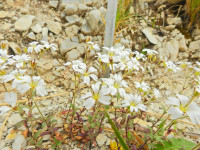
This species is an Italian endemic, present exclusively in the Apuan Alps. It preferably grows in mountainous environments, on dry and calcareous soils, such as screes, talus slopes and rocky slopes. The growth altitude ranges from about 600 to 1450 meters above sea level. The typical exposure is sunny and well-drained, in environments characterized by calcareous substrates and rather harsh conditions, typical of mountain areas.
Flowering period
The flowering of the peverina of the Apuan Alps extends from April to July, during which the plant develops its characteristic white flowers that contribute to pollination and subsequent fruit production.
Ecology and pollination
The white and actinomorphic flower, with its bilobed corolla and numerous petals, is adapted to pollination by pollinating insects, probably small hymenopterans or dipterans, attracted by the colors and shape of the flower. The arrangement of the stamens and the presence of dorsifixed anthers facilitate contact with pollinating insects.
Seed dispersal occurs through the denticidal capsule that opens at the apex releasing the reniform and verrucose seeds. The seed structure suggests possible anemochory (wind dispersal) or barochory (falling near the mother plant), but specific data on the mode of dispersal are not available.
Curiosities and traditional uses
No specific traditional, medicinal or food uses are known for this species. Its limited presence and rather restricted mountain habitat make it a species of primarily botanical and conservation interest. The peverina of the Apuan Alps represents an important element of the Italian endemic flora, contributing to the biodiversity of the Apuan Alps.
Etymology
The genus name Cerastium derives from the Greek “kéras”, meaning “horn”, referring to the shape of the characteristic fruit of the genus, a pointed capsule resembling a horn. The specific epithet apuanum indicates the area of origin and distribution of the species, the Apuan Alps, a mountain range located in Tuscany.
The Italian common name “peverina delle Apuane” refers both to the white color of the flowers, similar to other peverine, and to the geographic specificity of the plant.
Sources
- Acta Plantarum - Flora delle regioni italiane (scheda di Giuliano Salvai)
Characteristics
Classification
- Kingdom
- Plantae
- Family
- Caryophyllaceae
- Full name
- Cerastium apuanum Parl.
- Life form
- Emicriptofite scapose
Similar species
Search for species with similar characteristicsNoticed an error in the identification? Write to me
Other species of the same family
Caryophyllaceae
Explore
Other species of Caryophyllaceae