Description
Morphological description
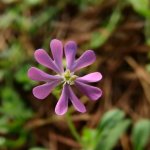
Annual herbaceous plant generally 20 to 30 cm tall, with a scapose habit and erect, branched, ascending stem. The stem appears pubescent, hirsute, and rough, without sterile shoots, and has a surface covered with soft, short hairs. The leaves are arranged decussately along the stem; the basal ones are spatulate with a blade narrowing into a long petiole, while the upper ones are sessile, elliptical or lanceolate, acute, and 1 to 3 cm long. The leaves are velvety and have cilia at the base.
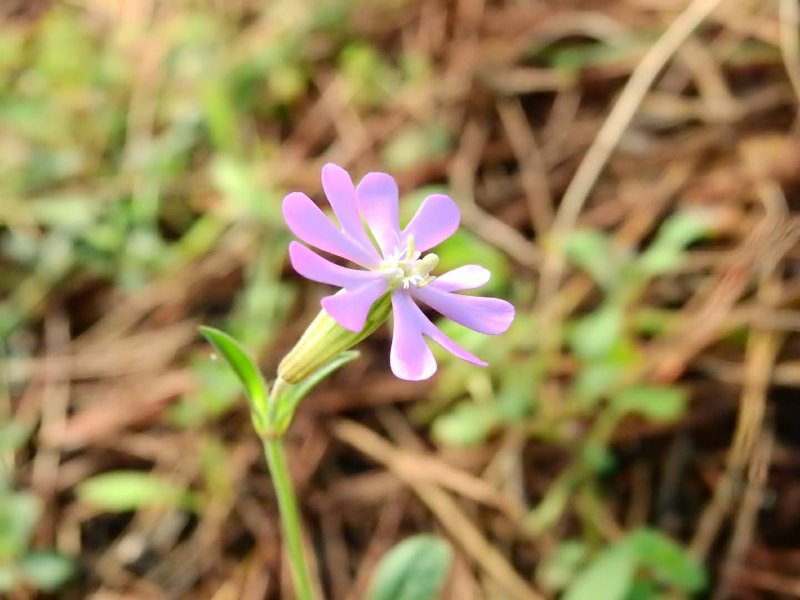
The flowers, hermaphroditic and actinomorphic, are arranged in dichasial inflorescences, generally 1 to 4 per plant, on pedicels shorter than the calyx. The calyx is tubular and cylindrical, 11-19 mm long, green with well-marked vertical violet veins (about 10), pubescent, with 5 acute triangular and ciliate teeth. At fruiting, the calyx becomes club-shaped. The corolla, longer than the calyx, consists of 5 bright pink petals, deeply bilobed and truncated, with a central crown formed by 10 small acute oblanceolate and obtuse teeth. There are 5 stamens with lanceolate anthers and a superior ovary with three styles. The carpophore, the part of the pistil supporting the styles, measures 5-6 mm, exceeding the length of the capsule.
The fruit is an ellipsoid capsule, denticidal, about 7-8 mm long, slightly larger than the carpophore. Inside are brown, reniform, and reticulated seeds, measuring 0.6-1.4 x 1-1.7 mm, equipped with two narrow wavy dorsal wings that facilitate dispersal. The root system is not specifically described in the sources, but since it is an annual psammophilous species, it is presumed to have fibrous roots suitable for stabilizing in sandy substrates.
Habitat and distribution
Steno-Mediterranean species, its distribution is limited to the Mediterranean coasts, especially in the Olivo area, which includes the Italian coasts facing the Mediterranean Sea. It mainly grows on coastal sandy substrates, marine dunes, and cultivated sandy fields, showing a clear preference for psammophilous environments (linked to coastal sands). It therefore grows in marine environments, with predominantly sunny exposure and well-drained, poor, and loose soils typical of dune and beach areas.
The growth altitude is typically low, limited to coastal zones. No significant presence is reported in inland or mountainous areas.
Flowering period
Flowering extends from April to June, with possible slight variations depending on latitude and local conditions. During this period, the plant produces its characteristic bright pink flowers, visible in inflorescences with few flowers. Flowering coincides with the spring season, a favorable period for reproduction and seed dispersal.
Ecology and pollination
Pollination is entomogamous, mainly carried out by nocturnal butterflies and other pollinating insects attracted by the bright color and shape of the flowers. The structure of the corolla, with bilobed petals and the central crown of teeth, is probably adapted to facilitate pollinator access to the nectaries and reproductive organs.
Seed dispersal occurs mainly through anemochory, i.e., by wind. The wavy wings on the seeds favor their long-distance dispersal, allowing the species to colonize new sandy areas along the coast.
Curiosities and traditional uses
No medicinal, food, or particular traditional uses are reported for this species. The genus name probably refers to Silenus, Bacchus's companion known for his swollen belly, in reference to the swollen and club-shaped calyx at fruiting. Another etymological hypothesis links the name to the Greek "sialon," meaning saliva, referring to the sticky liquid present on the stem of some species of the genus.
The specific name colorata refers to the bright pink color of the flowers, which represents one of the most evident and distinctive characteristics of the plant.
Etymology
The genus Silene could derive from the name of Silenus, a mythological figure companion of Bacchus, characterized by a swollen belly, similarly to the swollen calyx of these plants. Another possible root is the Greek term "sialon" (saliva), referring to the sticky secretion that some species of the genus present on the stem.
The specific name colorata alludes to the bright pink color of the flowers, which constitutes a distinctive and easily recognizable trait.
The common Italian name “Silene colorata” simply reflects the scientific denomination, highlighting the color of the flowers.
Sources
- Acta Plantarum - Flora delle regioni italiane (actaplantarum.org)
- Acta Plantarum - Scheda di Giuliano Salvai
- Tela Botanica / H. Coste, Flore descriptive et illustrée de la France
- World Flora Online (WFO)
Characteristics
Scheda botanica
| Famiglia | Caryophyllaceae |
|---|---|
| Fioritura | aprile – giugno |
| Forma biologica | Scapose |
| Habitat | with pink flowers, psammophilous plant, annual plant |
Domande frequenti
- Quando fiorisce Silene colorata?
- Silene colorata fiorisce aprile – giugno.
- Che tipo di pianta è Silene colorata?
- Silene colorata è una Therophytes (Scapose) secondo la classificazione di Raunkiaer.
- A quale famiglia appartiene Silene colorata?
- Silene colorata appartiene alla famiglia botanica Caryophyllaceae.
Where I found it (20 sightings)
Classification
- Kingdom
- Plantae
- Family
- Caryophyllaceae
- Full name
- Silene colorata Poir.
- Life form
- Therophytes scapose
Similar species
Search for species with similar characteristicsFurther reading
Noticed an error in the identification? Write to me
Other species of the same family
Caryophyllaceae
Explore
Other species of Caryophyllaceae