Botanical species
Saponaria officinalis
L.
Soapwort
Description
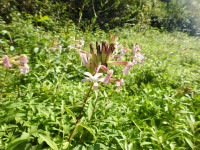
Morphological description
Perennial herbaceous plant 30 to 100 cm tall, Soapwort has an erect or ascending habit, with cylindrical, robust and generally glabrous stems, sometimes slightly pubescent, especially at the base, where they may show slight lignification. The root system consists of a creeping, branched, reddish-brown rhizome, which allows the plant to overwinter and expand.
The leaves are arranged oppositely along the stem and vary from oval to elliptic-lanceolate, with a length between 5 and 10 cm and a width of 1-4 cm. They are characterized by an entire margin, glabrous or slightly pubescent surface, and have 3-5 well-marked veins. The lower leaves are shortly petiolate while the upper ones are sessile, with an acute apex and attenuated base, sometimes slightly connate at the nodes.
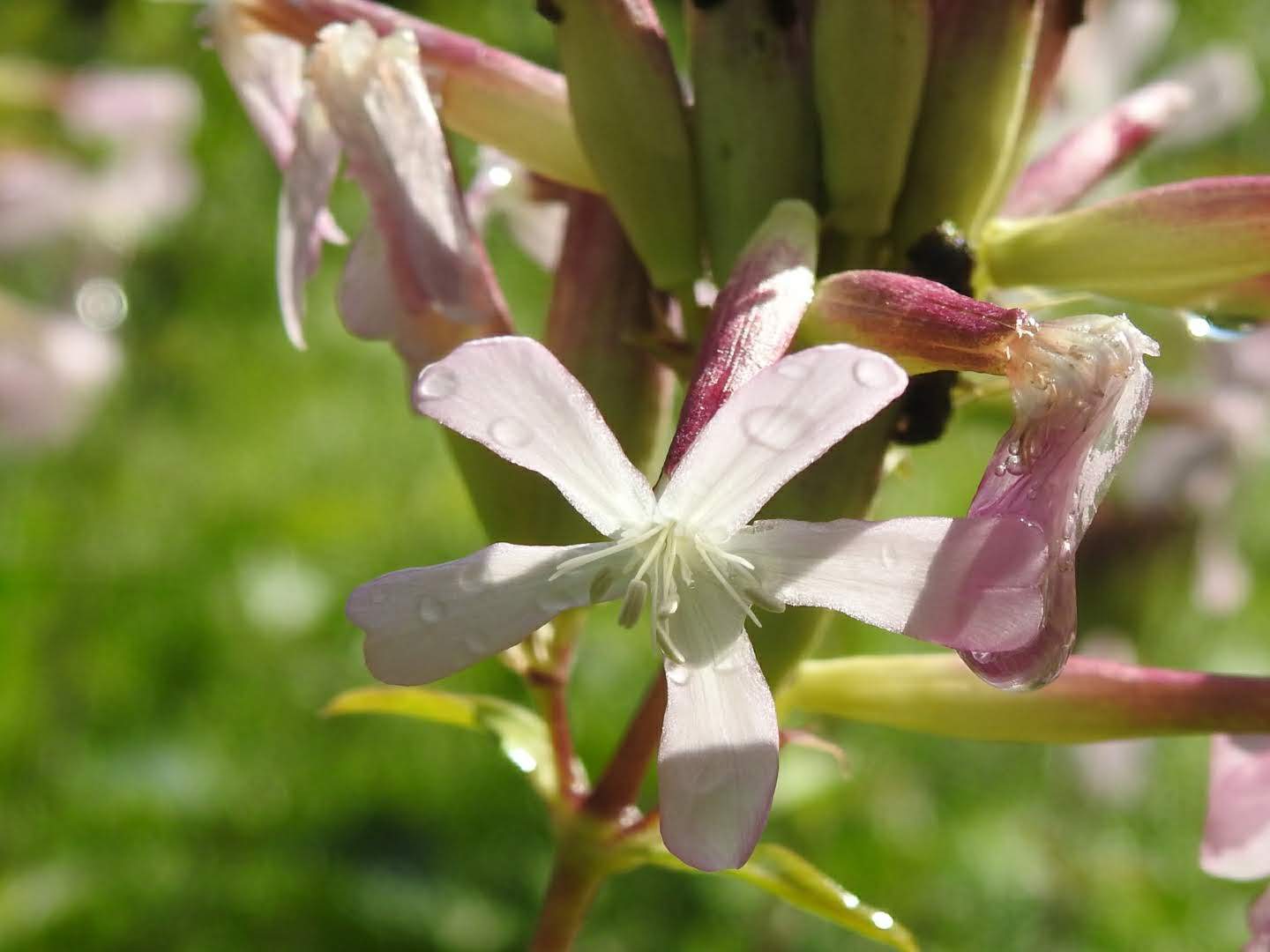
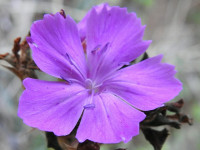
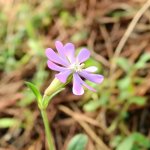
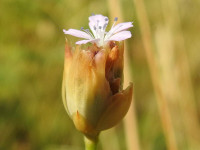
The flowers, about 3 cm in diameter, are grouped in dense and compact leafy cymes, terminal or axillary, composed of small groups of 3-7 flowers. Each flower is supported by a short peduncle (2-8 mm). The calyx is tubular, cylindrical, about 1.5-2.5 cm long and often shows a green coloration with violet or purple shades, especially towards the apex; it consists of 18-20 veins and ends with acuminate teeth of 1-2 mm. The corolla is formed by five pale pink petals, sometimes tending to whitish, wedge-obovate in shape, 1-1.5 cm long, with a slightly notched or emarginate margin. At the center of the petal there are small linear scales, characteristic of the genus. The stamens and styles protrude beyond the corolla. The flowers emit a delicate fragrance, stronger towards the evening, which attracts pollinating insects.
The fruit is an oblong-pyriform capsule, about 1.5-2 cm long, which opens by means of four apical teeth for seed dispersal. The seeds are numerous, black-brown in color, globose-reniform in shape, slightly compressed and with a tuberculate surface.
Habitat and distribution
Soapwort is widespread throughout Italy and the Mediterranean area, with confirmed presence also in many regions of continental Europe and Western Asia. It is a Eurosiberian species, typical of temperate and temperate-cold zones of Eurasia.
It prefers fresh and humid habitats such as riverbanks, periodically flooded woodland environments, clearings and forest edges, as well as ruderal places and anthropized areas. It grows on soils of various types, preferring well-drained but moist soils, with exposure from partially shaded to sunny. It is found from sea level up to about 1000 meters altitude, also adapting to hilly and submontane conditions.
In Italy, although spontaneous in some specific areas such as the beds of large rivers, it is often considered naturalized or synanthropic elsewhere, indicating a long history of cultivation and domestic use.
Flowering period
Flowering extends from June to September, with some variations related to latitude and altitude. In milder climates and lowland areas, flowering can begin as early as June, while in cooler or mountainous areas it lasts until September.
Ecology and pollination
Soapwort relies mainly on entomogamous pollination, attracted by pollinating insects such as bees, bumblebees and butterflies, drawn by the pink color of the flowers and their evening fragrance. The structure of the corolla, with petals equipped with scales and protruding stamens, facilitates insect contact with the reproductive organs, optimizing fertilization.
Seed dispersal occurs mainly by mechanical dehiscence of the capsule, which opens into four teeth, releasing the tuberculate seeds that can be transported by water or animals. The presence of a creeping rhizome also allows vegetative multiplication and the formation of stable colonies.
Curiosities and traditional uses
The genus name derives from the Latin "sapo", meaning soap, indicating the high concentration of saponins contained in the plant, which produce foam on contact with water. This has determined its traditional use as a natural detergent, particularly for washing delicate fabrics such as silk, lace and embroidery, even before the advent of commercial soap. A decoction of roots and leaves was used to restore shine to ancient fabrics, exploiting the plant's cleansing ability.
Soapwort was known since antiquity: the Assyrians already used it as soap in the 8th century BC and five centuries before Christ it was used to degrease wool from which the famous carpets of the nomadic populations of Asia were made. Hippocrates praised its purifying properties and benefits for the skin, while the Romans used it in thermal baths. In medieval and modern times, the plant was used in herbal medicine for its purifying, diuretic, expectorant and sudorific properties, and as a remedy for dermatitis, gout, bronchial congestion and jaundice.
However, it is important to underline that Soapwort is a medicinal species toxic if taken in high doses, potentially causing irritation of the digestive system, hemolysis and paralysis of the nervous centers. For external use, decoctions are employed to treat acne, psoriasis and other skin conditions, but application must be cautious to avoid eye and skin irritation.
In European herbal folklore, Soapwort was attributed curative virtues for venereal diseases such as syphilis, especially in times when other treatments were ineffective or toxic.
Etymology
The scientific name "Saponaria officinalis" derives from two Latin terms: "sapo" meaning soap, referring to the plant's ability to produce foam thanks to saponins, and "officinalis", indicating its historical importance as a medicinal and officinal plant used in pharmacy and herbalism.
The Italian common name "saponaria" directly recalls the traditional function of the plant as a natural detergent, in line with its main characteristic and the best-known historical use.
Sources
- Prof. S. Pignatti, "Flora d'Italia"
- Acta Plantarum - Flora delle regioni italiane (scheda di Marinella Zepigi)
- Tela Botanica / H. Coste, "Flore descriptive et illustrée de la France"
- World Flora Online (WFO)
Characteristics
Scheda botanica
| Famiglia | Caryophyllaceae |
|---|---|
| Fioritura | giugno – agosto |
| Forma biologica | Scapose |
| Habitat | with pink flowers, Perennial plant |
Domande frequenti
- Quando fiorisce Soapwort?
- Soapwort fiorisce giugno – agosto.
- Che tipo di pianta è Soapwort?
- Soapwort è una Hemicryptophytes (Scapose) secondo la classificazione di Raunkiaer.
- A quale famiglia appartiene Soapwort?
- Soapwort appartiene alla famiglia botanica Caryophyllaceae.
Where I found it (10 sightings)
Classification
- Kingdom
- Plantae
- Family
- Caryophyllaceae
- Full name
- Saponaria officinalis L.
- Life form
- Hemicryptophytes scapose
Similar species
Search for species with similar characteristicsFurther reading
Noticed an error in the identification? Write to me
Other species of the same family
Caryophyllaceae
Explore
Other species of Caryophyllaceae