Botanical species
Serapias neglecta
De Not.
Scarce Tongue-orchid
Description
Morphological description
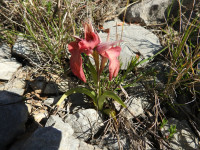
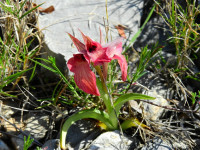
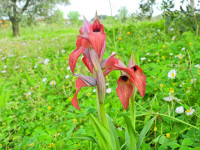
Perennial herbaceous plant, robust, with a height ranging from 15 to 30 cm, which can exceptionally reach 40 cm. The root system consists of two globose-oblong rhizotubers, connected by a short peduncle, flanked by a few linear roots. The stem is erect and robust, green in the lower leafy part, while in the upper part it may show reddish shades; at the base there is a green sheath.
The basal leaves are opposite, lanceolate, acute and glabrous, with parallel veins and free of spots; they measure up to 14 cm in length and from 1 to 2 cm in width. The higher ones are smaller, scattered, sessile and sheathing the stem; in the inflorescences they take on a bracteiform shape.
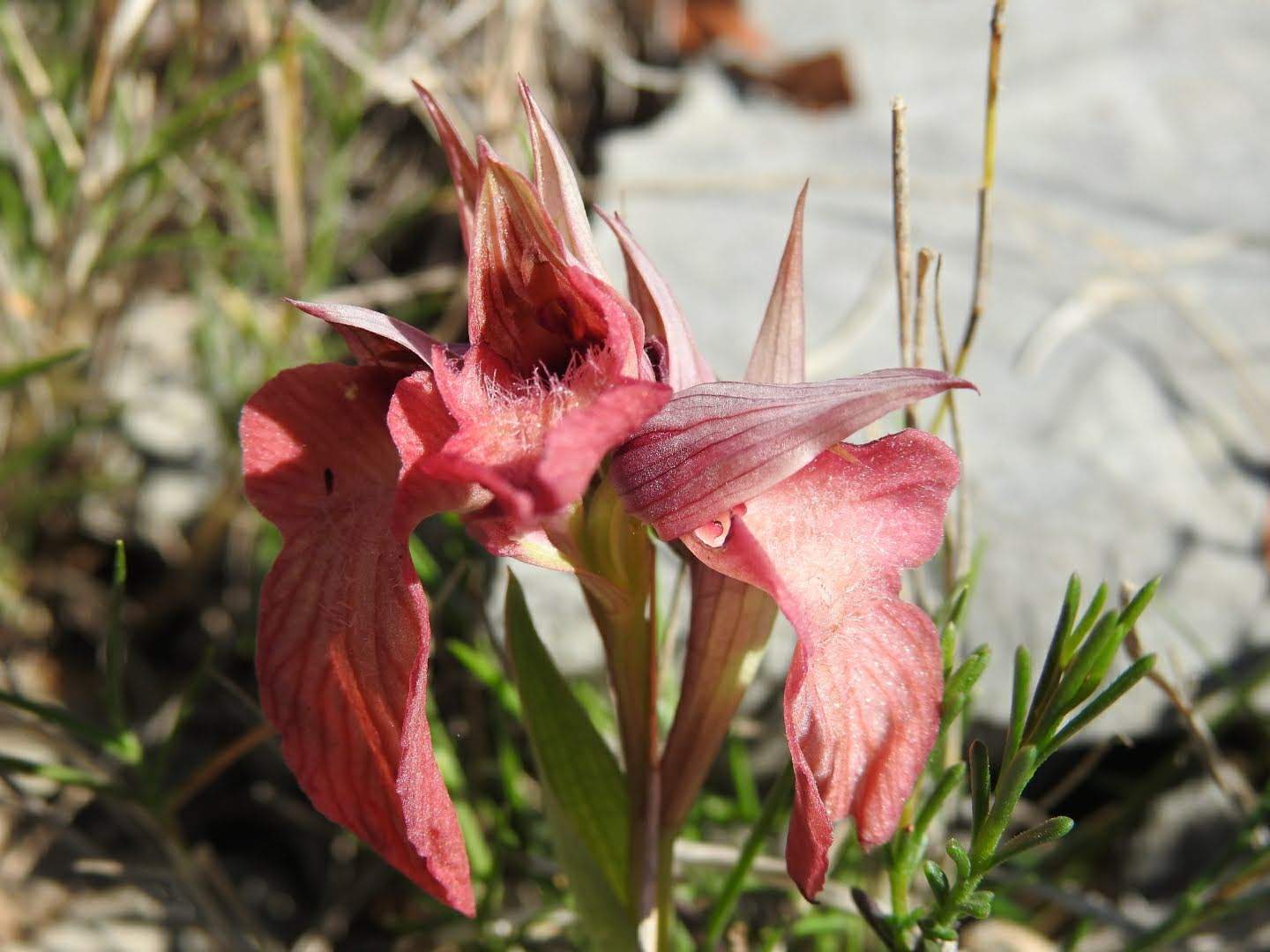
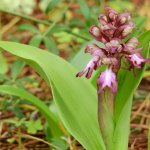
The inflorescence is ovoid, dense and compact, composed of 3-8 (up to 12) large flowers. The tepals, grayish with purplish veins, are petaloid and lanceolate, gathered in a helmet slightly turned upwards, whose tip slightly exceeds the base of the labellum. The labellum is trilobed, about three times the length of the tepals, with a coloration ranging from brick-red or rust-red at the edges to ochre-yellow in the center. The two lateral lobes constitute the hypochile, with two dark callosities parallel at the base, and protrude largely from the helmet. The central lobe, or epichile, is heart-shaped or ovate-lanceolate, pendulous, with dark veins, sinuate margin and long pale hairs. The ovary is inferior.
The fruit is a fissure capsule containing very small seeds.
Habitat and distribution
Typical species of the steno-Mediterranean Mediterranean areas, with distribution limited to the coasts of the Mediterranean basin, particularly in the olive area. It is mainly present in Italy with some limited incursions into surrounding territories.
It grows in open woodland environments, meadows, olive groves and uncultivated land with a preference for slightly acidic soils. It is found from sea level up to about 800 meters of altitude.
Flowering period
Flowering occurs mainly between March and May, with possible variations related to geographic location and altitude.
Ecology and pollination
The reproductive strategy of this orchid involves pollination by specific pollinating insects, attracted by the particular morphology and coloration of the flower, which acts as a mimetic lure. The flowers, with their helmet and colored labellum, facilitate selective access to pollinators. Seed dispersal occurs through fissure capsules that release microscopic seeds, easily carried by the wind.
Hybrids are known with other species of the genus Serapias, as well as with species belonging to the genus Anacamptis, including Anacamptis laxiflora, A. palustris, A. papilionacea, A. coriophora and A. morio.
Curiosities and traditional uses
No particular ethnobotanical applications, medicinal or traditional food uses are known associated with this species, which is rather rare and protected. Its specific name "neglecta" (neglected or forgotten) could refer precisely to its scarce distribution and the difficulty of observing it in nature.
Etymology
The genus name, Serapias, derives from Serapis, an Egyptian deity, while the specific epithet "neglecta" means "neglected" or "forgotten", probably referring to the rarity of the plant or its difficult identification in nature. In Italian it is commonly called “Scarce Tongue-orchid”, a name that reflects this characteristic of being little known or frequent.
Sources
- Acta Plantarum - Flora delle regioni italiane (actaplantarum.org)
- Acta Plantarum - Flora delle regioni italiane (scheda di Giuliano Salvai)
Characteristics
Where I found it
The sighting locations of this species are not public for conservation reasons.
Classification
- Kingdom
- Plantae
- Family
- Orchidaceae
- Full name
- Serapias neglecta De Not.
- Life form
- Geofite bulbose
Similar species
Search for species with similar characteristicsFurther reading
Noticed an error in the identification? Write to me
Other species of the same family
Orchidaceae
Explore
Other species of Orchidaceae