Botanical species
Spiranthes spiralis
(L.) Chevall.
Autumn Lady's-Tresses
Description
Morphological description
Perennial herbaceous plant belonging to the Orchidaceae family, it has an erect and slender habit, with a height ranging from 5 to 30 cm. The root system consists of 3-4 fusiform, deep and tuberous rhizotubers, which serve as storage organs for the plant. The stem is thin, covered with dense hairs especially in the upper part, while at the base it takes on a reddish coloration; it does not bear true leaves but is covered by bracteiform sheaths.
The true leaves are arranged in a basal rosette, with an ovate-elliptical shape. During the flowering period, however, the visible leaves belong to the plant that will bloom the following year and are destined to disappear with the appearance of the new stem.
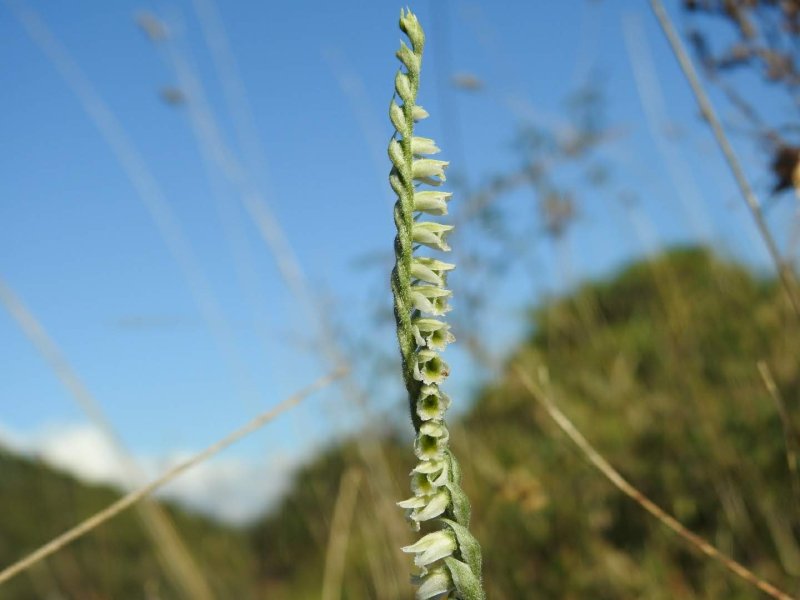
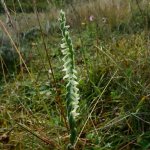
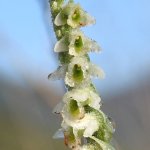
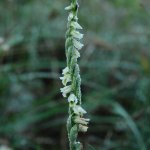
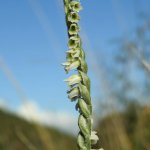
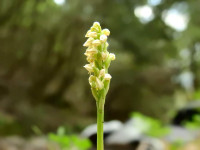
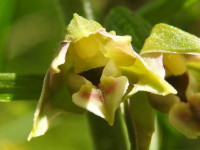
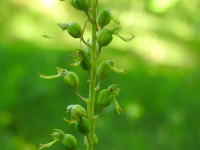
The inflorescence is a long raceme of small white-greenish flowers, arranged in a characteristic spiral that wraps around the stem, from which the genus name derives. The tepals are connivent and forward-facing in a hood shape, about 4 to 6 mm long, with a greenish exterior. The labellum is oblong, concave at the base, with a crenulate and fringed margin on the sides, facing downward and joined to the tepals to form a tube; it is white with a greenish or yellowish base. The bracts, hairy, are similar or slightly shorter than the ovary, which is also fusiform and hairy.
The fruit is an ovoid fissure-dehiscent capsule with three ribs, containing numerous minute seeds, typical of orchids, which are mainly dispersed by the wind.
Habitat and distribution
The species is mainly widespread in Mediterranean and Atlantic regions, with extensive penetration into the European inland up to the Caucasus. In Italy it is present from sea level up to about 1000 meters altitude, in habitats such as poor and dry meadows, whether mown or uncultivated, at the edge of thermophilous woods, paths and pine forests. It prefers well-drained soils, often calcareous, and exposure conditions ranging from sunny to partially shaded.
Flowering period
Flowering occurs in autumn, generally from September to November, making this species the last orchid of the year in many areas. No particularly significant geographic variations in the flowering period are known.
Ecology and pollination
The flowers, small but fragrant, attract pollinating insects that facilitate pollination. The spiral arrangement of the flowers on the inflorescence favors an effective visit by pollinating insects. The species adopts a reproductive strategy that combines the production of numerous minute seeds, dispersed by the wind, with the ability to perennialize thanks to the rhizotubers, thus ensuring survival even in variable environmental conditions.
Curiosities and traditional uses
No particular ethnobotanical applications, medicinal or traditional food uses are known for this species. However, its presence is reported as an indicator of poor meadows and valuable semi-natural environments, and for this reason it is protected in some Italian regions, including Lombardy and Emilia-Romagna, where collection is regulated or prohibited to preserve wild populations.
Etymology
The genus name derives from ancient Greek: "speira" means spiral and "anthos" flower, recalling the characteristic spiral arrangement of the flowers on the inflorescence. The specific epithet "spiralis" reiterates this spiral conformation. The Italian common name "viticcini autunnali" refers to the twining tendril-like shape and the late flowering period, which coincides with autumn.
Sources
- Acta Plantarum - Flora delle regioni italiane (actaplantarum.org)
- Acta Plantarum - Flora delle regioni italiane (scheda di Marinella Zepigi)
- World Flora Online (WFO)
Characteristics
Scheda botanica
| Famiglia | Orchidaceae |
|---|---|
| Fioritura | settembre – novembre |
| Forma biologica | Rhizomatous |
| Habitat | with white flowers, with green flowers |
Domande frequenti
- Quando fiorisce Autumn Lady's-Tresses?
- Autumn Lady's-Tresses fiorisce settembre – novembre.
- Che tipo di pianta è Autumn Lady's-Tresses?
- Autumn Lady's-Tresses è una Geophytes (Rhizomatous) secondo la classificazione di Raunkiaer.
- A quale famiglia appartiene Autumn Lady's-Tresses?
- Autumn Lady's-Tresses appartiene alla famiglia botanica Orchidaceae.
Where I found it
The sighting locations of this species are not public for conservation reasons.
Classification
- Kingdom
- Plantae
- Family
- Orchidaceae
- Full name
- Spiranthes spiralis (L.) Chevall.
- Synonyms
- Ophrys spiralis L.; Spiranthes autumnalis Rich.
- Life form
- Geophytes rhizomatous
Similar species
Search for species with similar characteristicsFurther reading
Noticed an error in the identification? Write to me
Other species of the same family
Orchidaceae
Explore
Other species of Orchidaceae