Botanical species
Platanthera bifolia
(L.) Rich.
Lesser Butterfly-Orchid
Description
Morphological description
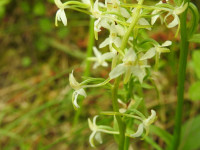
Perennial herbaceous plant of medium height, the Lesser Butterfly-Orchid has an erect habit generally ranging between 25 and 60 cm, with slightly angular, striated stems wrapped by brown sheaths in the lower part. The root system consists of two whole, oval tubers, which act as perennial organs from which stem, leaves, and flowers develop each year.
The leaves are dimorphic: the two basal leaves, sometimes three or four, are spatulate, oblanceolate or elliptical in shape, with entire margins and rounded apex, varying in size between 2-3 × 8-12 cm, rarely up to 7 × 20 cm, characterized by 13-15 well-marked parallel veins. The cauline leaves are narrower, lanceolate with acute apex, progressively reduced upwards, with a length of about 4-6 × 15-25 mm.
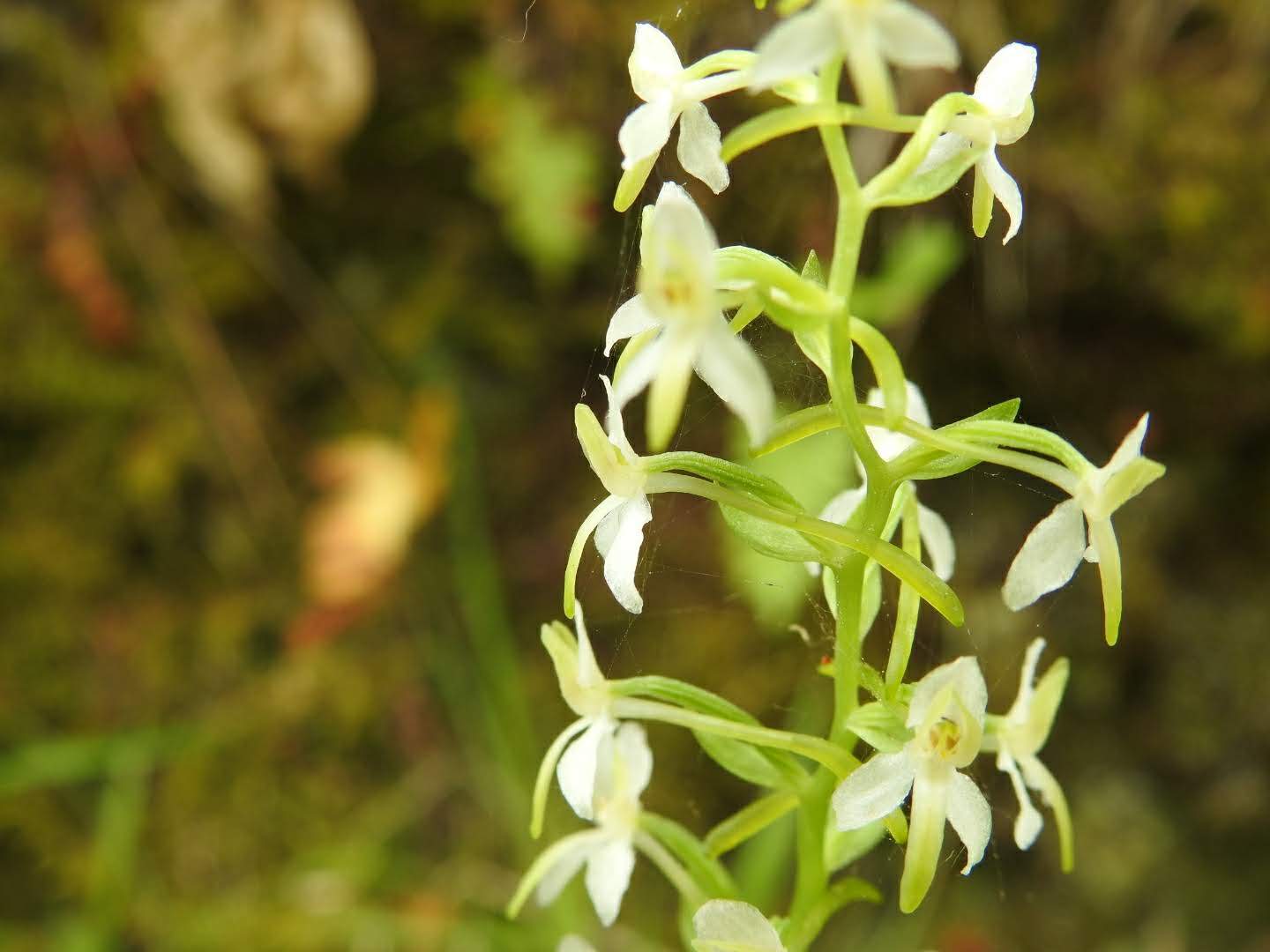
The inflorescence is a cylindrical, lax spike, which can host from 15 up to 25 well-spaced flowers, supported by narrow lanceolate bracts 3-12 mm long, generally longer than the ovary. The ovary is semicircularly curved, cylindrical, 12-15 mm long.
The flowers are white, often fragrant, with outer tepals lanceolate of 7-9 mm and inner tepals narrower and erect. The labellum is linear, narrow and entire, pendulous, about 1.5-2 × 12 mm long, with rounded apex and sometimes slightly greenish at the base. The spur is filiform, cylindrical, 20 to 30 mm long (1.5-2 times the length of the ovary), tapered towards the apex. The pollinia sacs are parallel and close together.
The fruits are capsules containing numerous minute seeds, typical of orchids.
Habitat and distribution
The Lesser Butterfly-Orchid is a paleotemperate species with a wide Eurasian distribution and also includes some areas of North Africa. In Italy it is present in almost all regions, more frequently in coniferous woods, but it can also be found in broadleaf forests and in shrub environments or mountain meadows up to 2000 meters altitude. It prefers calcareous, well-drained soils and is often found in bright or semi-shaded woodland environments, where the soil is moderately rich and not too acidic.
The species is adapted to temperate and subalpine climates, finding its ideal habitat in places with good availability of indirect light and a substrate often rich in calcium.
Flowering period
The flowering extends from June to August, with a peak between July and August, which may vary slightly depending on altitude and latitude. In some more northern areas or at higher elevations, flowering may start later and continue until September.
Ecology and pollination
The white and fragrant flower is particularly attractive to nocturnal butterflies equipped with a long proboscis spiral, allowing them to reach the nectar contained in the thin and elongated spur. This specialization favors cross-pollination through highly adapted pollinating insects, thus increasing the genetic variability of the species.
The arrangement of the parallel and close pollinia sacs is characteristic and helps in the effective transfer of pollen during insect visits. Seed dispersal occurs through capsules that open releasing numerous extremely small and light seeds, favoring anemochory (wind dispersal).
Curiosities and traditional uses
Despite the inconspicuous appearance and the pale colors of the flowers, the strong fragrance makes this orchid very attractive to nocturnal insects. The elongated spur is an evolutionary adaptation aimed at ensuring visits from specific pollinators with long and thin mouths.
The Lesser Butterfly-Orchid is a species protected at national and regional levels, due to its vulnerability and ecological importance in woods and natural environments it frequents. No documented traditional food or medicinal uses are known with certainty for this species, nor particular references in Italian folklore.
Etymology
The generic name Platanthera derives from the Greek platys (broad) and anthera (anther), referring to the broad and characteristic shape of the plant’s anthers. The specific epithet bifolia indicates the typical presence of two basal leaves, although in some cases 3-4 leaves may be present. The Italian common name "platantera comune" precisely recalls this distinctive characteristic and the relatively high frequency of the species compared to other related orchids.
Sources
- Prof. S. Pignatti, Flora d'Italia
- Acta Plantarum - Flora delle regioni italiane (scheda di Marinella Zepigi)
- World Flora Online (WFO)
Characteristics
Scheda botanica
| Famiglia | Orchidaceae |
|---|---|
| Fioritura | maggio – luglio |
| Forma biologica | Bulbous |
| Habitat | with white flowers, with fragrant flowers, with tubular flowers with bilobed spur |
Domande frequenti
- Quando fiorisce Lesser Butterfly-Orchid?
- Lesser Butterfly-Orchid fiorisce maggio – luglio.
- Che tipo di pianta è Lesser Butterfly-Orchid?
- Lesser Butterfly-Orchid è una Geophytes (Bulbous) secondo la classificazione di Raunkiaer.
- A quale famiglia appartiene Lesser Butterfly-Orchid?
- Lesser Butterfly-Orchid appartiene alla famiglia botanica Orchidaceae.
Where I found it
The sighting locations of this species are not public for conservation reasons.
Classification
- Kingdom
- Plantae
- Family
- Orchidaceae
- Full name
- Platanthera bifolia (L.) Rich.
- Synonyms
- Orchis bifolia L.; Platanthera bifolia (L.) Rich. subsp. osca R.Lorenz, Romolini, V.A.Romano & Soca; Platanthera fornicata (Bab.) Buttler; Platanthera osca (R.Lorenz, Romolini, V.A.Romano & Soca) Biagioli, Kreutz & De Simoni; Platanthera solstitialis Boen.
- Life form
- Geophytes bulbous
Similar species
Search for species with similar characteristicsNoticed an error in the identification? Write to me
Other species of the same family
Orchidaceae
Explore
Other species of Orchidaceae