Botanical species
Oxalis pes-caprae
L.
Bermuda-Buttercup
Description
Morphological description
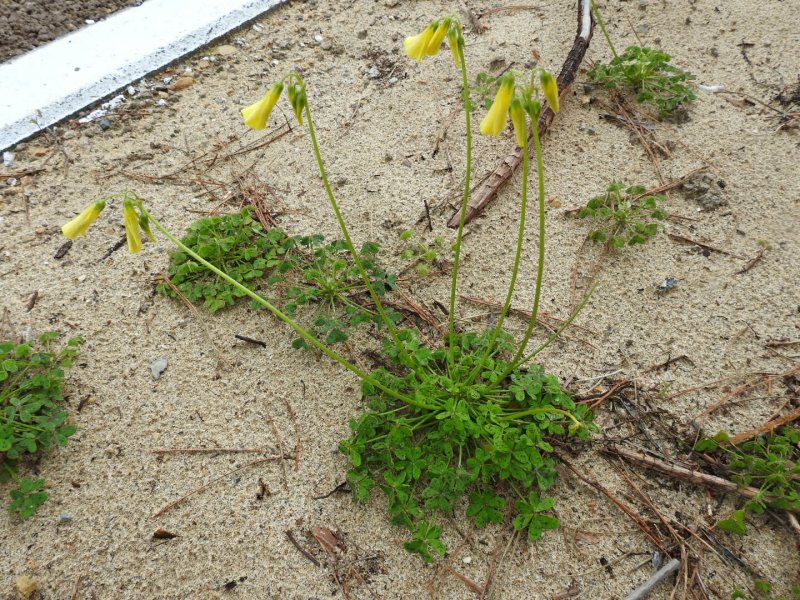
Perennial herbaceous plant, acaulescent, generally 5 to 15 cm tall, with a basal rosette habit. It has a fleshy underground rhizome, from which numerous bulbils develop, varying in size between 5-15 mm, covered by dark chestnut tunics. These bulbils constitute the main organ of vegetative propagation. The true stem is reduced or absent, but erect petioles emerge from the base supporting the leaves.
The leaves are trifoliate, with three obcordate segments, fleshy and slightly succulent, about 15-25 mm long and 10-15 mm wide, often with dotted and slightly pubescent margins. The upper surface is glabrous and bright green, sometimes with dark purple spots. The petioles are erect, 3.5 to 17 cm long, and can be glabrous or slightly pubescent. The stipules at the base of the petiole are rectangular with a ciliate margin.
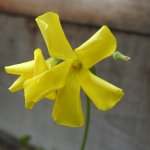
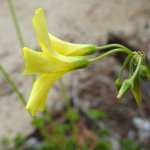
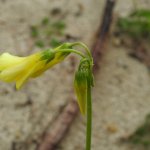
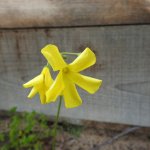
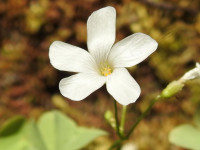
The inflorescence is an umbel (umbel-like cyme) borne on a long, leafless, and slightly pubescent scape, rising above the leaves and can bear from 1 up to 19 flowers. The flowers are pendulous, hermaphroditic, intense citron yellow in color, with a corolla about 2.5 cm in diameter. Each flower has five lanceolate sepals, about 6-7 mm long, with an acuminate apex and equipped with two orange calli at the base. The petals are obovate, distinct or partially connate at the base, and bright yellow. The number of stamens is ten, arranged on glabrous filaments, five of which are shorter. The ovary has five styles with stigmas ending in a button or papillose shape.
The fruit is a cylindrical, subglabrous capsule, elongated and pointed in shape, which rarely reaches full maturity and produces seeds. The seeds are globose, about 1 mm in diameter, with a reticulated surface; each locule can contain 3 to 5 seeds.
The root system includes fibrous roots and a bulb with a fleshy white and contractile root.
Habitat and distribution
Native to South Africa and Madagascar, this species is now widely naturalized and distributed throughout the Mediterranean basin, including Italy. In Italy, it is present in many regions, from Sicily (where it was cultivated since the 18th century and later became spontaneous) up to Tuscany, Lazio, and the north, with reports also in Corsica and minor islands such as Pantelleria. Its introduction in some areas, such as Malta, is documented from the early 19th century.
It prefers cultivated soils, uncultivated lands, roadside edges, and anthropized environments, generally from 0 up to 600 meters altitude. It favors sunny exposures and warm places, typical of the Mediterranean climate. It is considered an invasive neophyte species, often weedy due to its rapid vegetative propagation via bulbils.
Flowering period
Flowering extends from November to June, with peaks of greater abundance from April to September in milder areas. In some Mediterranean areas, it can therefore be observed in bloom for most of the year, thanks to favorable climatic conditions.
Ecology and pollination
The plant exhibits a predominantly vegetative reproductive strategy, propagating mainly through underground bulbils that ensure rapid and localized expansion. Seed production is rare and, for a long time, was not observed in nature; however, recently sporadic fruiting cases have been reported, probably due to adaptations allowing self-pollination.
The flowers, thanks to their intense yellow color and bell-shaped form, attract various pollinating insects, including bees and bumblebees, which contribute to pollination. The presence of stamens of different lengths is consistent with a heterostyly mechanism, although in Mediterranean populations only the microstyle form is present, suggesting reduced genetic variability and origin from a single introduction.
Seed dispersal is limited, while bulbils allow rapid soil colonization. The plant is also very resistant to herbicides, which contributes to its invasive capacity in anthropized habitats.
Curiosities and traditional uses
This species is also known as "South African yellow wood sorrel" or "yellow clover" and is used in some food traditions as an edible plant. It contains oxalic acid, which gives it a sour taste, from which the genus name derives (from Greek "òxys" = acid and "sal" = salt). Oxalic acid is present in salt form and can be associated with anthraquinones.
Fresh leaves can be eaten raw, for example in salads, but due to the high oxalate content, it is not recommended for people with kidney stones, rheumatism, arthritis, or gout. Cooking significantly reduces the amount of oxalates, making it safer.
In folk medicine, the plant has been used as a diuretic and detoxifying agent, as well as for external applications on reddened skin. It is also appreciated for its ability to relieve thirst during hikes. A peasant custom observes that before rain the plant folds its leaves, serving as a natural weather indicator.
There are double-petaled varieties used for ornamental purposes, while the wild species is often considered weedy.
Etymology
The scientific name derives from Greek: "Oxalis" indicates the sour taste due to the presence of oxalic acid in the leaves, while "pes-caprae" means "goat’s foot," referring to the shape of the root or rhizome that resembles a goat’s hoof.
The Italian common name “South African yellow wood sorrel” recalls the sour taste and the geographic origin of the species, native to South Africa.
Sources
- Acta Plantarum - Flora delle regioni italiane (actaplantarum.org)
- Acta Plantarum - Flora delle regioni italiane (scheda di Nino Messina)
- Tela Botanica / H. Coste, "Flore descriptive et illustrée de la France"
- World Flora Online (WFO)
Characteristics
Where I found it (8 sightings)
Classification
- Kingdom
- Plantae
- Family
- Oxalidaceae
- Full name
- Oxalis pes-caprae L.
- Synonyms
- Acetosella cernua (Thunb.) Kuntze; Bolboxalis cernua (Thunb.) Small; Oxalis burmannii Jacq.; Oxalis cernua Thunb.
- Life form
- Geofite bulbose
Similar species
Search for species with similar characteristicsFurther reading
Noticed an error in the identification? Write to me
Other species of the same family
Oxalidaceae
Explore
Other species of Oxalidaceae