Botanical species
Oxalis debilis
Kunth
Large-Flowered Pink-Sorrel
Description
Morphological description
Perennial herbaceous plant belonging to the family Oxalidaceae, with acaulescent habit, that is lacking a visible stem, and equipped with a bulbous root system, with a globose or oblong bulb measuring 1-3 cm in diameter. The roots are napiform, that is stout and swollen at the base.
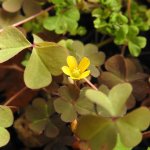
The leaves are basal, gathered in rosettes, and show a trifoliate arrangement typical of the genus Oxalis. Each trifoliate is composed of three orbicular or obovate leaflets, 1 to 2.6 cm long and 1.4 to 3.5 cm wide, with an obcordate apex (inverted heart shape) and rounded lobes. The base of the leaflets is cuneate. The leaf surfaces range from slightly hairy to almost glabrous, sometimes with visible punctiform crystals, and the petioles are 6.5 to 13.5 cm long, also pubescent. Stipules are present at the base of the petioles.
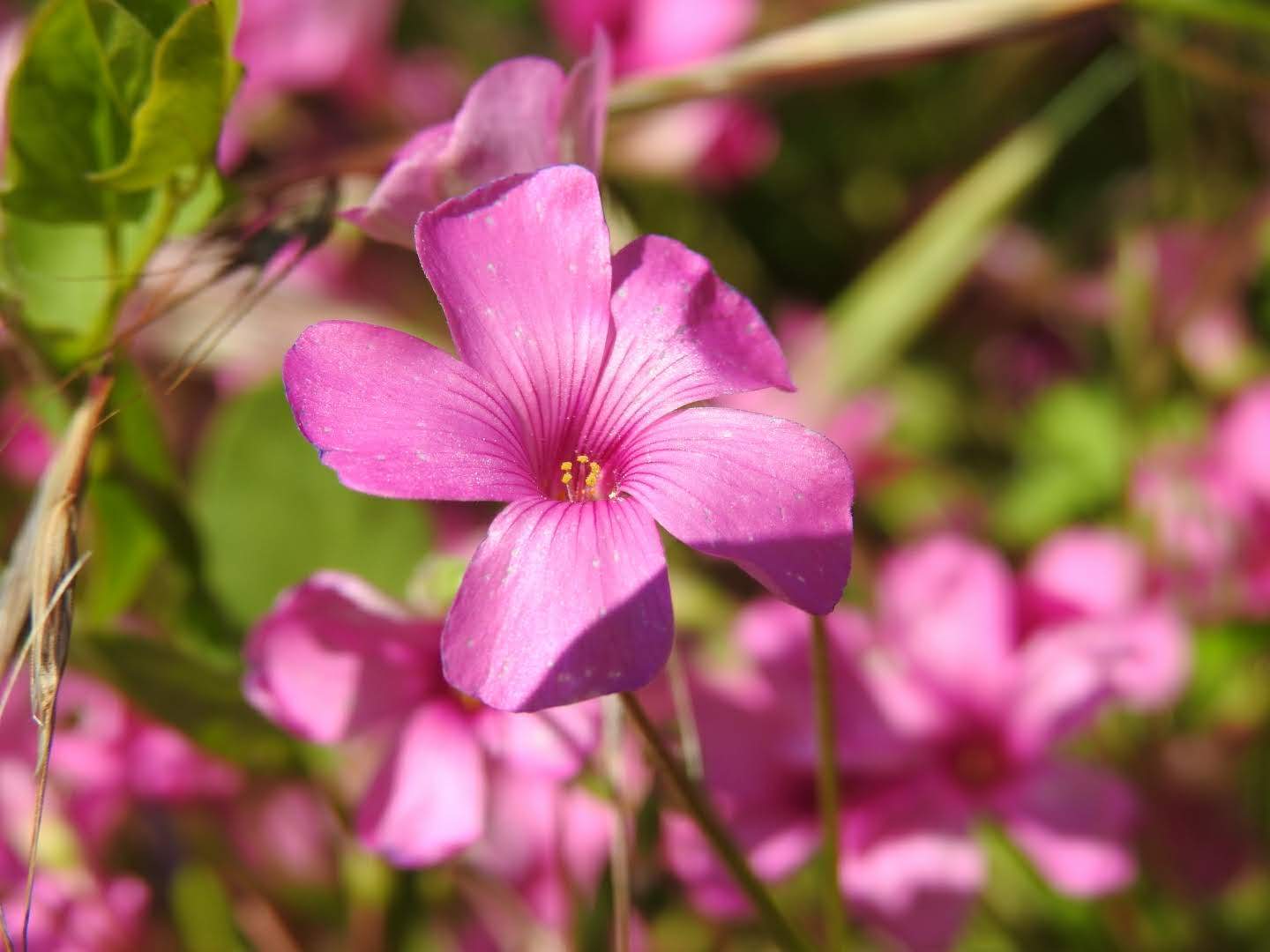
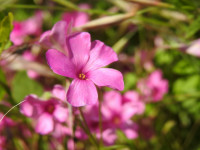
Flowering occurs in umbels (umbelliform inflorescence) with 3-11 flowers per umbel, supported by peduncles 7 to 18 cm long and pedicels 10-30 mm long. The flowers, open and showy, have 5 obovate petals 10-13 mm long and 5-7 mm wide, with colors ranging from pink to reddish-violet, often with a pleasant fragrance. The sepals are linear to elliptic, 4-7 mm long, with an apex from obtuse to acute and equipped with 1-3 ciliate calli. The stamens are of two lengths: the long ones measure 4-5.5 mm, the short ones 3-4 mm. The ovary is ovoid with 2 to 12 ovulate carpels and glabrous styles.
The fruit is an oblong pod about 17-18 mm long, containing ovoid seeds characterized by longitudinal ribs and transverse crests.
Habitat and distribution
Native to South America, this species is now widely distributed worldwide, also as a cultivated plant in gardens. In Italy and the Mediterranean area it is frequently found in anthropized environments, gardens, borders, flowerbeds, and urban areas, but it can also naturalize in open and sunny soils. It prefers sunny or partially shaded exposures and well-drained soils, often with sandy or light substrates.
The growth altitude generally ranges between 100 and 900 meters above sea level. The plant adapts to different soil types, provided they are not excessively moist or compacted.
Flowering period
Flowering extends almost throughout the year, from January to December, with peaks in the summer and autumn months. This long flowering period contributes to the species’ ability to naturalize in many regions.
Ecology and pollination
The flowers, with shape and color that attract insects, are pollinated by various pollinating insects, including bees and other small hymenopterans, which favor sexual reproduction. The plant can also multiply vegetatively thanks to the bulb and sometimes by the formation of bulbils.
Seed dispersal occurs through the pods which, at maturity, open to release the seeds, favoring colonization of new habitats in the immediate vicinity.
Curiosities and traditional uses
This species, like many of the homonymous genus, is edible: the leaves contain oxalic acid, which gives the characteristic sour taste typical of Large-Flowered Pink-Sorrel. It has traditionally been used in small quantities to flavor dishes or in popular herbal medicine for its astringent and digestive properties, although it is important not to exceed consumption due to the toxicity of oxalic acid in high doses.
In ornamental use it is appreciated for the long and abundant flowering with bright colors and decorative foliage, used in gardens and flowerbeds to create flowering turf. However, no particular popular beliefs or folkloric uses are reported for this species.
Etymology
The generic name Oxalis derives from the Greek “óxys”, meaning “acid”, referring to the sour taste of the leaves, due to the oxalic acid contained in the plant. The specific epithet debilis (from Latin “weak”) probably refers to the delicacy or apparent fragility of the plant compared to other species of the genus.
The Italian common name “acetosella debole” recalls both the sour taste (“acetosella”) and the more delicate and small nature of the plant compared to other Large-Flowered Pink-Sorrel.
Sources
- Tela Botanica / H. Coste, "Flore descriptive et illustrée de la France"
- World Flora Online (WFO)
Characteristics
Scheda botanica
| Famiglia | Oxalidaceae |
|---|---|
| Fioritura | tutto l'anno |
| Forma biologica | Bulbous |
| Habitat | edible plant, with fuchsia flowers, with fragrant flowers |
| Uso alimentare | Commestibile |
Domande frequenti
- Quando fiorisce Large-Flowered Pink-Sorrel?
- Large-Flowered Pink-Sorrel fiorisce tutto l'anno.
- È commestibile Large-Flowered Pink-Sorrel?
- Large-Flowered Pink-Sorrel è considerata commestibile. Verifica sempre le parti eduli e la preparazione corretta prima del consumo.
- Che tipo di pianta è Large-Flowered Pink-Sorrel?
- Large-Flowered Pink-Sorrel è una Geophytes (Bulbous) secondo la classificazione di Raunkiaer.
- A quale famiglia appartiene Large-Flowered Pink-Sorrel?
- Large-Flowered Pink-Sorrel appartiene alla famiglia botanica Oxalidaceae.
Where I found it (7 sightings)
Classification
- Kingdom
- Plantae
- Family
- Oxalidaceae
- Full name
- Oxalis debilis Kunth
- Synonyms
- Acetosella debilis (Kunth) Kuntze; Acetosella martiana (Zucc.) Kuntze; Acetosella violacea auct. p.p., non (L.) Kuntze; Ionoxalis martiana (Zucc.) Small; Oxalis amoena auct. p.p., non Salisb.; Oxalis bipunctata A.St.-Hil.; Oxalis bipunctata Grahm, non A.St.-Hil., nom. illeg.; Oxalis bulbillifera Herter; Oxalis corymbosa DC.; Oxalis debilis Kunth subsp. corymbosa (DC.) O.Bolòs & Vigo; Oxalis debilis Kunth var. corymbosa (DC.) Lourteig; Oxalis macrophylla Kunth; Oxalis martiana Zucc.; Oxalis multibulbosa Turcz.; Oxalis purpurata auct. p.p., non Jacq.; Oxalis urbica A.St.-Hil.; Oxalis violacea auct. p.p., non L.
- Life form
- Geophytes bulbous
Similar species
Search for species with similar characteristicsFurther reading
Noticed an error in the identification? Write to me
Other species of the same family
Oxalidaceae
Explore
Other species of Oxalidaceae