Botanical species
Oxalis corniculata
L.
Procumbent Yellow-Sorrel
Description
Morphological description
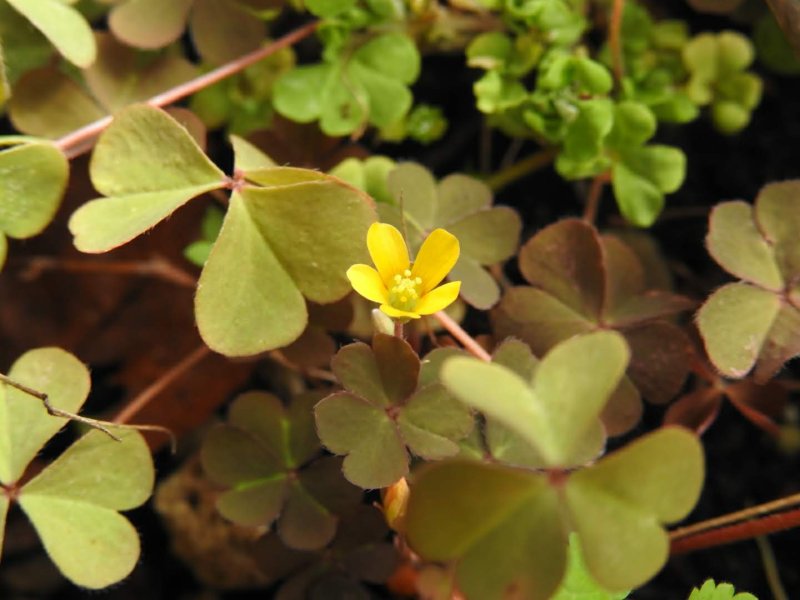
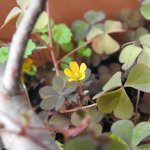
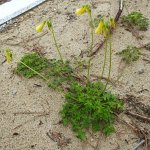
Perennial herbaceous plant, small in size, with height generally ranging between 5 and 30 cm, characterized by a creeping and prostrate-ascending habit. The stems are thin, branched, glabrous or with patent or reflexed hairs, rooting at the nodes in contact with the soil, but lacking underground stolons. The root is taproot, gradually tapered and sometimes woody at the base.
The leaves are alternate, trifoliate, with a petiole length from 1 to over 8 cm, and have small rectangular, auriculate stipules adherent to the petiole. The leaflets are obcordate in shape, with a bilobed apex, approximately 5–9 mm long by 8–12 mm wide, with a herbaceous texture. The color can vary from green to green spotted with violet, with variable pubescence on both surfaces, more often on the underside.
The flowers are hermaphroditic, small-medium sized (5–7 mm petal length), bright yellow in color, often with reddish streaks at the base and on the outer face of the petals. They are grouped in umbelliform inflorescences of 2–7 flowers, located at the axil of the cauline leaves. The calyx consists of 5 lanceolate-linear sepals, about 4 mm long, with ciliate margins especially at the apex. The floral peduncle is pubescent, of similar or shorter length than the leaf petiole, and bends after flowering. There are 10 stamens, with the 5 inner ones longer and opposite the petals. The ovary is superior, with 5 carpels and as many styles with capitate stigmas.
The fruit is a fissure-dehiscent capsule, cylindrical, with a star-shaped pentagonal cross-section, 8 to 25 mm long and 2–3 mm wide, covered with simple hairs (hirsute) and with few setose hairs along the dehiscence fissures. Each locule contains 3 to 8 ovoid, compressed seeds, about 1 mm, brown-reddish, with 6–8 transverse ridges and lacking white lines.
Habitat and distribution
Cosmopolitan species widely distributed throughout the Italian territory and the Mediterranean basin, it is particularly common in anthropized environments. It grows spontaneously in cultivated fields, vegetable gardens, threshing floors, sidewalks, wall cracks, and disturbed areas. It prefers well-drained soils, often sandy or gravelly, with sunny or partially shaded exposure.
In Italy it is found from the lowlands up to about 800 meters altitude, more frequently present in hilly and flat areas. In the Mediterranean, the species is common in central and southern regions, less frequent in higher mountainous areas and colder northern regions.
Flowering period
Flowering extends from April to October, with some geographic variation linked to local climate: earlier and prolonged in mild and Mediterranean climate areas, more concentrated in the summer months in cooler or mountainous zones.
Ecology and pollination
The plant is mainly pollinated by pollinating insects attracted by the bright yellow color of the flowers. The umbelliform inflorescence facilitates access to pollinator visitors, which include small hymenopterans and other phytophagous insects. The reproductive strategy is predominantly entomogamous, with hermaphroditism and prolonged flowering.
Seed dispersal occurs through the fissure-dehiscent capsule which, opening, releases seeds that fall on the surrounding soil; the presence of hairs on the capsule and fruit surface may facilitate limited mechanical or animal transport. The stems rooting at the nodes allow the plant to expand vegetatively, promoting colonization of disturbed habitats.
Curiosities and traditional uses
The genus name Oxalis derives from the Greek “oxys” (acid) and “hall” (salt), referring to the high content of oxalic acid present in the leaves and flowers, giving them a characteristic sour taste. The specific epithet “corniculata” means “horned”, probably referring to the elongated shape of the fruits.
In ethnobotany, Procumbent Yellow-Sorrel has traditionally been used for its medicinal properties: anti-inflammatory, astringent, depurative, diuretic, febrifuge, and stomachic. The leaves and flowers, rich in vitamin C, have been used for treating fever, influenza, diarrhea, traumatic lesions, and urinary tract infections, as well as against scurvy.
Externally, leaf extracts are used to soothe skin eruptions, insect stings, and burns. In cooking, the leaves can be eaten raw in salads or the flowers used as decoration, but always in moderation due to the oxalate content which can be toxic for people with kidney or joint problems.
From a dyeing perspective, the plant is known for producing yellow, orange, and red colors.
Etymology
The scientific name derives from Greek: “Oxalis” from “oxys” (acid) for the sour taste due to oxalic acid contained in the plant, while “corniculata” (from Latin) means “provided with small horns”, probably referring to the shape of the elongated and pointed fruits. The common Italian name “acetosella dei campi” also recalls the sour taste (“vinegar”) and the habitat frequently found in open fields.
Sources
- Prof. S. Pignatti, Flora d'Italia
- Acta Plantarum – Flora delle regioni italiane (scheda di Marinella Zepigi)
- Tela Botanica / H. Coste, Flore descriptive et illustrée de la France
- World Flora Online (WFO)
Characteristics
Scheda botanica
| Famiglia | Oxalidaceae |
|---|---|
| Fioritura | aprile – ottobre |
| Forma biologica | Creeping plants |
| Habitat | with yellow flowers, creeping plant, Perennial plant |
Domande frequenti
- Quando fiorisce Procumbent Yellow-Sorrel?
- Procumbent Yellow-Sorrel fiorisce aprile – ottobre.
- Che tipo di pianta è Procumbent Yellow-Sorrel?
- Procumbent Yellow-Sorrel è una Hemicryptophytes (Creeping plants) secondo la classificazione di Raunkiaer.
- A quale famiglia appartiene Procumbent Yellow-Sorrel?
- Procumbent Yellow-Sorrel appartiene alla famiglia botanica Oxalidaceae.
Where I found it (8 sightings)
Classification
- Kingdom
- Plantae
- Family
- Oxalidaceae
- Full name
- Oxalis corniculata L.
- Synonyms
- Oxalis repens Thunb.; Oxalis tropaeoloides Schlachter ex Planch.
- Life form
- Hemicryptophytes creeping plants
Similar species
Search for species with similar characteristicsFurther reading
Noticed an error in the identification? Write to me
Other species of the same family
Oxalidaceae
Explore
Other species of Oxalidaceae