Botanical species
Oxalis incarnata
L.
Pale Pink-Sorrel
Description
Morphological description
Perennial herbaceous plant, the Pale Pink-Sorrel has a tufted and caulescent habit, with erect stems reaching a height between 10 and 30 cm. The stems are thin, glabrous or sometimes very slightly pubescent in the younger parts, and branch out from the leaf axils. The plant has long and thin rhizomes from which bulbils originate both on the rhizomes themselves and in the leaf axils; the bulbils are ovoid or narrowly ovoid, up to 2 cm long, with outer tunics of light brownish color and slightly puberulent.
The leaves, arranged mainly in basal rosettes and in pseudo-whorls of 4-10 elements along the stem (sometimes also opposite lower down), are trifoliate, with three obcordate leaflets (inverted heart-shaped) 0.8 to 2 cm wide and 0.5 to 1.5 cm long. The leaflets, of herbaceous texture, are glabrous and have a margin incised for about a quarter of their length. The color is green, sometimes with purplish shades on the underside, which often appears darker and may show downward folds during the night. The petioles are thin, 2-7 cm long and slightly dilated at the base.
The inflorescence consists of a single flower, borne on a peduncle 3-7 cm long, which develops terminally or in the axils of the upper leaves. The calyx is formed by oblong-subacute sepals 4-6 mm long, with apices bearing two orange tubercles and more brown callosities converging towards the apex.
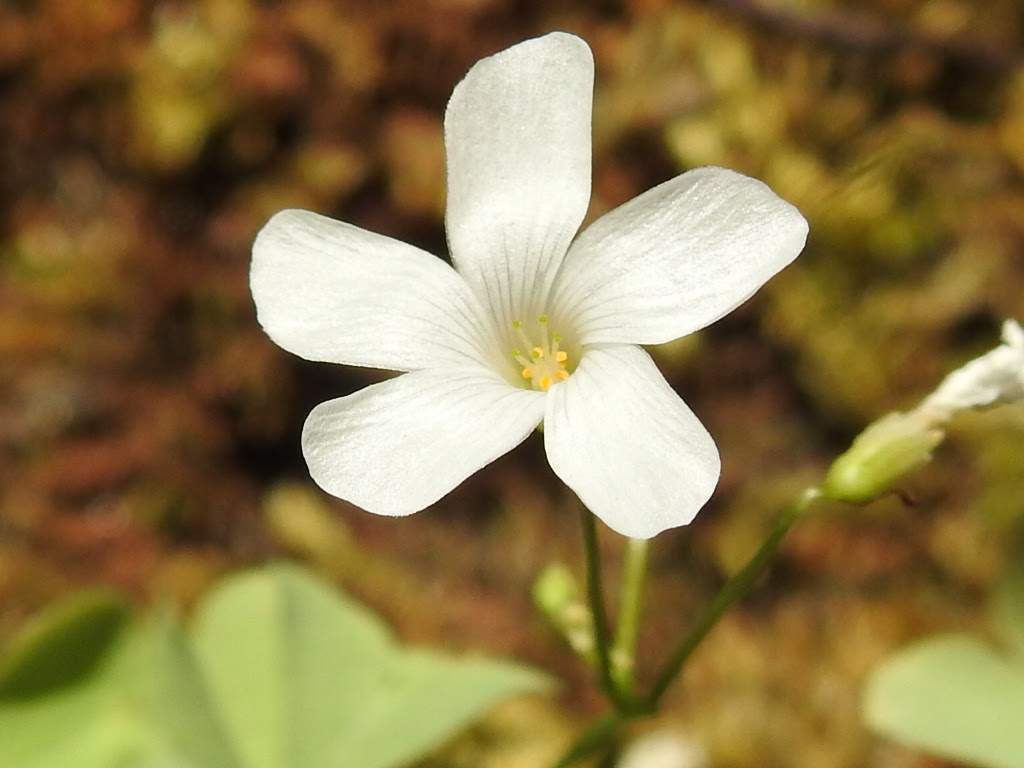
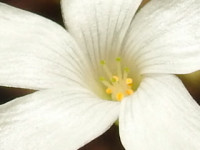
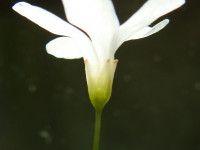
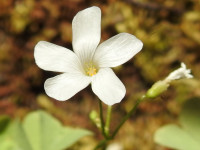
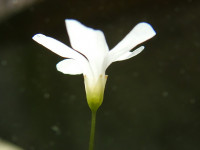
The flower is characterized by five petals of white or very pale white-lilac color with darker veins, 10 to 20 mm long. The corolla has a tubular base of light green color. The petals are subcuneate and slightly attenuated towards the base, with a rounded or slightly truncate apex and a finely papillose basal surface. The stamens are pubescent and equipped with obtuse and swollen teeth; the ovary is also pubescent in the upper half, with unilocular chambers. The styles are also pubescent, with small green stigmas.
Capsules or mature fruits have not been described with certainty, but the seeds have endosperm.
Habitat and distribution
This species is typical of mountainous and submontane environments, preferring sandy soils and shady places, such as the undergrowth of mixed forests or conifers. In Italy, it is mainly found in the alpine and pre-alpine regions, where it grows between 50 and 300 meters of altitude, preferring shaded or semi-shaded exposures. It is a plant that loves fresh and more humid microhabitats, often on loose and well-drained substrates. In the Mediterranean basin, its presence is more limited and linked to mountainous areas with similar conditions.
Flowering period
Flowering mainly extends between May and August, with some reports of flowering also in later periods (up to September) or winter (from January to April) in areas with milder climate or favorable microclimates. This variability suggests a certain phenological plasticity in response to local environmental conditions.
Ecology and pollination
The Pale Pink-Sorrel is pollinated by pollinating insects, which are attracted by the white-lilac flowers and their structure. The arrangement of single flowers and the presence of articulated peduncles facilitate access to pollinating insects, probably hymenopterans and dipterans. The species produces bulbils both on the rhizomes and in the leaf axils, which suggests a reproductive strategy combining sexual reproduction through seeds and vegetative reproduction through bulbils. This allows the plant to quickly colonize favorable microhabitats and survive in variable conditions. Seed dispersal is not well documented, but presumably occurs by falling near the mother plant or through insects or small animals that can carry them.
Curiosities and traditional uses
The Pale Pink-Sorrel, like other species of the genus Oxalis, contains oxalic acid, which gives the leaves a sour taste similar to vinegar, from which the common name "acetosella" derives. This sour taste has historically suggested a limited food use, for example as an ingredient in salads or dressings in small quantities. However, no particular medicinal or folkloric uses are reported for this specific species in the Italian territory.
Etymology
The scientific name Oxalis derives from the Greek "oxys" meaning "acid," referring to the sour taste of the leaves, due to the presence of oxalic acid. The specific epithet incarnata refers to the color originally attributed to the flowers (which in other observations may also appear slightly violet or white). The Italian common name "acetosella carnicina" recalls both the sour taste ("acetosella") and the historically or geographically significant region, Carnia, in Friuli, where the species was probably observed and studied.
Sources
- Tela Botanica / H. Coste, Flore descriptive et illustrée de la France
- World Flora Online (WFO)
Characteristics
Scheda botanica
| Famiglia | Oxalidaceae |
|---|---|
| Fioritura | maggio – agosto |
| Habitat | with white flowers, Perennial plant |
Domande frequenti
- Quando fiorisce Pale Pink-Sorrel?
- Pale Pink-Sorrel fiorisce maggio – agosto.
- A quale famiglia appartiene Pale Pink-Sorrel?
- Pale Pink-Sorrel appartiene alla famiglia botanica Oxalidaceae.
Where I found it (1 sightings)
Classification
- Kingdom
- Plantae
- Family
- Oxalidaceae
- Full name
- Oxalis incarnata L.
- Synonyms
- Acetosella incarnata (L.) Kuntze; Oxys incarnata (L.) Medik.
Similar species
Search for species with similar characteristicsFurther reading
Noticed an error in the identification? Write to me
Other species of the same family
Oxalidaceae

Explore
Other species of Oxalidaceae