Botanical species
Oxalis latifolia
Kunth
Garden Pink-Sorrel
Description
Morphological description
Perennial herbaceous plant, the Broad-leaved Acetosella has a bushy habit and reaches a height of about 15-25 cm. It is a acaulescent species, meaning it lacks an evident stem, with an underground stem reduced to a disc from which bulbils and leaves develop. The root system is characterized by ovoid or globose bulbs, up to 1-1.5 cm long and about 1 cm wide, generally found at the base of the plant. These bulbs are wrapped in external protective scales, papery in texture, and internal nutritive scales, brown, elliptical, acute, 7-15 mm long and 4-6 mm wide, with a very marked central vein and two pairs of thinner lateral veins. From the base of these bulbs arise numerous stolons that generate new ovoid bulbils, about 1 cm long, protected by hyaline bracts.
The leaves are basal, arranged in a trifoliate manner with broad and obdeltoid-shaped leaflets, 10 to 45 mm long and 20 to 75 mm wide, with margins generally straight or rarely incised up to a quarter of the length. The leaflets are green with a violet underside, glabrous or slightly hairy especially along the lower veins. The petioles are ascending, 5 to 15 cm long, glabrous or weakly pubescent, with fleshy stipules, connected to the petiole, brown-reddish in color, provided with sticky hairs and glandular margins.
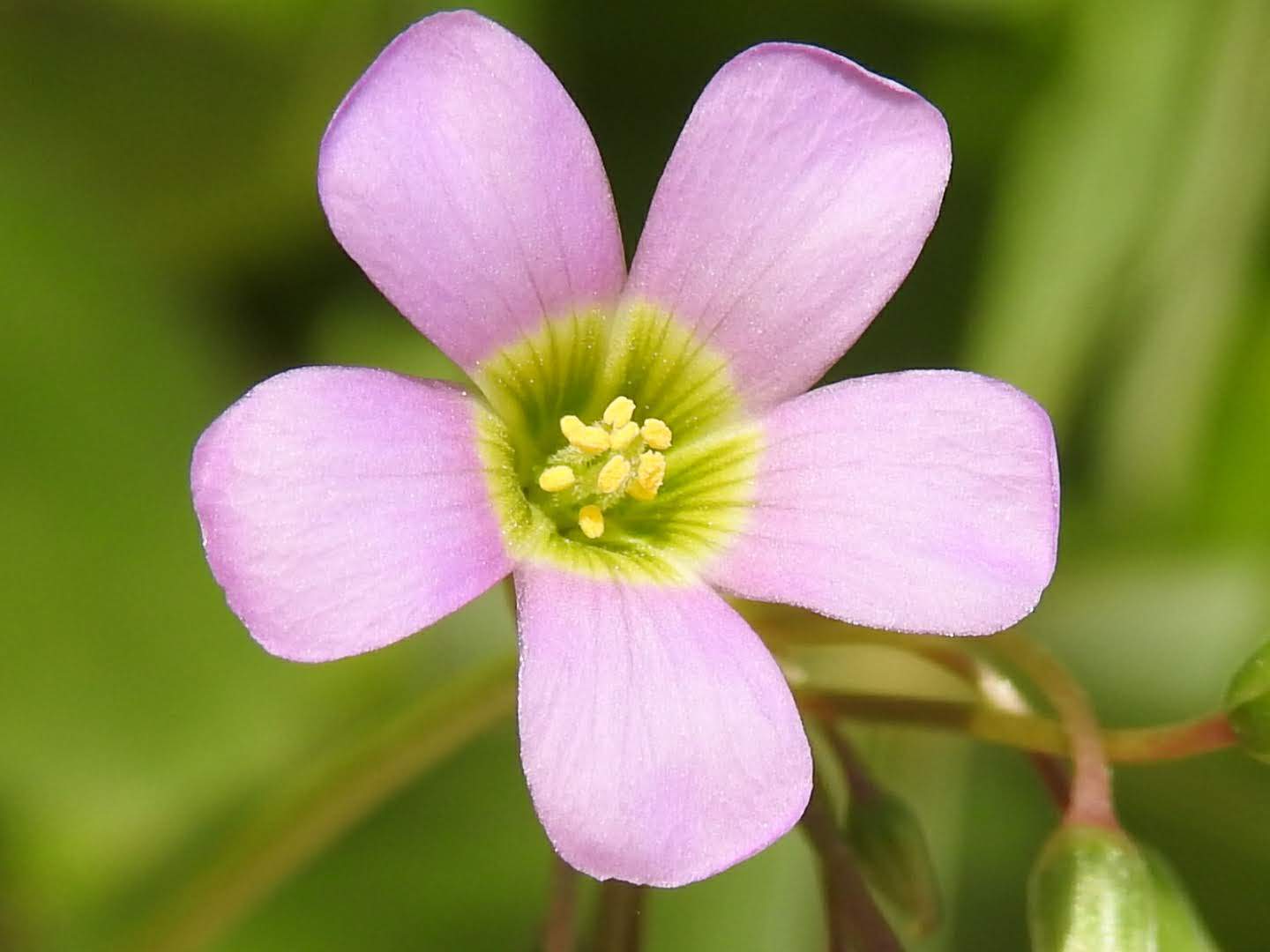
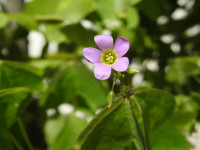
The inflorescence is an umbel of flowers, generally longer than the leaves, which can reach up to 30 cm in length and bear 5 to 20 flowers. The peduncles are 10-25 cm long, thin and glabrous or slightly pubescent. The flowers consist of five violet-lilac petals, with a white base and green tube, obovate and spatulate, 2.5-3.5 times the length of the calyx. The calyx is made up of light green sepals with hyaline and glabrous margins, 3-5 mm long, with two conspicuous apical orange-brown outgrowths. The stamens are in two groups of different lengths, with hairy filaments in the upper half and anthers about 3-4 mm long. The ovary is ovoid and glabrous, with carpels containing 4-8 ovules. The fruit is an oblong-acute capsule, glabrous, 4-8.5 mm long, containing seeds about 1 mm, ellipsoid, slightly flattened and characterized by 8-9 zigzag ribs with 12-13 transverse stripes.
Habitat and distribution
This species is native to Central and South America but has spread to many other regions, including some Mediterranean territories. In Italy it can be found in humid and shady environments, often in cultivated or disturbed areas, but it is not a typically spontaneous species of the native Mediterranean flora. It prefers well-drained soils, medium texture, with exposure from partial shade to full sun. It grows at low and medium altitudes, up to about 1000 meters, in areas with temperate and subtropical climates.
Flowering period
Flowering mainly occurs between May and June, with geographical variations that can anticipate it to February-April in milder or subtropical regions. The flowers, with delicate violet-lilac tones, are clearly visible in spring and early summer.
Ecology and pollination
The Broad-leaved Acetosella reproduces both sexually through seeds and asexually through the production of bulbils that develop from underground stolons. Pollination is mediated by pollinating insects, particularly bees and other hymenopterans, attracted by the flower color and the presence of nectar. The flower structure favors entomophilous pollination, while seed dispersal occurs mainly by gravity and, secondarily, through insects or small animals that can carry the seeds on their bodies.
Curiosities and traditional uses
Like many species of the genus Oxalis, the Broad-leaved Acetosella contains oxalic acid, which gives it the typical sour taste of wood sorrels. This makes the plant edible in small quantities and it is traditionally used in some local cuisines to flavor salads or soups, although moderate consumption is necessary to avoid toxic effects related to oxalic acid. No specific medicinal uses or particular folkloric references are known for this species, but plants of the genus Oxalis have often been used in folk medicine for their diuretic and refreshing properties.
Etymology
The genus name Oxalis derives from the Greek “oxys” meaning “acid,” referring to the sour taste of the leaves due to the presence of oxalic acid. The specific name latifolia is composed of “lati-” (broad) and “-folia” (leaf), indicating the main characteristic of the species, namely the broader leaves compared to other Oxalis. The Italian common name “acetosella a foglie larghe” precisely recalls this morphological peculiarity and the typical sour taste of wood sorrels.
Sources
- World Flora Online (WFO)
Characteristics
Where I found it (12 sightings)
Classification
- Kingdom
- Plantae
- Family
- Oxalidaceae
- Full name
- Oxalis latifolia Kunth
- Synonyms
- Acetosella violacea (L.) Kuntze subsp. latifolia (Kunth) Kuntze; Acetosella violacea auct. p.p., non (L.) Kuntze; Ionoxalis intermedia (A.Rich.) Small; Ionoxalis latifolia (Kunth) Rose; Ionoxalis vespertilionis (Zucc.) Rose; Oxalis chiriquensis Woodson; Oxalis intermedia A.Rich.; Oxalis lilacina Klotzsch; Oxalis mauritiana G.Lodd., nom. nud.; Oxalis vespertilionis Zucc.; Oxalis violacea auct. p.p., non L.
- Life form
- Geofite bulbose
Similar species
Search for species with similar characteristicsNoticed an error in the identification? Write to me
Other species of the same family
Oxalidaceae


Explore
Other species of Oxalidaceae