Botanical family
Oxalidaceae
Description
Botanical characteristics
The plants belonging to the family Oxalidaceae are predominantly perennial herbs, but also include shrub forms, small trees, and lianas. Many species have bulbous or tuberous roots. The leaves are generally petiolate, alternate, and simple; however, in some cases they can be compound, both pinnate and palmately compound. These leaves are often fleshy in some species, with particular photosynthetic adaptations such as CAM photosynthesis present in Oxalis megalorrhiza.
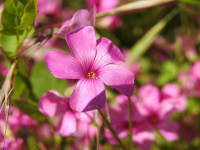
The flowers are hermaphroditic, actinomorphic (radially symmetrical), and pentamerous, that is with five petals and five sepals. They are often solitary or grouped in inflorescences of the panicle, corymb, or sometimes umbel type. They have ten stamens arranged in two series. The ovary is superior and formed by five carpels, which can be free or fused.
The fruit is generally a capsule, but in some species it can take the form of a berry. The family is distinguished by the combination of pentamerous flowers with a superior ovary and often complex inflorescences, characteristics that make it recognizable within the order Oxalidales.
Distribution and diversity
The family Oxalidaceae is distributed worldwide, particularly in temperate and tropical regions. It includes about five genera and over 600 species, most of which are concentrated in the genus Oxalis. The species can adapt to different habitats, from herbaceous environments to forests with shrub or tree species.
In Italy the family is mainly represented by the genus Oxalis, present in the spontaneous flora. The Italian species are mostly herbaceous and found in various natural environments.
Main genera and representative species
The main genera of the family Oxalidaceae are:
- Oxalis: with about 560 species, it is the richest and most widespread genus, including numerous spontaneous and ornamental species. Some Italian species, such as Oxalis acetosella, are well known for their herbaceous habit and trifoliate leaves similar to those of clover.
- Biophytum: about 81 species, distributed mainly in tropical regions.
- Averrhoa: with 5 species, known for including fruit plants such as the starfruit tree (carambola).
- Dapania: includes 3 species.
- Sarcotheca: with 12 species, mostly of Asian origin.
The genus Hypseocharis, once included in this family, has been reassigned to the family Geraniaceae.
Etymology
The name of the family derives from the type genus Oxalis, a name which in turn derives from the Greek "oxys", meaning "acid", referring to the sour taste of the leaves of many species, due to the presence of oxalic acid.
Curiosities and uses
Many species of Oxalis are known for their acidic leaves, used in some culinary traditions to add flavor to foods. Some species also have ornamental value thanks to their delicate flowers and interesting leaf shapes. From an ecological point of view, these plants play a role in soil cover and biodiversity of temperate and tropical habitats.
Sources
- Wikipedia




Explore
Other botanical families