Botanical species
Loncomelos pyrenaicum
(L.) L.D.Hrouda
Spiked Star-of-Bethlehem
Description
Morphological description
Perennial herbaceous plant belonging to the family Asparagaceae, characterized by an ovoid bulb, 2.5-4 cm long, covered by whitish tunics. The stem is erect, glabrous and has a glaucous surface, typically 30 to 100 cm tall. The basal leaves are 6 to 7, linear and rather large, 6-8 (up to 11) mm wide and 20-40 cm long; they have a grooved surface and are typically absent at flowering time.
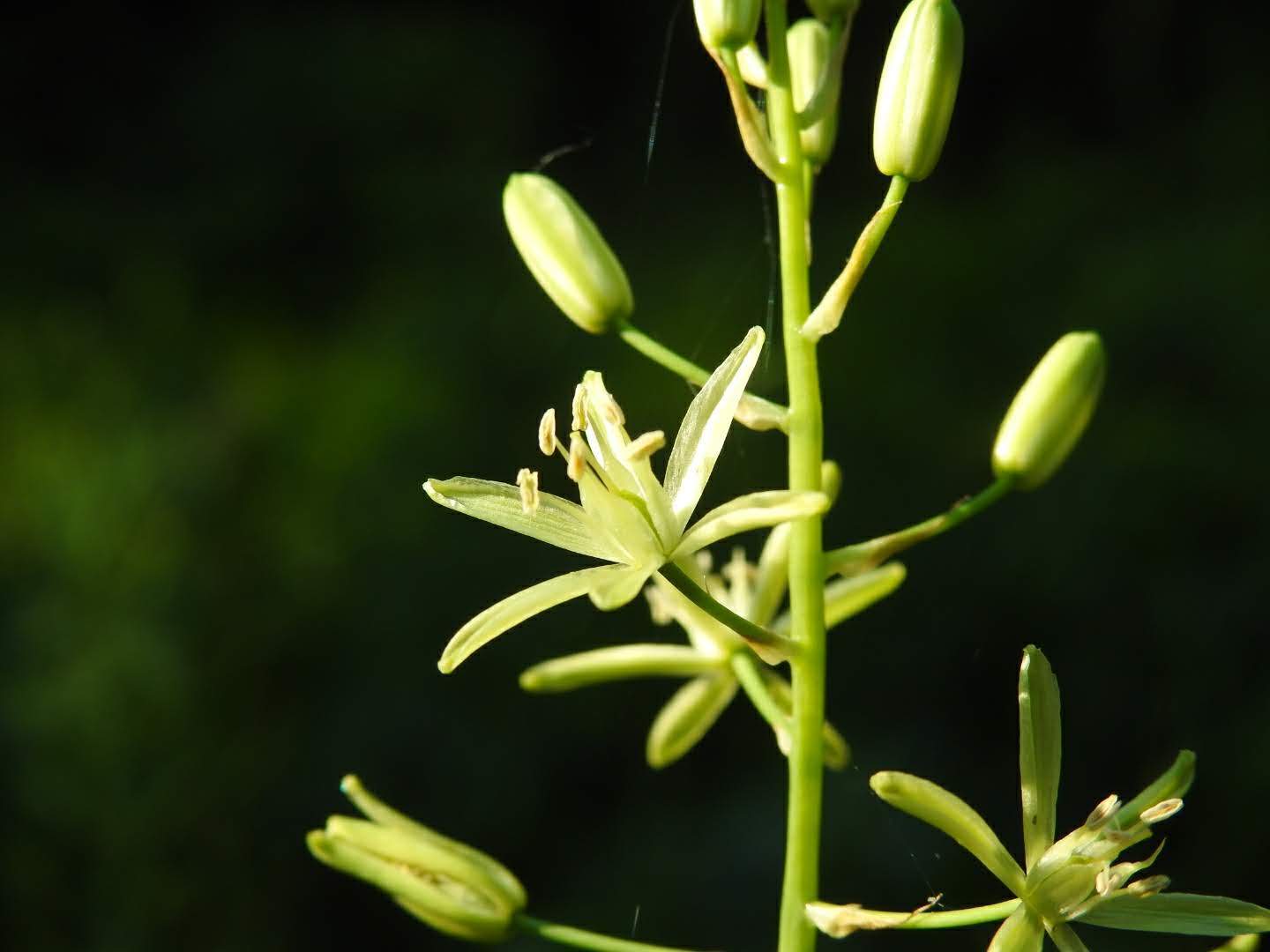
The inflorescence is a spicate raceme, initially compact and then elongated and loose, which can measure from 10 up to 40 cm in length, bearing 20-40 small slightly fragrant flowers. The floral pedicels are spreading and 9-20 mm long, with membranous bracts 5-7 x 13 mm, ending with a awn and reaching about two thirds of the pedicel length.
The flowers have a perigonium formed by six tepals of greenish-yellow color, 11-12 mm long and about 3 mm wide, with a characteristic greenish band on the outer part. During anthesis, the margins of the tepals fold inward. The stamens are about three quarters the length of the tepals, with anthers about 3 mm long. The style is filiform and slightly longer than the ovary, which is tricarpellary, greenish and 2-3 mm long.
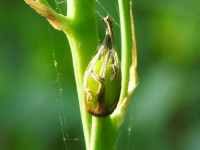
The fruit is a loculicidal capsule, subtrigonous ovoid, 8-9 mm long with marked grooves. The seeds are black, irregular and have a rough surface. The root system is bulbous, a perennial element that allows the plant to survive from one season to another.
Habitat and distribution
This species has a eurymediterranean range, with a distribution concentrated on the Mediterranean coasts but extending northwards and eastwards. In Italy it is found in various environments, from broadleaf woods, especially oak woods, to shrubs and moist uncultivated areas. It grows on soils ranging from moist to moderately drained, up to 1600 meters altitude, showing good adaptability. The preferred exposure is bright or semi-shaded typical of woodland areas.
Flowering period
Flowering occurs between May and July. Depending on altitude and local climatic conditions, the period may vary slightly; generally flowers appear earlier in warmer and lower altitude areas, while in cooler and higher stations flowering tends to shift towards June-July.
Ecology and pollination
The flowers, slightly fragrant and with greenish-yellow tepals, attract various pollinating insects, although no precise specific data on pollinator species are known. The open structure of the inflorescence and the presence of well-developed stamens suggest an entomophilous pollination strategy, facilitated by access to nectar and pollen. Seed dispersal occurs through the loculicidal capsule which, once mature, opens releasing rough black seeds; the dispersal mode is probably barochory (direct fall to the ground), with possible aid from secondary agents such as small animals or water.
Curiosities and traditional uses
This species is edible and has been known since ancient times for its food use. Pliny the Elder and Dioscorides already mentioned it as a plant with bulbous roots consumable raw or cooked. During famine periods, the bulb was used as a source of sustenance, often roasted and sprinkled with honey to improve its flavor. Young shoots, after cooking, were used like asparagus, similarly to those of related species such as Loncomelos narbonensis.
However, it should be noted that the raw bulb is poisonous to animals, requiring caution in food use. Curiously, in past times, pilgrims heading to Mecca consumed the dry bulb as a source of nourishment during the journey. Some varieties of Ornithogalum (the genus from which Loncomelos was separated) are also used in the cut flower industry, although it is not specified whether this species is among them.
Historical medicinal uses are less documented and are currently not recommended for therapeutic purposes.
Etymology
The genus name Loncomelos probably derives from Greek: "lonchus" means "spear", while "melos" can refer to "member" or "part", perhaps alluding to the elongated shape of the leaves or flowers. The specific epithet pyrenaicum indicates the origin or association with the Pyrenees, the mountain range from which it was originally described.
The Italian common name "Spiked Star-of-Bethlehem" refers to the pale color of the flowers, reminiscent of foam or milk, and to the region of origin, emphasizing its geographic identification.
Sources
- Acta Plantarum - Flora delle regioni italiane (scheda di Marinella Zepigi)
Characteristics
Scheda botanica
| Famiglia | Asparagaceae |
|---|---|
| Fioritura | maggio – luglio |
| Forma biologica | Bulbous |
| Habitat | with white flowers, edible plant |
| Uso alimentare | Commestibile |
Domande frequenti
- Quando fiorisce Spiked Star-of-Bethlehem?
- Spiked Star-of-Bethlehem fiorisce maggio – luglio.
- È commestibile Spiked Star-of-Bethlehem?
- Spiked Star-of-Bethlehem è considerata commestibile. Verifica sempre le parti eduli e la preparazione corretta prima del consumo.
- Che tipo di pianta è Spiked Star-of-Bethlehem?
- Spiked Star-of-Bethlehem è una Geophytes (Bulbous) secondo la classificazione di Raunkiaer.
- A quale famiglia appartiene Spiked Star-of-Bethlehem?
- Spiked Star-of-Bethlehem appartiene alla famiglia botanica Asparagaceae.
Where I found it (11 sightings)
Classification
- Kingdom
- Plantae
- Family
- Asparagaceae
- Full name
- Loncomelos pyrenaicum (L.) L.D.Hrouda
- Synonyms
- Loncomelos pyrenaicus (L.) L.D.Hrouda; Ornithogalum pyrenaicum; Ornithogalum pyrenaicum L.
- Life form
- Geophytes bulbous
Similar species
Search for species with similar characteristicsNoticed an error in the identification? Write to me
Other species of the same family
Asparagaceae
Explore
Other species of Asparagaceae