Botanical species
Neottia ovata
(L.) Bluff & Fingerh.
Common Twayblade
Description
Morphological description
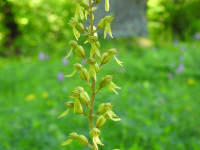
Perennial herbaceous plant belonging to the Orchidaceae family, characterized by a cylindrical and tuberous rhizome, from which filiform and sinuous roots develop. The stem is erect, robust, and cylindrical, with a height varying between 40 and 60 cm. The surface of the stem may present a slight whitish pubescence especially above the leaf insertion and varies in color from green to brownish.
The leaves are generally arranged oppositely at about one third of the stem height and are ovate, 5-10 cm long, thick and glabrous, with a shiny upper surface. The veins are parallel and well evident. Rarely, 3-4 small additional leaves can be observed, higher than the two main ones. The bracts are poorly developed, triangular in shape, and shorter than the floral peduncles.
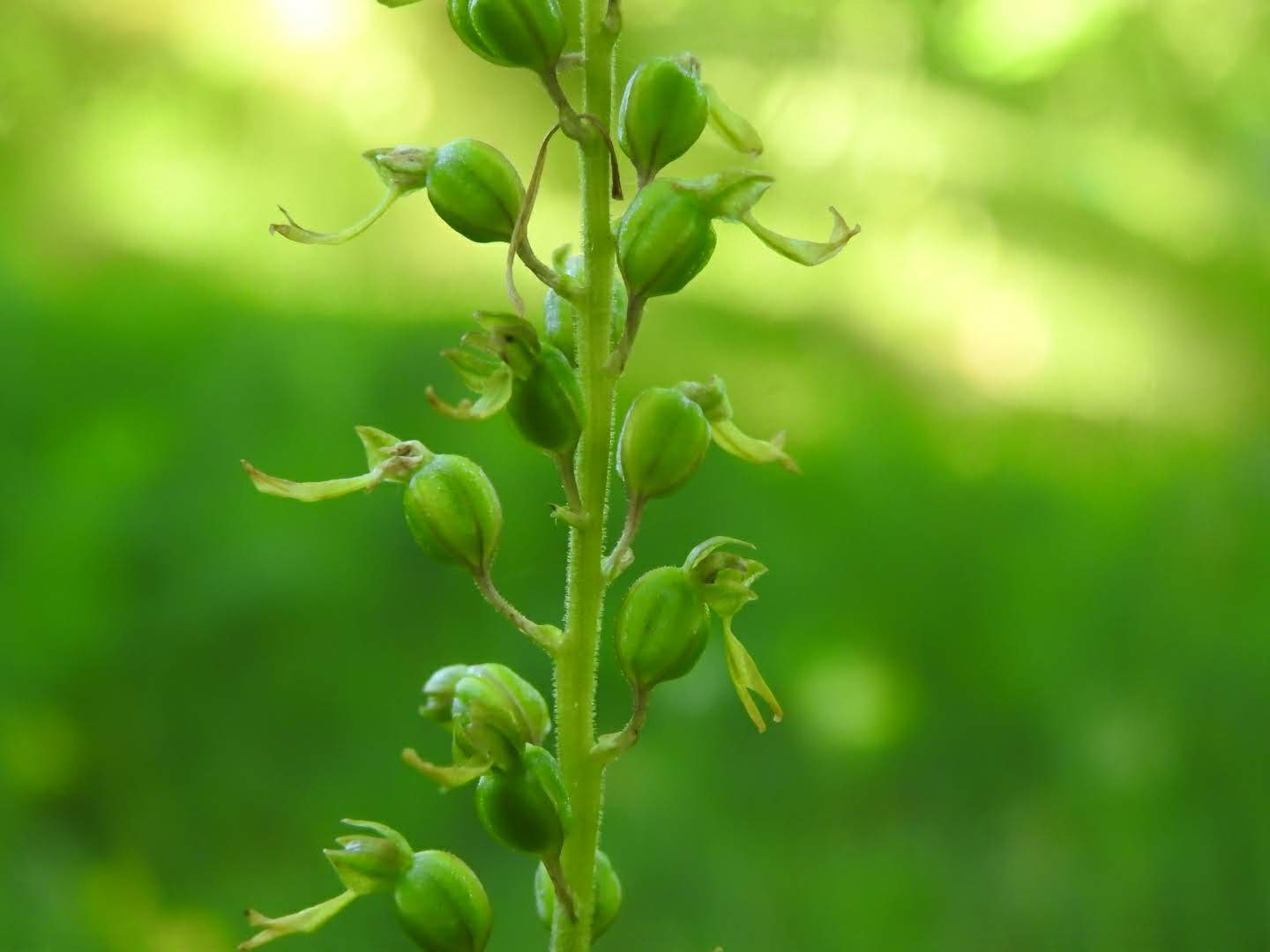
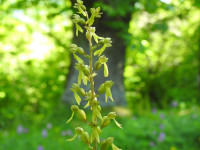
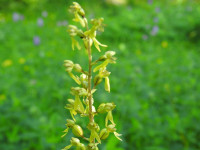
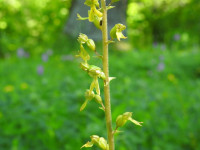
The inflorescence is a loose raceme, cylindrical or cylindrical-conical in shape, bearing slightly pedunculated, odorless flowers, greenish-yellow in color. Each flower is composed of ovate and acute tepals 8-10 mm long, which are connivent forming a sort of hood. The labellum is linear, elongated, and pendulous, yellow-greenish in color, with a bifid apex formed by two narrow and acuminate slightly divergent lobules. At the base of the labellum there is a shiny cavity containing nectar, essential for pollination. The structure lacks a spur. The ovary is inferior, globose, pubescent, and supported by a twisted peduncle.
The fruit is a capsule containing extremely minute seeds, typical of orchids, which allow effective dispersal by wind.
Habitat and distribution
It is a species widespread throughout Italy, although less frequent in the central-southern regions. It grows mainly in fresh broadleaf forest environments, but can also be found in spruce forests, alpine pastures, scrublands and clearings, as well as along the edges of paths. It rarely colonizes meadows with moist soil. It tolerates a wide range of soil conditions, growing on both acidic and basic soils.
Its altitude range varies from 0 up to 1900 meters above sea level, thus covering a wide altitudinal range. In the Mediterranean context, the species is mainly present in areas with temperate and humid climates, particularly in shady and fresh woods.
Flowering period
The flowering generally extends from May to August, with possible variations related to latitude and altitude. In more northern territories or in high mountains, flowering may start later and end within the summer.
Ecology and pollination
Common Twayblade presents an interesting reproductive strategy, mainly based on entomophilous pollination by hymenopterans parasitic on insects and plants. Insects are attracted by the nectar contained in the cavity at the base of the labellum and, landing on it, touch the tip of the rostellum, which allows the release of a sticky liquid. This liquid adheres to the pollinia, which thus attach to the pollinating insects.
The mechanism is further refined by the fact that the rostellum, once activated, moves to cover the stigma, preventing self-pollination. When the insect moves away, the rostellum returns to its original position. The plant also propagates vegetatively through lateral shoots originating from the rhizome, thus ensuring local expansion even in the absence of pollinators.
Seed dispersal occurs through the wind, favored by their tiny size, which allows wide diffusion.
Curiosities and traditional uses
Traditional medicinal or food uses for this species are not widely documented. However, like all wild orchids, it is subject to regulatory protection as a species at risk, included in the Washington Convention and protected by specific regional laws, such as in Lombardy.
From a naturalistic point of view, the presence of this orchid is an indicator of good quality forest habitats and balanced ecosystems.
Etymology
The generic name "Neottia" derives from Greek and means “bird’s nest”, referring to the particular intertwined root conformation, which indeed resembles a nest. The specific epithet "ovata" refers to the ovate shape of the leaves, a distinctive characteristic of the species.
The Italian common name "Listera maggiore" derives from the previous genus "Listera", with the addition of "maggiore" to distinguish it from Listera minore (Neottia cordata), which is smaller and has different leaf characteristics.
Sources
- Acta Plantarum - Flora delle regioni italiane (scheda di Marinella Zepigi)
Characteristics
Scheda botanica
| Famiglia | Orchidaceae |
|---|---|
| Fioritura | maggio – agosto |
| Forma biologica | Rhizomatous |
| Habitat | with green flowers |
Domande frequenti
- Quando fiorisce Common Twayblade?
- Common Twayblade fiorisce maggio – agosto.
- Che tipo di pianta è Common Twayblade?
- Common Twayblade è una Geophytes (Rhizomatous) secondo la classificazione di Raunkiaer.
- A quale famiglia appartiene Common Twayblade?
- Common Twayblade appartiene alla famiglia botanica Orchidaceae.
Where I found it
The sighting locations of this species are not public for conservation reasons.
Classification
- Kingdom
- Plantae
- Family
- Orchidaceae
- Full name
- Neottia ovata (L.) Bluff & Fingerh.
- Synonyms
- Distomaea ovata (L.) Spenn.; Helleborine ovata (L.) F.W.Schmidt; Listera ovata (L.) R.Br.; Ophrys ovata L.; Pollinirhiza ovata (L.) Dulac; Serapias ovata (L.) Steud.
- Life form
- Geophytes rhizomatous
Similar species
Search for species with similar characteristicsFurther reading
Noticed an error in the identification? Write to me
Other species of the same family
Orchidaceae
Explore
Other species of Orchidaceae