Botanical species
Petasites albus
(L.) Gaertn.
White Butterbur
Description
Morphological description
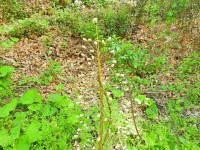
Perennial herbaceous plant belonging to the family Asteraceae, characterized by an erect habit and a height typically ranging from 10 to 40 cm during flowering, reaching up to 80 cm in the fruiting stage. The stem is cylindrical, hollow, simple, white-greenish in color, covered by leaf-like scales of a green-yellowish hue arranged along the stem; these scales are often folded at the apex and have a surface grooved by veins.
The leaves are arranged in a basal rosette and appear towards the end of the flowering period. Their blade is broadly reniform, with a diameter generally between 10 and 20 cm, but in some cases can reach up to 45 cm. The lower surface of the leaves is gray-tomentose, with evident cobwebby hairs and well-marked veins forming a green network; the margin is doubly toothed. The petiole, 10 to 20 cm long, is initially tomentose but tends to become glabrous with maturation; it is slightly grooved and at the base slightly flattened. The cauline leaves, smaller and lanceolate, are sessile and clasp the stem, often becoming pale bracts near the inflorescence.
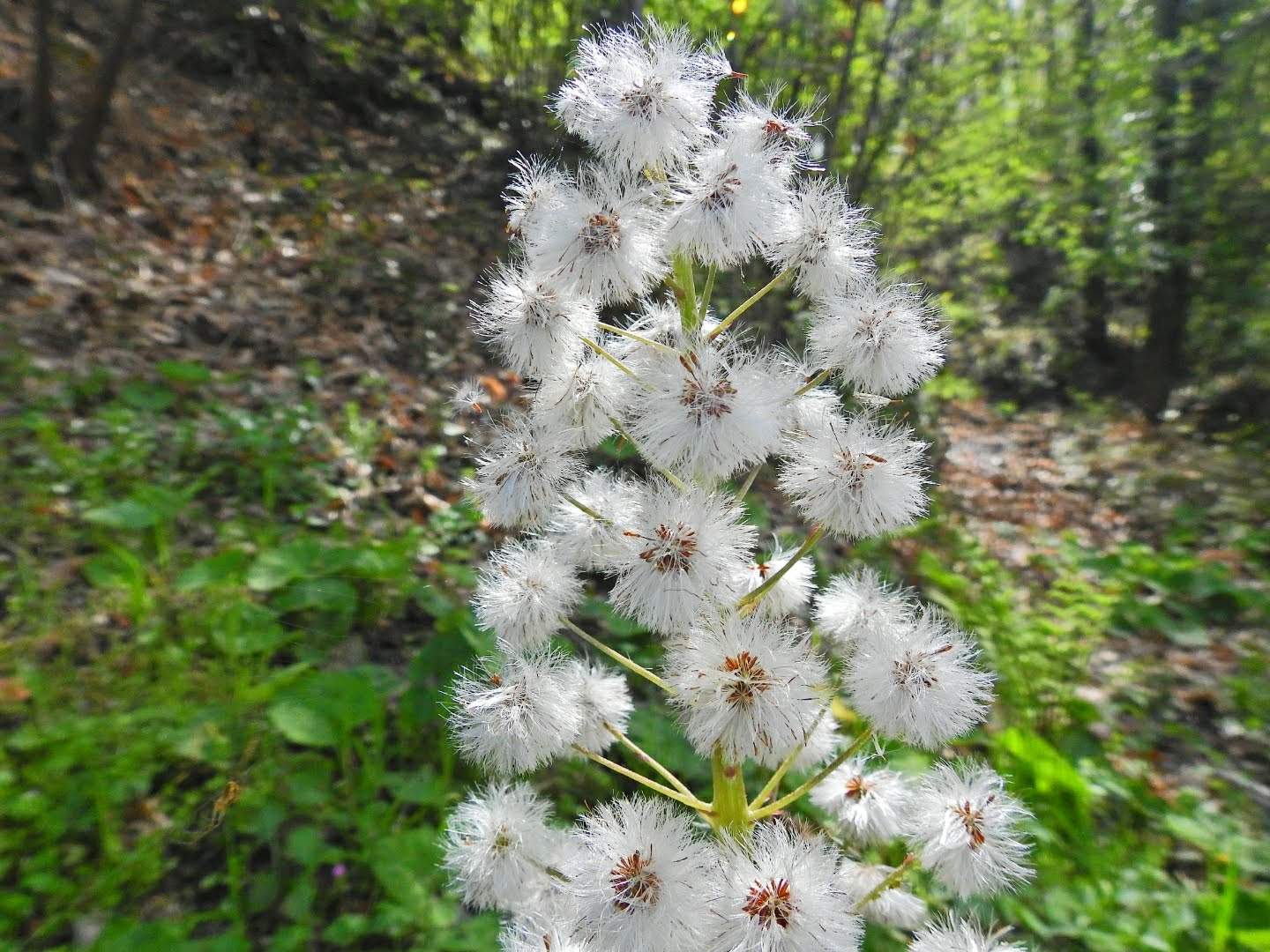
The capitula are pedunculated, about 7 x 25 mm in size, and gathered in terminal inflorescences of two types depending on the plant's sex: the male ones form an oval raceme with fewer capitula, while the female ones are arranged in a broad and compact panicle. The flowers are exclusively tubular, white-yellowish in color, with five-toothed corollas; the peripheral female flowers may show a slight ligule. The stamens, five in number, have free filaments and anthers fused together surrounding the style; the stigmas, filiform and pubescent, protrude well beyond the corolla tube. No distinct ligulate flowers are present.
The fruits are subcylindrical achenes, 2-3 mm long, with a rough surface. The pappus consists of white bristles about 12 mm long, facilitating anemochorous dispersal.
The root system consists of a whitish underground rhizome, thin (about 1 cm in diameter) and creeping, which each year produces new roots and adventitious shoots, allowing the plant to survive and regenerate.
Habitat and distribution
Orographic species of Central European origin, mainly distributed in the Alps, Jura, and Carpathians, with occasional occurrences also in mountainous areas of the Mediterranean and western and southern Asia. In Italy it commonly grows in montane and subalpine environments, between 400 and 2000 meters of altitude.
It prefers humid and cool habitats, such as moist woods, forest clearings, slopes, trail edges, and riverbanks. It is a nitrophilous plant that develops well in nutrient-rich soils and maintains a preference for shaded or semi-shaded exposures.
Flowering period
Flowering generally extends between April and May. Basal leaves appear only towards the end of the flowering period, when the plant is already in the development phase of female and male capitula. No significant geographic variations in the flowering period are known.
Ecology and pollination
The species exhibits a dioecious reproductive strategy, with separate male and female individuals. The capitula, rich in white tubular flowers, attract pollinating insects, especially hymenopterans and dipterans, which favor cross-pollination. The presence of a feathery and bristly pappus allows anemochorous dispersal of the achenes, facilitating colonization of suitable new areas.
Curiosities and traditional uses
Petasites albus has a long history of uses in medicinal and food fields. The leaves, rich in mucilages, tannins, petasin, and essential oils, were traditionally used in infusions to calm coughs thanks to their sedative and expectorant properties. Local applications of fresh, crushed leaves placed on gauzes were used to speed up the healing of ulcers and abscesses, exploiting the cicatrizing and cleansing action of the crushed rhizome.
In cooking, the fleshy petioles of the leaves were consumed like a kind of asparagus, appreciated for their delicate flavor. An interesting folkloric use concerns butter preservation: in the past, it was wrapped in the leaves of this plant to maintain its freshness.
Caution is recommended in therapeutic and food use, as traditional applications are reported here for informational purposes only and do not replace qualified medical advice.
Etymology
The generic name Petasites derives from the Greek "petàsos," indicating a broad-brimmed hat, referring to the wide and rounded shape of the leaves. The specific epithet albus is Latin and means “white,” clearly referring to the color of the flowers. The Italian common name “farfaraccio bianco” also recalls the light color of the plant’s capitula, distinguishing it from other species of the genus characterized by pinkish or reddish-brown flowers.
Sources
- Prof. S. Pignatti, Flora d’Italia
- Acta Plantarum - Flora delle regioni italiane (sheet by Marinella Zepigi)
- World Flora Online (WFO)
Characteristics
Where I found it (8 sightings)
Classification
- Kingdom
- Plantae
- Family
- Asteraceae
- Full name
- Petasites albus (L.) Gaertn.
- Synonyms
- Tussilago alba L.
- Life form
- Geofite rizomatose
Similar species
Search for species with similar characteristicsFurther reading
Noticed an error in the identification? Write to me
Other species of the same family
Asteraceae
Explore
Other species of Asteraceae