Botanical species
Briza minor
L.
Lesser Quaking-Grass
Description
Morphological description
The species has an annual herbaceous habit, with erect stems, simple or sometimes branched near the base, generally 10 to 60 cm tall, with dark nodes and a glabrous surface. The stems are thin, about 1-2 mm in diameter, and form scattered tufts. The leaves are alternate, linear, herbaceous in texture, with a blade 3 to 9 mm wide and 4 to 22 cm long; they are glabrous, with smooth margins. The ligule is a sharp membrane, 3-10 mm long, slightly decurrent along the stem.
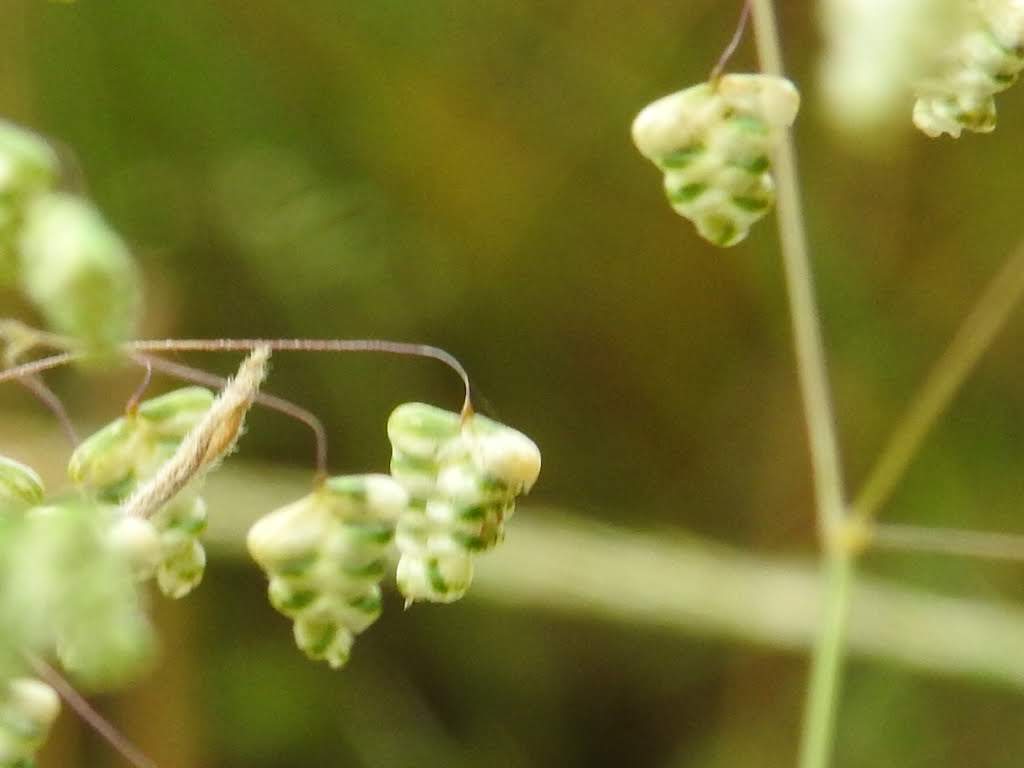
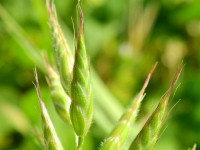
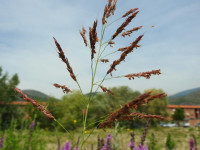
The inflorescence is a broad, pyramidal, and open panicle, 10-15 cm long, with numerous single branches or grouped in fascicles of 2 to 4. The spikelets, pendulous and trembling, are more than 20 per panicle, deltate in shape, as wide as or slightly wider than long (3-6 mm), with 3-8 small flowers each. The glumes, subequal, measure 1.5-2 mm, with 3-5 well-defined nerves, green with purplish shades and lighter margins. The lemmas are obtuse, broad, cordate-based and entire, papillose on the back and glabrous, also green with purplish tones. The anthers are purple, about 0.3-0.7 mm long. The fruit is a caryopsis about 0.6-1 mm long, with a dotted awn about one ninth the length of the fruit.
This species does not have petals, typical of Poaceae, and the flowers are scape-borne, meaning they are carried on a floral axis without leaves.
Habitat and distribution
The species is native to Eurasia, with a very frequent distribution in Mediterranean regions. In Italy it is mainly found in areas with a Mediterranean climate and tends to disappear rapidly towards northern Italy, where reports often concern casual or adventitious plants also used as ornamentals, especially in dried flower arrangements.
It prefers disturbed and open habitats, such as road margins, ruderal areas, edges of cultivated fields, humid and shady environments along watercourses or marshy areas on clayey or silty soils. It is commonly found between 900 and 3900 meters of altitude, adapting to a wide range of conditions but preferring places with a certain degree of moisture and partial shade.
Flowering period
Flowering mainly occurs between April and May, with possible extensions up to December in some areas, especially in milder climates or Mediterranean locations. The duration and intensity of flowering may vary depending on altitude and environmental conditions.
Ecology and pollination
Like many grasses, reproduction occurs mainly by anemophilous pollination (wind pollination), given the absence of petals and structures attractive to pollinating insects. The presence of purple anthers and the light structure of the spikelets favor pollen dispersion in the air. Seed dispersal mainly occurs by falling near the mother plant or through secondary transport by water or animals. The species often behaves as a pioneer plant in disturbed environments, rapidly colonizing open spaces.
Curiosities and traditional uses
The Italian common name "Lesser Quaking-Grass" derives from the particular shape of the spikelets, which resemble small rattles or little bells, a reference to the trembling movement of the inflorescences in the wind. Although no specific medicinal or food uses are known for this species, it is sometimes used as an ornamental plant in dried flower arrangements for the lightness and grace of the pendulous inflorescences.
Etymology
The scientific name Briza minor derives from Latin: "Briza" is a term of uncertain origin, probably ancient, used for some grasses with pendulous spikelets; "minor" means smaller, referring to the smaller size compared to related species such as Briza maxima. The Italian name "Lesser Quaking-Grass" emphasizes the small size and the shape of the spikelets that resemble small bells or rattles.
Sources
- Prof. S. Pignatti, "Flora d'Italia"
- World Flora Online (WFO)
Characteristics
Scheda botanica
| Famiglia | Poaceae |
|---|---|
| Fioritura | aprile – maggio |
| Forma biologica | Scapose |
| Habitat | flower without petals |
Domande frequenti
- Quando fiorisce Lesser Quaking-Grass?
- Lesser Quaking-Grass fiorisce aprile – maggio.
- Che tipo di pianta è Lesser Quaking-Grass?
- Lesser Quaking-Grass è una Therophytes (Scapose) secondo la classificazione di Raunkiaer.
- A quale famiglia appartiene Lesser Quaking-Grass?
- Lesser Quaking-Grass appartiene alla famiglia botanica Poaceae.
Where I found it (3 sightings)
Classification
- Kingdom
- Plantae
- Family
- Poaceae
- Full name
- Briza minor L.
- Life form
- Therophytes scapose
Similar species
Search for species with similar characteristicsNoticed an error in the identification? Write to me
Other species of the same family
Poaceae
Explore
Other species of Poaceae