Botanical species
Vicia cassubica
L.
Danzig Vetch
Description
Morphological description
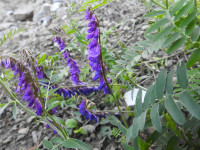
The plant appears as a perennial species belonging to the Fabaceae family, characterized by a scapose habit with angular and quadrangular stems, which can reach a variable height depending on environmental conditions. The stems are sparsely pubescent, giving the plant a slight hairiness distributed along the entire surface.
The leaves are imparipinnate, generally between 5 and 12 cm long, composed of 16-24 narrowly elliptical leaflets, measuring between 5-7 mm in width and 12-20 mm in length. Each leaflet has an entire margin and a rounded apex, with a herbaceous texture. The leaves end with branched tendrils, which facilitate the climbing of the plant on other vegetation or natural supports. The stipules are linear and generally entire.
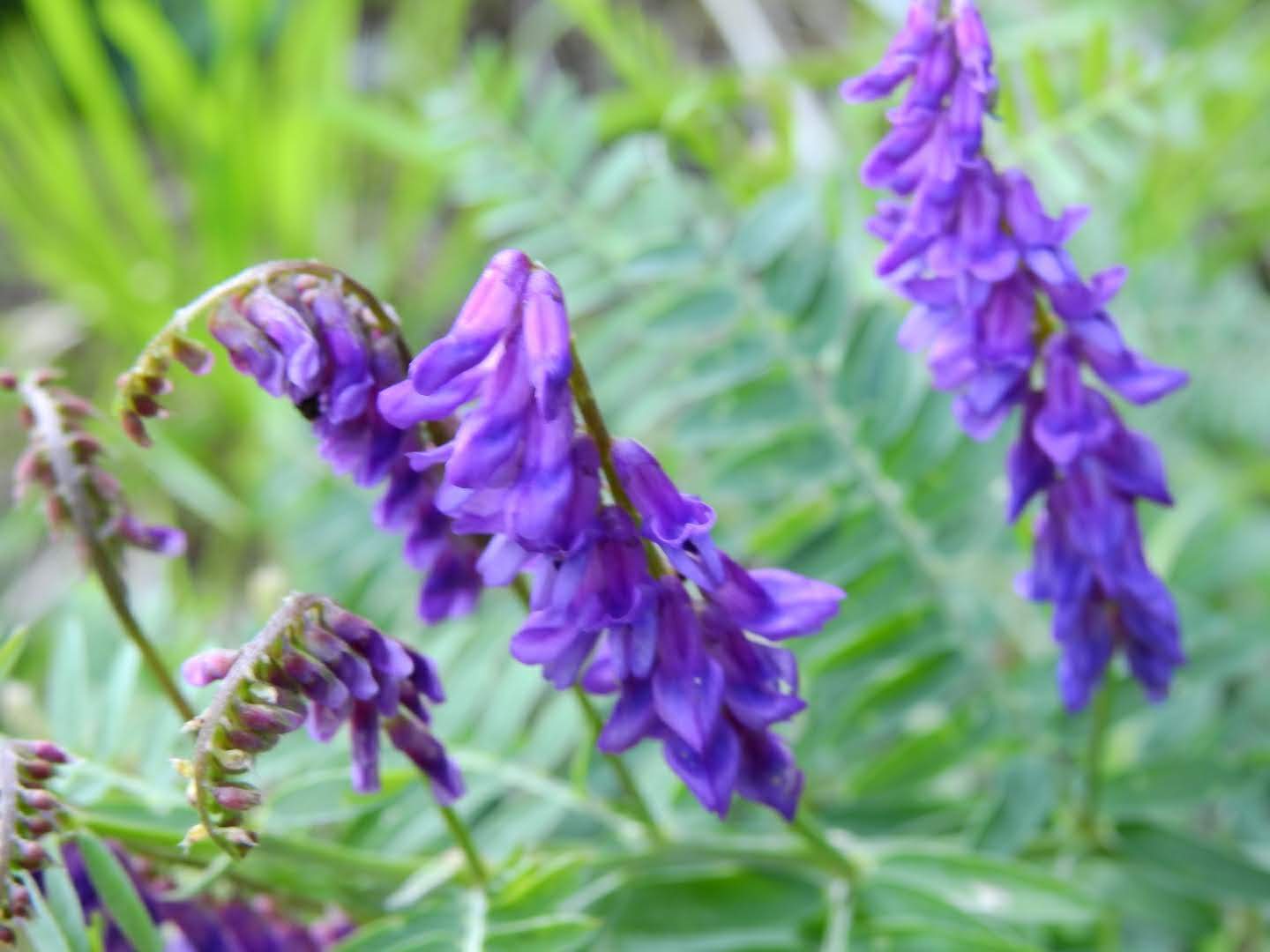
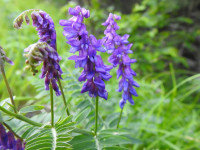
The flowers are gathered in racemes counting from 5 to 15 flowers each, typically shorter than the leaves. The corolla, of intense violet or purple color, has lighter wings and keel, and measures between 9 and 12 mm in length. The calyx has somewhat uneven teeth. The flower is distinguished by its scapose habit, that is with floral peduncles emerging singly or in small groups, giving a certain elegance to the flowering.
The fruit is an elongated legume, with dimensions varying between 6-8 mm in width and 15-25 mm in length. Inside it contains from 1 to 3 seeds, each characterized by a hilum occupying about one third of the circumference of the seed itself. The root system, typical of Fabaceae, includes roots with rhizobial nodules that promote biological nitrogen fixation, contributing to soil enrichment.
Habitat and distribution
The species has a predominantly Central European and Caucasian distribution, extending in Italy mainly in the northern regions, with sporadic and localized presence. It is found up to the Via Emilia, but is absent in Umbria and much of the central-southern peninsula, except for some residual populations in Sicily. In northern Italy it is found in areas such as Trieste, Gorizia, Montello, Colli Euganei, South Tyrol (from the Bressanone area to Merano) and Piedmont.
It preferably grows in mountainous environments, where it adapts to well-drained soils, often calcareous or with rocky substrates, in sunny or slightly shaded exposures. The presence of branched tendrils and the scapose structure suggest an adaptation to habitats with herbaceous and shrubby vegetation, where the plant can climb to exploit light.
Flowering period
The flowering typically extends from May to July, with possible local variations related to altitude and climate. In higher or northern areas flowering may start later, while in milder zones it can be observed already from May.
Ecology and pollination
The plant, like many Fabaceae, relies on pollination by pollinating insects, particularly hymenopterans such as bees and bumblebees, attracted by the violet color of the corolla and the presence of nectar. The flower structure, with lighter wings and keel, facilitates access to pollinating insects and promotes effective fertilization.
Seed dispersal occurs mainly through release from the mature legume, which opens to release the seeds into the surrounding soil. No particularly specialized long-distance dispersal strategies are known, but the presence of seeds with hilum suggests a possible involvement of microorganisms or animals in the germination and local distribution process.
Curiosities and traditional uses
No specific ethnobotanical, medicinal or food uses are documented for this species. Being a mountain vetch with limited and sporadic distribution, its use in popular tradition appears marginal or absent. However, like other Fabaceae, it could have an important ecological role in improving soil fertility thanks to its ability to fix nitrogen.
Etymology
The scientific name of the genus derives from the Latin vicia, a term used since antiquity to indicate vetches, herbaceous plants belonging to the Fabaceae family. The specific name cassubica refers to the Kassubi, a Slavic people originating from the historical region of Cassubia (in present-day Poland), indicating the original area or one of the first localities where the species was recognized.
The Italian common name, "veccia dei Kassubi", directly reflects this geographical and cultural link, emphasizing the Central European origin and the ethnic identification associated with the species.
Sources
- Prof. S. Pignatti, "Flora d'Italia"
Characteristics
Scheda botanica
| Famiglia | Fabaceae |
|---|---|
| Fioritura | maggio – luglio |
| Forma biologica | Scapose |
| Habitat | with purple flowers, plant with a scapose habit |
Domande frequenti
- Quando fiorisce Danzig Vetch?
- Danzig Vetch fiorisce maggio – luglio.
- Che tipo di pianta è Danzig Vetch?
- Danzig Vetch è una Hemicryptophytes (Scapose) secondo la classificazione di Raunkiaer.
- A quale famiglia appartiene Danzig Vetch?
- Danzig Vetch appartiene alla famiglia botanica Fabaceae.
Where I found it (10 sightings)
Classification
- Kingdom
- Plantae
- Family
- Fabaceae
- Full name
- Vicia cassubica L.
- Life form
- Hemicryptophytes scapose
Similar species
Search for species with similar characteristicsFurther reading
Noticed an error in the identification? Write to me
Other species of the same family
Fabaceae
Explore
Other species of Fabaceae