Botanical species
Misopates orontium
(L.) Raf.
Weasel's-Snout
Description
Morphological description
Annual herbaceous plant with a scapose habit, it can reach a variable height between 20 and 90 cm. The stem is erect or ascending, thin and branched, with the upper part densely covered by glandular hairs giving it a sticky texture, while the lower part appears almost glabrous. The root system is slender, suitable for shallow soils.
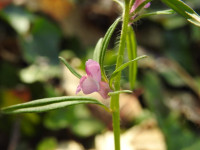
The leaves are small-sized, linear-lanceolate, with a length ranging from about 30 to 40 mm and a width between 3 and 7 mm. They are generally alternate on the upper part of the stem, while near the base they can be opposite. The upper leaves are narrower and subsessile or with a short petiole; the texture is herbaceous and the surface can be glabrous or slightly pubescent. The leaves tend to become dark and almost black upon drying.
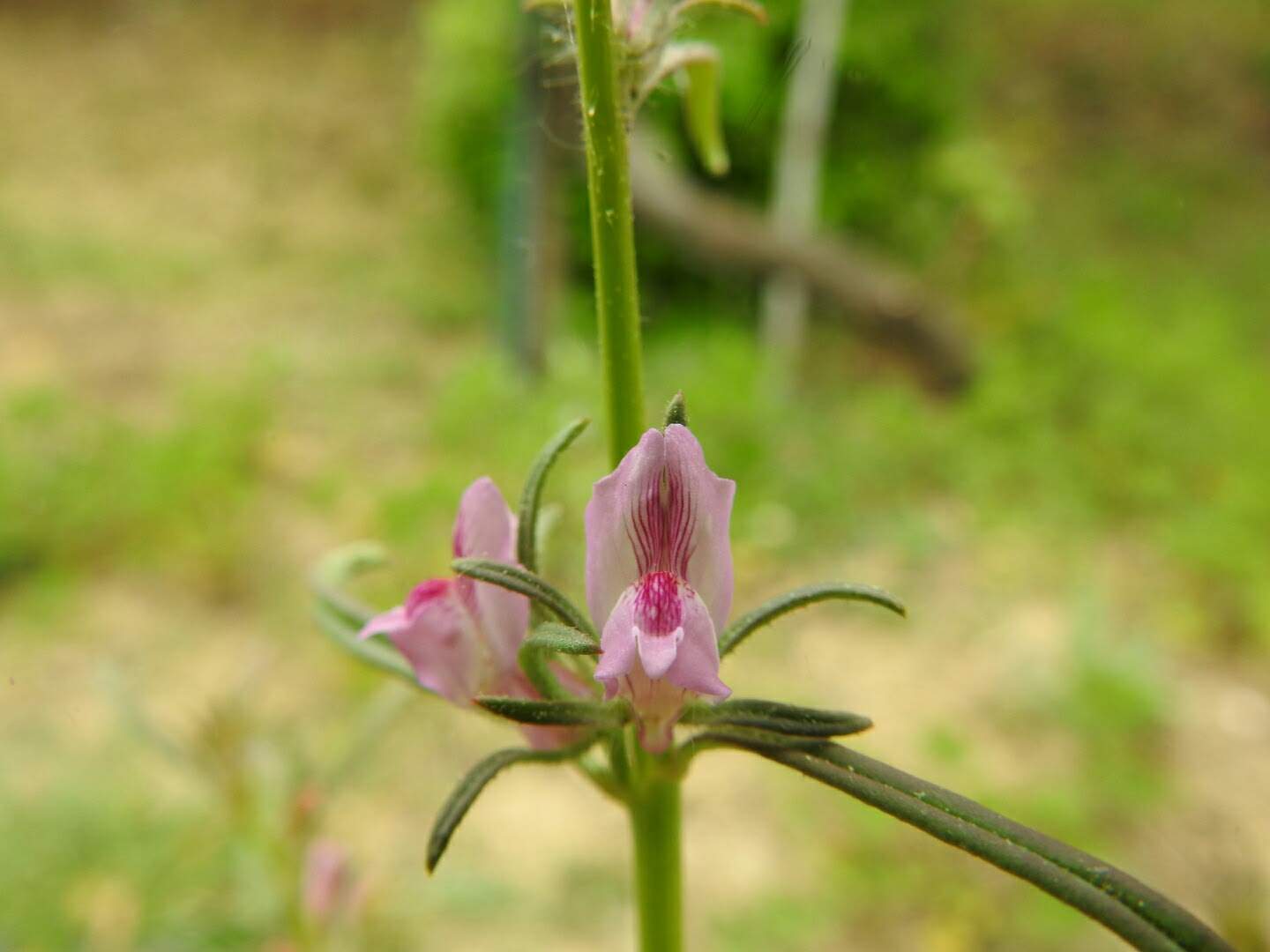
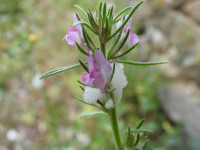
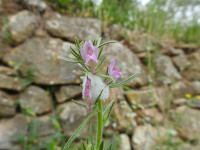
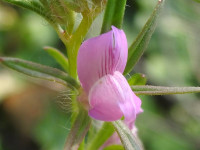
The inflorescence is an elongated and loose raceme, with sub-sessile flowers or with short peduncles, in groups of 2 to 8 spaced flowers. The flowers are small-sized, with a diameter around 6-15 mm and a corolla length that can reach 15-17 mm. The corolla is bilabiate, bilaterally symmetrical, pink-lilac in color with purple veins especially inside the lower lip, which is tripartite. The upper lip, bipartite, has two smaller lobes. The base of the corolla tube is swollen and velvety. The corolla does not have a spur. The calyx is divided into linear lobes, 8-11 mm long, rough especially at the base, and of slightly unequal length.
The reproductive organs include a central pistil and two pairs of stamens with yellow anthers with two equal thecae. The fruit is an ovoid capsule, poricidal, about 7-10 mm long and 4-5 mm wide, pubescent and glandular, with 2-3 opening pores, shorter than the calyx. The capsule is characteristically swollen and gibbous at the base, resembling in shape a "death's head," from which some common names in other languages derive. The seeds are brown, about 1 mm long, with non-alveolated endosperm.
Habitat and distribution
The species is common throughout the Italian territory and the Mediterranean basin, including Sardinia and Corsica, also widespread in Europe, Western Asia up to the Himalayas, and North Africa. It mainly grows in anthropized environments such as road edges, cultivated fields, especially cereals, disturbed and fertilized soils, and uncultivated places. It adapts to moist and nitrified soils, often sandy or well-drained.
The growth altitude ranges from sea level up to about 1,200 meters above sea level. It prefers sunny exposures and open environments, where it can develop without excessive herbaceous competition.
Flowering period
Flowering extends from May to September, with a higher concentration between June and September. This time window may vary slightly depending on location and altitude, with earlier flowering in warmer and lower areas.
Ecology and pollination
Weasel's-Snout is an annual species with rapid development that completes its biological cycle in one year. The inflorescence presents bilabiate flowers suitable for pollinating insects, especially bees and bumblebees which, attracted by the pink-lilac color and the internal purple veins, facilitate entomogamous pollination. The bilabiate structure of the corolla is functional to this type of pollination, offering a support and guide point for insects.
Seed dispersal occurs through the poricidal dehiscence of the capsule, which releases small brown seeds about 1 mm in size. These seeds can be dispersed mainly by falling to the ground and, to a lesser extent, through accidental transport by animals or surface water.
Curiosities and traditional uses
Weasel's-Snout is also known by other common names such as "field snapdragon." The French name "Tête-de-mort" (death's head) and the Spanish "Cabeza de muerto" refer to the characteristic shape of the fruit capsule.
From an ethnobotanical point of view, the species has traditionally been used as a medicinal plant with diuretic properties, capable of increasing urine production. However, medicinal applications are poorly documented and there is a lack of reliable data on toxic or beneficial effects on the human body. Food or cosmetic uses are not known or widespread.
Etymology
The generic name "Misopates" derives from ancient Greek, with "misos" meaning "hatred" and "patein" meaning "to tread," suggesting a sort of warning not to trample this plant. In the past the species was assigned to the genus Antirrhinum, which means "snout in front" referring to the particular shape of the bilabiate flower that resembles a snout or a mouth.
The specific name "orontium" comes from ancient Greek "orontio," a name already used by Galen in the 2nd century, which may refer to the Orontes River in Syria, where the plant was probably known or widespread.
The Italian common name "gallinetta" is probably a popular reference to the shape of the flower or fruit, which can resemble a small head or profile, similar to that of a bird.
Sources
- Prof. S. Pignatti, "Flora d'Italia"
- Acta Plantarum - Flora delle regioni italiane (scheda di Giuliano Salvai)
- Tela Botanica / H. Coste, "Flore descriptive et illustrée de la France"
- World Flora Online (WFO)
Characteristics
Scheda botanica
| Famiglia | Plantaginaceae |
|---|---|
| Fioritura | maggio – settembre |
| Forma biologica | Scapose |
| Habitat | with pink flowers, annual plant, plant with a scapose habit |
Domande frequenti
- Quando fiorisce Weasel's-Snout?
- Weasel's-Snout fiorisce maggio – settembre.
- Che tipo di pianta è Weasel's-Snout?
- Weasel's-Snout è una Therophytes (Scapose) secondo la classificazione di Raunkiaer.
- A quale famiglia appartiene Weasel's-Snout?
- Weasel's-Snout appartiene alla famiglia botanica Plantaginaceae.
Where I found it (11 sightings)
Classification
- Kingdom
- Plantae
- Family
- Plantaginaceae
- Full name
- Misopates orontium (L.) Raf.
- Synonyms
- Antirrhinum orontium L.
- Life form
- Therophytes scapose
Similar species
Search for species with similar characteristicsFurther reading
Noticed an error in the identification? Write to me
Other species of the same family
Plantaginaceae
Explore
Other species of Plantaginaceae