Botanical species
Veronica cymbalaria
Bodard
Pale Speedwell
Description
Morphological description
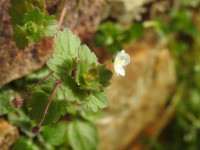
It is an annual herbaceous plant with a prostrate or creeping habit, often with weak, branched and thin stems reaching lengths between 10 and 60 cm. The stems are characteristically hirsute or pubescent, with simple, stiff hairs and sometimes glandular hairs, giving a hairy and rough surface to the touch.
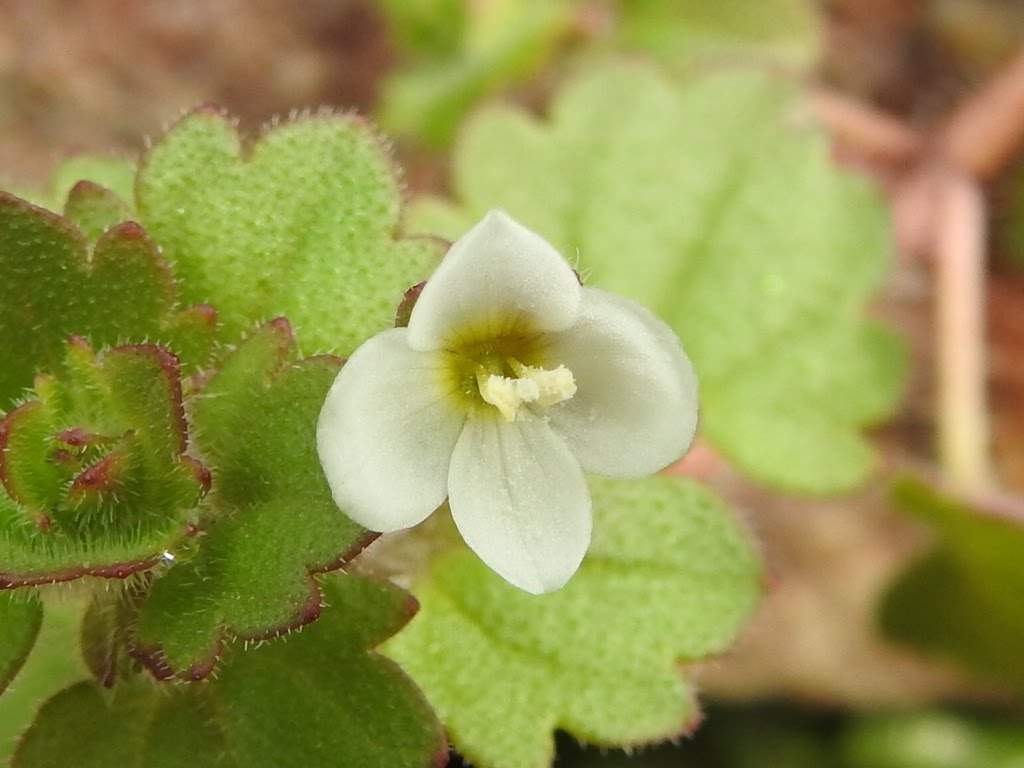
The leaves are petiolate, with a blade shape varying from ovate to suborbicular, with a cordate, truncate or cuneate base, and deeply divided into 5-9 lobes (rarely up to 11). The lobes are unequal, with the central one generally wider. The dimensions vary from 5 to 20 mm, with a herbaceous texture and pubescent surface on both sides due to simple and glandular hairs. The leaf margin is crenate-dentate or finely dentate. The lower leaves are arranged alternately, while the upper ones are opposite.
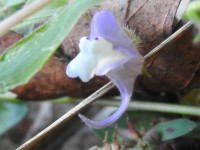
The flowers are solitary, white and small (6-12 mm in diameter), borne on axillary peduncles that often exceed the length of the subtending leaf. The corolla is gamopetalous, formed by four petals, one of which is shorter than the other three; the petals are white and longer than the sepals. The calyx is gamosepalous, with four oblong or oval sepals, obtuse and ciliate-glandular at the margins, 3-4 mm long, generally shorter than the corolla. Two protruding stamens emerge from the corolla, and the style measures about 1 mm.
The fruit is a subglobose, bilobed capsule, slightly flattened and pubescent with simple and sometimes glandular hairs. The capsule, 2-4 mm long, contains 2 to 4 ovoid seeds, dark brown or brown-blackish, about 2-2.7 mm long. The fruit peduncle is much longer than the calyx, from four to ten times, facilitating dispersal.
The root system is typically fibrous, suitable for stabilizing in loose or sandy substrates.
Habitat and distribution
The plant is mainly widespread in Mediterranean regions, with a range that includes much of the coasts and temperate inland areas of the Mediterranean basin, extending northwards and eastwards. In Italy it is present in several regions, including Lazio, Sicily, Sardinia, Calabria and central-northern areas, particularly along the coasts and in areas with mild climate.
It preferably grows on sandy soils, poor and well-drained substrates, often in disturbed environments such as roadsides, cultivated lands, at the foot of walls or on rocks. It can also be found in wet meadows and along forest edges, favoring sunny or partially shaded exposures. The altitude of growth ranges from 0 up to about 800 meters, although some sources report presence up to 1500 m, depending on local conditions.
Flowering period
The flowering has a wide temporal window from February to October, with the peak flowering concentrated between April and June. In warmer climates or in lower altitude areas, flowering can extend until autumn, showing some phenological plasticity.
Ecology and pollination
The flowers, characterized by white corollas and protruding stamens, are probably pollinated by pollinating insects attracted by the color and shape, such as small hymenopterans and other generalist pollinating insects. It does not seem to be a specialist or exclusively self-fertile species; the presence of long floral peduncles favors pollinator access.
Seed dispersal occurs through bilobed capsules containing small and light seeds, favoring anemochory (wind dispersal) or barochory (falling near the mother plant). The length of the fruit peduncle, much longer than the calyx, facilitates dispersal away from the mother plant.
Curiosities and traditional uses
No specific food or medicinal uses are reported for this species in the consulted sources. The common name “veronica with leaves like cymbalaria” derives from the similarity of the leaves to those of Cymbalaria muralis, a plant often present in the same habitats.
Etymology
The genus name "Veronica" has ancient and uncertain origins, used already in the 16th century by European botanists and probably derived from the name “Veronica” linked to the Christian legend of the woman who supposedly wiped the face of Christ during the Via Crucis, leaving the imprint of the face on her cloth (in Latin “vera icon” means “true image”). Other hypotheses suggest derivations from Germanic terms or from common names used in medieval pharmacopoeias.
The specific epithet "cymbalaria" refers to the shape of the leaves, similar to those of Cymbalaria muralis, characterized by deep lobes and a cordate base.
The Italian common name “veronica a foglie di cimbalaria” precisely indicates this distinctive morphological characteristic.
Sources
- Prof. P.V. Arrigoni, "Flora analitica della Toscana", "Flora dell'Isola di Sardegna"
- Acta Plantarum - Flora delle regioni italiane (scheda di Giuliano Salvai)
- Tela Botanica / H. Coste, "Flore descriptive et illustrée de la France"
- World Flora Online (WFO)
Characteristics
Where I found it (6 sightings)
Classification
- Kingdom
- Plantae
- Family
- Plantaginaceae
- Full name
- Veronica cymbalaria Bodard
- Life form
- Terofite scapose
Similar species
Search for species with similar characteristicsFurther reading
Noticed an error in the identification? Write to me
Other species of the same family
Plantaginaceae
Explore
Other species of Plantaginaceae