Botanical species
Digitalis purpurea
L.
Foxglove
Description
Morphological description
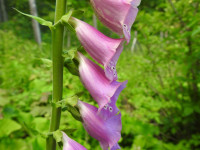
Biennial or perennial herbaceous plant, generally 30 to 150 cm tall, with an erect and tufted habit. The stem is robust, cylindrical or angular, green in color sometimes slightly purplish, covered by fine hairs, mainly glandular hairs, giving it a white-puberulent or woolly surface. In the second year of growth, the stem develops and supports the inflorescence. The base of the plant presents a rosette of basal leaves, ovate or ovate-lanceolate, herbaceous in texture, with crenate or slightly serrated margins. The basal leaves are larger, generally 5 to 20 cm long and 1.5-10 cm wide, arranged spirally with a dark green and glossy upper surface, while the lower side is lighter and tomentose. The cauline leaves are smaller, lanceolate, sessile, and arranged alternately along the stem.
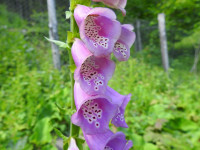
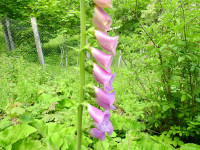
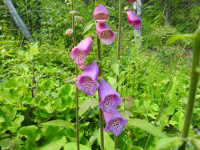
The inflorescence consists of an elongated raceme, often unilateral and scapose, up to 50-60 cm or more long, bearing numerous pendulous flowers, generally from 30 to 100, arranged compactly or more sparsely along the axis. The peduncles of individual flowers are about 8-16 mm long and are also pubescent.
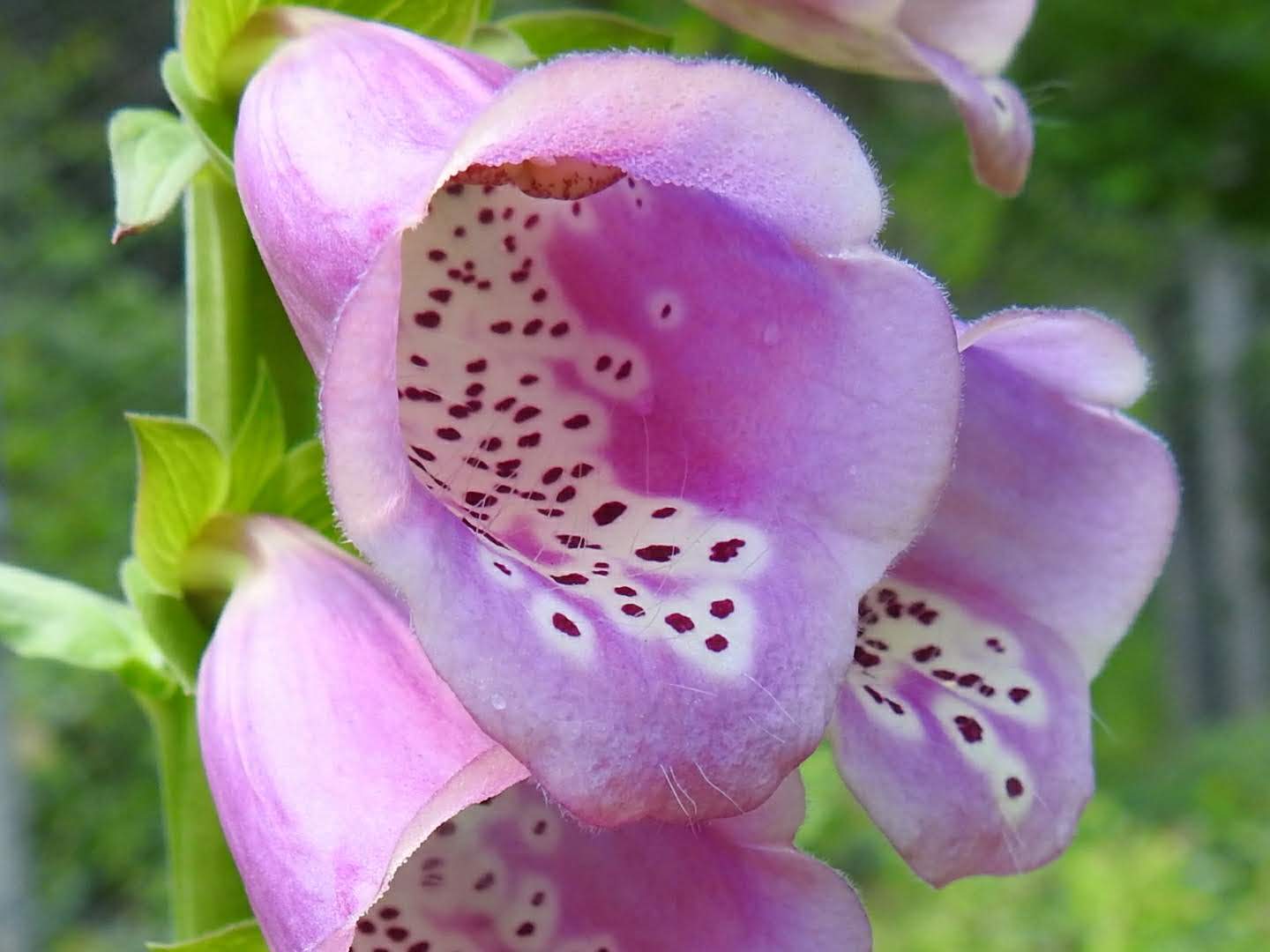
The flowers are large, tubular-campanulate, with a corolla 3 to 5 cm long, characterized by a coloration ranging from purplish red, through carmine to violet, often with dark or purplish spots circled in white inside the corolla tube. The lower part of the corolla has a protruding lip about 5 mm long, ciliate at the margins and hairy internally. The calyx is formed by five ovate, acute lobes, varying in size from 6 to 18 mm, often covered by glandular hairs. The pistil has a filiform style with a bifid stigma, persistent even after flowering.
The fruit is an ovoid-oblong capsule, about 9-15 mm long and 6-10 mm wide, pubescent at the base, which opens by septicidal dehiscence. The seeds are small (0.6-0.7 x 0.4-0.5 mm), obconical in shape with a reticulated seed coat.
The root system consists of a fusiform, branched, and tomentose root, which allows the plant to survive even in difficult conditions.
Habitat and distribution
Foxglove is a typical species of the mountainous and hilly areas of the western Mediterranean and western Europe, with a distribution ranging from Scandinavia to the Iberian Peninsula, including Sardinia and Corsica, where it is an integral part of the natural vegetation. In Italy, it is mainly present in mountainous and foothill areas, but also found in feral populations in various Alpine and pre-Alpine zones such as Friuli, Carnia, Asiago, Baldo, Comasco, Poschiavo, Ossola, and Ivrea, often from ancient medicinal cultivations. However, in the Alps it does not grow spontaneously but exclusively as a naturalized plant.
It prefers habitats of broadleaf forest clearings, mountain pastures, and glades on siliceous soils rich in organic matter, with exposure from hilly areas up to about 1600 meters altitude. It grows on well-drained soils with abundant humus and in open or semi-shaded environments, often in association with other herbaceous species typical of the mountain understory.
Flowering period
Flowering generally extends from May to September, with a peak that can vary depending on altitude and latitude. In colder or mountainous areas, flowering may start later and last until the end of summer, while in warmer Mediterranean areas it may start as early as May and finish earlier. Flowering is progressive and prolonged, allowing a long availability of flowers for pollinating insects.
Ecology and pollination
Foxglove is mainly pollinated by pollinating insects, particularly bees and bumblebees, attracted by the showy tubular flowers and their purplish-red color spotted internally, which serves as a visual signal. The tubular shape of the flower is suitable for pollination by insects with long mouthparts, which can penetrate the corolla tube to reach the nectar. The flower symmetry is zygomorphic, a characteristic that facilitates contact with the reproductive organs during insect visits.
Seed dispersal occurs through the dehiscence of mature capsules, which open to release a large number of light and small seeds, facilitating limited-distance dispersal mainly by gravity and light wind. The plant is also able to regenerate through the persistence of basal buds, allowing it to survive and regrow in subsequent years.
Curiosities and traditional uses
Foxglove is one of the best-known and studied medicinal plants for its content of cardioactive glycosides, historically used in the treatment of some heart diseases. However, these active principles are also highly toxic, and the plant must be handled with caution. Currently, the pharmacopoeia more frequently uses Digitalis lanata, a related species with similar active principles but less labile and less toxic.
Besides medicinal use, Foxglove is also appreciated for its ornamental beauty and is cultivated as a garden plant for flower beds and for cut flower production. Numerous hybrids and cultivars with flowers of various shades have been created, and sometimes the mutation called "peloria" is observed, in which the flower symmetry becomes radial instead of bilateral.
The plant has also inspired culture and art: the poet Giovanni Pascoli described it evoking the image of "a spike of flowers, indeed fingers, sprinkled with blood, human fingers," while Van Gogh portrayed it in a famous painting ("Portrait of Dr. Gachet").
Despite its potential medicinal use, it is important to emphasize that Foxglove is toxic and should not be used for therapeutic purposes without proper expertise.
Etymology
The genus name "Digitalis" derives from the Latin digitus, meaning "finger," referring to the tubular shape of the flowers which resemble a thimble, a sewing tool shaped like a finger. The name was Latinized from the German term "Fingerhut" (thimble).
The specific epithet purpurea derives from the Greek porphýreos, meaning "purple-red in color," describing the vivid coloration of the flowers.
The Italian common name "digitale rossa" refers both to the shape of the flowers (similar to small thimbles or fingers) and the characteristic purplish-red color of the species.
Sources
- Prof. S. Pignatti, "Flora d'Italia"
- Acta Plantarum - Flora delle regioni italiane (scheda di Marinella Zepigi)
- World Flora Online (WFO)
Characteristics
Scheda botanica
| Famiglia | Plantaginaceae |
|---|---|
| Fioritura | maggio – settembre |
| Forma biologica | Scapose |
| Habitat | with fuchsia flowers, toxic plant, Perennial plant |
| Tossicità | Tossica — non consumare |
Domande frequenti
- Quando fiorisce Foxglove?
- Foxglove fiorisce maggio – settembre.
- È tossica Foxglove?
- Foxglove è una pianta tossica o velenosa. Non consumare nessuna sua parte senza aver consultato un esperto.
- Che tipo di pianta è Foxglove?
- Foxglove è una Hemicryptophytes (Scapose) secondo la classificazione di Raunkiaer.
- A quale famiglia appartiene Foxglove?
- Foxglove appartiene alla famiglia botanica Plantaginaceae.
Where I found it (10 sightings)
Classification
- Kingdom
- Plantae
- Family
- Plantaginaceae
- Full name
- Digitalis purpurea L.
- Synonyms
- Digitalis gyspergerae Rouy; Digitalis purpurea L. subsp. gyspergerae (Rouy) Rouy; Digitalis purpurea L. var. gyspergerae (Rouy) Fiori
- Life form
- Hemicryptophytes scapose
Similar species
Search for species with similar characteristicsFurther reading
Noticed an error in the identification? Write to me
Other species of the same family
Plantaginaceae
Explore
Other species of Plantaginaceae