Botanical species
Cyclamen hederifolium
Aiton
Sowbread
Description
Morphological description
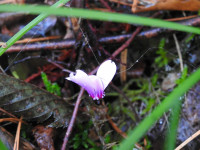
Perennial bulbous geophyte plant, the Sowbread presents a tuber of orbicular shape, slightly compressed at the poles, with a diameter of 3-5 (up to 6) cm. The bark of the tuber is brown-reddish and corky in texture, while the internal pulp is white. The roots develop only on the upper half of the tuber.
Basal leaves originate from the tuber, generally emerging in spring, sometimes simultaneously with flowering. The leaves have a petiole 4-5 cm long, pinkish and often twisted, with an oval-polygonal blade measuring 3-5 cm in width and 4-7 cm in length. The shape is characterized by 5-9 obtuse lobes, with a finely dentate margin and a deep basal sinus. The upper leaf surface is dark green, matte and variegated with white spots, while the lower surface is generally purple or green with purple reflections. The surface is pubescent.
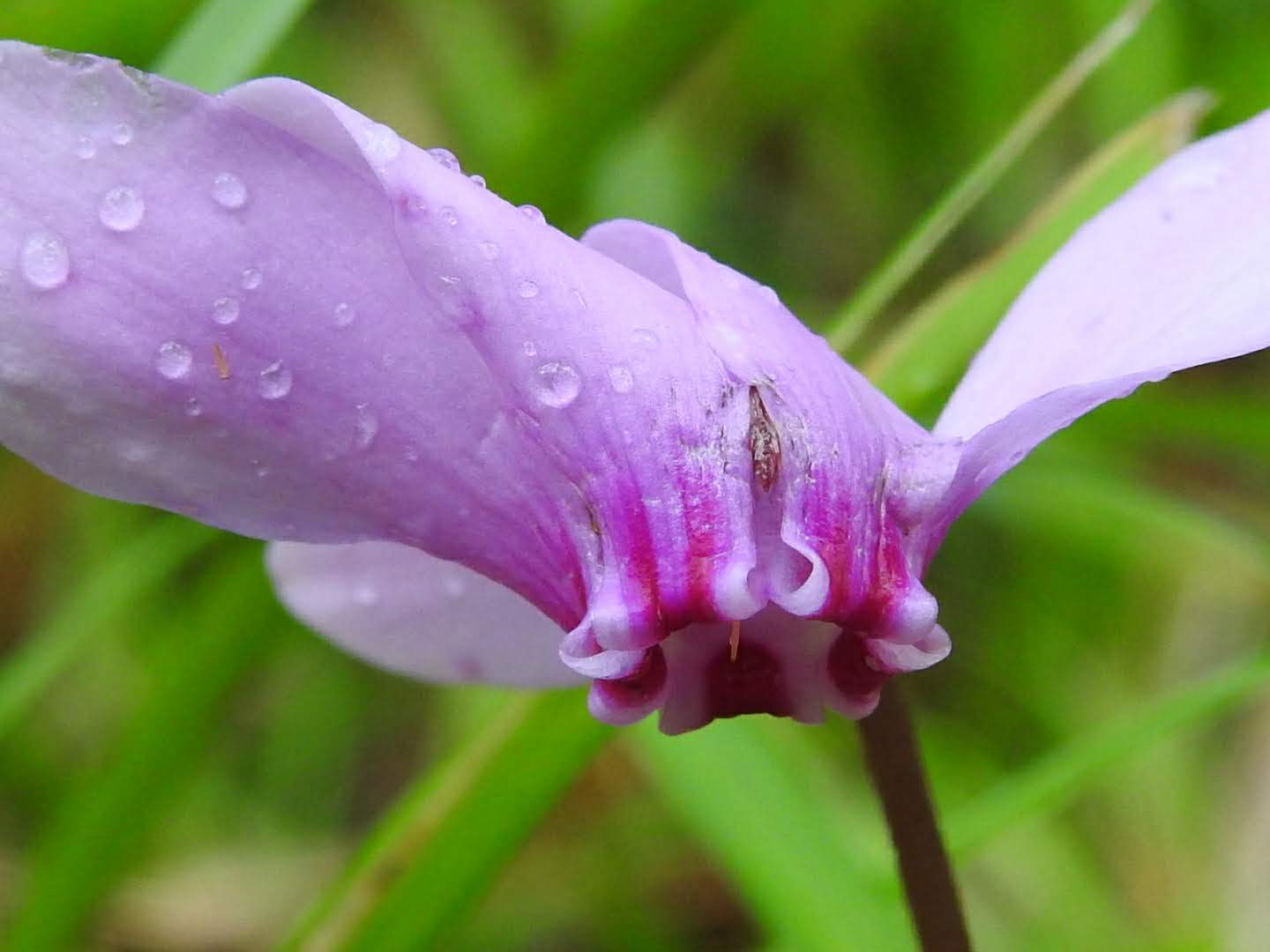
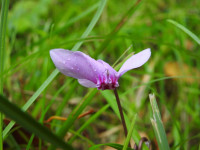
The flowers are solitary, hermaphroditic and odorless, borne on a pinkish and pubescent peduncle 6-12 cm long, which coils spirally after flowering. The calyx is pentapartite gamosepalous with laciniae of 2-3 mm, acuminate in shape. The corolla is gamopetalous, actinomorphic and pale pink in color, with a tube about 6 mm long. The five corolla laciniae measure 8-9 mm in width and 18-21 mm in length, are reflexed and narrowed at the base (about 3 mm). At the throat of the flower there is a pentagonal purple throat, adorned with 10 protruding whitish auriculate teeth forming five semicircles.
The stamens are five, with a superior unilocular ovary and a slightly protruding style. The fruit is a globose capsule with apical dehiscence (pissidium), which matures underground and contains numerous round seeds.
The plant height generally ranges between 5 and 20 cm. The leaf surface is hairy, while the margin is dentate and the leaf shape resembles that of ivy, from which the specific name derives.
Habitat and distribution
The species is widespread in the regions of the western and central-southern Mediterranean, from southern Spain to Greece, and in Italy it is mainly found in the southern and insular regions, with presence also in some regions of central and northwestern Italy.
The Sowbread prefers humid deciduous woodland environments, such as oak woods, chestnut groves and holm oak woods, generally on calcareous soils. It grows from the hill belt up to about 1300 m altitude. It is a mesophilic and shade-loving species, developing in partial or full shade conditions within woods and thickets.
In Italy two subspecies are known, of which subsp. hederifolium is the most widespread, while subsp. confusum is present only in regions such as Calabria and Sicily and is distinguished by thicker, glossy and light green leaves.
Flowering period
Flowering extends from August to November, a characteristic that distinguishes this species from other spring or summer flowering cyclamens. In some areas the appearance of flowers may precede that of the leaves, which generally emerge in spring.
Ecology and pollination
The Sowbread reproduces mainly through entomogamous pollination: it is visited by pollinating insects that facilitate pollen transfer. After flowering, the peduncle coils spirally contributing to the dispersion of seed capsules, which mature underground (hypogeal maturation).
Seed dispersal also occurs through myrmecochory, i.e., transport by ants attracted by nutrients present in the seeds, facilitating their distribution in the undergrowth.
Curiosities and traditional uses
All cyclamens, including this one, contain a saponin called cyclamin in the tuber, a highly toxic substance. Nevertheless, some traditional populations have used the plant in herbal medicine, but with great caution due to its toxicity. The popular name "Pan porcino" derives from the fact that pigs can consume the plant without harmful effects, unlike humans.
The species is protected at national and regional levels in some Italian regions, such as Liguria and Molise, due to its vulnerability and restricted habitat.
Etymology
The generic name Cyclamen derives from the Greek "kýklos", meaning circle or cycle, probably referring to the rounded shape of the tuber or the characteristic coiling of the peduncle after flowering. The specific epithet hederifolium means "with ivy-like leaves", due to the similarity in shape and margin of the leaves with those of Hedera helix (common ivy).
The Italian common name "ciclamino autunnale napoletano" recalls the flowering season and the original distribution in the Campania region.
Sources
- Prof. P.V. Arrigoni, "Flora analitica della Toscana", "Flora dell'Isola di Sardegna"
- Acta Plantarum - Flora delle regioni italiane (scheda di Anja Michelucci)
- Tela Botanica / H. Coste, "Flore descriptive et illustrée de la France"
- World Flora Online (WFO)
Characteristics
Scheda botanica
| Famiglia | Primulaceae |
|---|---|
| Fioritura | agosto – ottobre |
| Forma biologica | Bulbous |
| Habitat | with white flowers, toxic plant, with pink flowers |
| Tossicità | Tossica — non consumare |
Domande frequenti
- Quando fiorisce Sowbread?
- Sowbread fiorisce agosto – ottobre.
- È tossica Sowbread?
- Sowbread è una pianta tossica o velenosa. Non consumare nessuna sua parte senza aver consultato un esperto.
- Che tipo di pianta è Sowbread?
- Sowbread è una Geophytes (Bulbous) secondo la classificazione di Raunkiaer.
- A quale famiglia appartiene Sowbread?
- Sowbread appartiene alla famiglia botanica Primulaceae.
Where I found it (15 sightings)
Classification
- Kingdom
- Plantae
- Family
- Primulaceae
- Full name
- Cyclamen hederifolium Aiton
- Life form
- Geophytes bulbous
Similar species
Search for species with similar characteristicsFurther reading
Noticed an error in the identification? Write to me
Other species of the same family
Primulaceae
Explore
Other species of Primulaceae