Botanical species
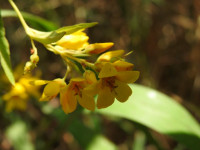
Lysimachia vulgaris
L.
Yellow Loosestrife
Description
Morphological description
Perennial herbaceous plant, equipped with a creeping underground rhizome that allows it to survive and regenerate at ground level. The stem is erect, generally 40 to 130 cm tall, often extensively branched in the upper part, with a grooved surface and covered by a pubescence made up of simple and glandular hairs. This indumentum is brown in color, with long articulated hairs alternating with shorter capillary hairs.
The leaves are arranged oppositely along the stem in the lower parts, while they may appear whorled in groups of 3 or 4 in some upper areas. The blade is lanceolate or oblanceolate, with dimensions ranging from 2-3 cm wide by 7-12 cm long up to 4 x 12-14 cm in larger specimens. The leaves are glabrous and shiny on the upper surface, lighter and pubescent on the veins on the lower surface; the margin is entire and undulate, with well-visible reticulate veins. The petiole is short, 1-2 cm, sometimes up to 4 mm.
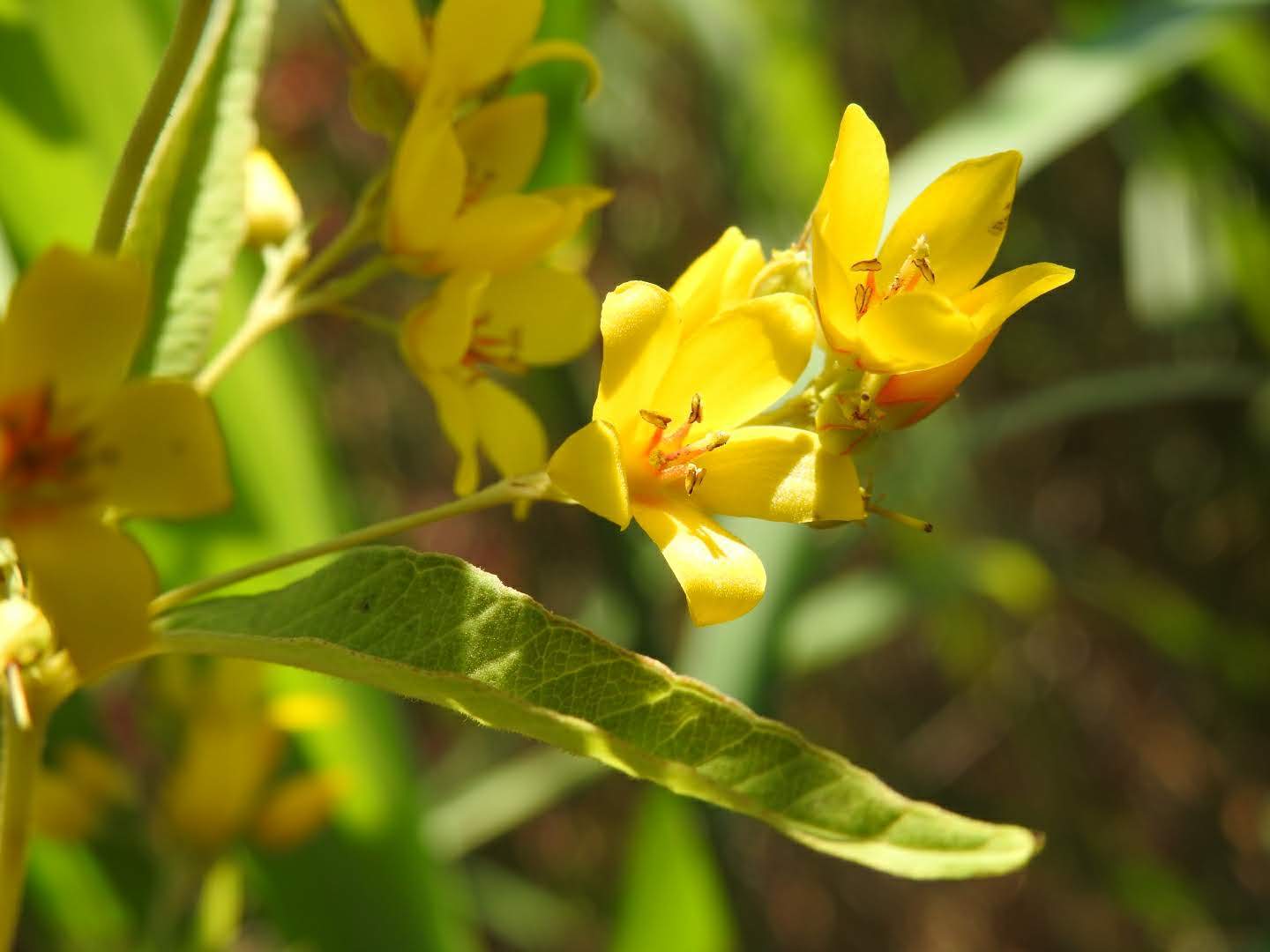
The flowers are gathered in dense pyramidal panicle inflorescences, arranged terminally or in the axils of the upper leaves. At the base, these inflorescences are leafy, while above they have linear bracts 5-6 mm long, green with dark red margins and stripes. The floral peduncles, up to 8 mm long, are also pubescent with glandular hairs.
The calyx is composed of acute lobes, about 3-5 mm long, with membranous margins bordered with bright red. The corolla is a vivid golden yellow, composed of five elliptic-oblong petals 7-12 mm long and 4.5-5.5 mm wide, imbricate and basally united, with the inner surface covered by short glandular hairs. The stamens are included within the corolla and the filaments are connected at the base forming a glandular tube adherent to the petals; the anthers are basifixed. The ovary is subglobose with a glandular apex, while the style is persistent, up to 5 mm long, often equal to or longer than the stamens, with the lower half covered by glands.
The fruit is a spherical or subspherical capsule about 4-6 mm in diameter, unilocular and dehiscent, containing numerous trigonal seeds, light brown matte in color with a rough surface.
Habitat and distribution
The species is typical of wet and marshy environments, linked to muddy or peaty soils often covered by a layer of water. It commonly grows along the edges of reed beds (Phragmites australis), in wet meadows, marshes, lake shores and watercourses, ditches, shallow bends, and riparian thickets. It can tolerate permanent flooding conditions and develop epigeal stolons up to several meters long in such environments.
In Italy it is mainly present in the northern and central regions, in some areas of Corsica, and sporadically in Basilicata, Calabria (Pollino massif) and Sicily (Spaccaforno). Its distribution extends throughout Eurasia, from Europe to Japan, with wide diffusion in temperate and submontane regions. It prefers altitudes between 0 and 1200 meters above sea level.
Flowering period
Flowering generally occurs between June and August. Due to the wide geographic distribution and local climatic conditions, the flowering period may vary slightly, occurring earlier in warmer areas and later in cooler or mountainous ones.
Ecology and pollination
The flowers, bright yellow with petals bearing glands and hairs, are particularly attractive to a variety of pollinating insects, especially bees and other hymenopterans, which promote cross-pollination. However, the species is also capable of self-pollination through autogamy mechanisms, especially under less favorable environmental conditions.
The plant often grows in small groups, rooting directly in the mud, and in permanently flooded stations it can expand via superficial stolons. This mode of vegetative propagation is particularly efficient for colonizing unstable habitats or those subject to frequent water level changes.
The seeds are contained in capsules that open at maturity, allowing dispersion into the surrounding environment, favoring colonization of new wet sites. The morphology of the capsule and the presence of numerous seeds suggest a predominantly barochorous dispersal strategy (falling near the mother plant), possibly supported by water transport.
Curiosities and traditional uses
The genus name recalls Lysimachus, an ancient Greek physician, while the specific epithet “vulgaris” indicates the common distribution of the plant. The Italian common name “Mazza d’oro” undoubtedly derives from the characteristic golden yellow color of its flowers.
Historically, the plant was used in herbal medicine as a medicinal herb, thanks to its expectorant, astringent, soothing, and febrifuge properties. It was used for treating fevers and abscesses. The stem was used to obtain a yellow dye, while the flowers were exploited to produce a tincture useful for lightening hair. Moreover, burning the plant produces fumes believed to repel and destroy flies, a popular use for domestic protection.
Today the species is sometimes cultivated as an ornamental plant for the beauty of its vivid inflorescences and its resistance in wet environments.
Etymology
The scientific name Lysimachia derives from Lysimachus, an ancient Greek physician, while “vulgaris” means “common,” emphasizing the frequency and wide distribution of the species. The Italian name “Mazza d’oro” is inspired by the appearance of the golden yellow flowers, resembling bright maces standing out among aquatic vegetation.
Sources
- Prof. S. Pignatti, Flora d’Italia
- Acta Plantarum - Flora delle regioni italiane (sheet by Marinella Zepigi)
- World Flora Online (WFO)
Characteristics
Where I found it (5 sightings)
Classification
- Kingdom
- Plantae
- Family
- Primulaceae
- Full name
- Lysimachia vulgaris L.
- Life form
- Emicriptofite scapose
Similar species
Search for species with similar characteristicsNoticed an error in the identification? Write to me
Other species of the same family
Primulaceae
Explore
Other species of Primulaceae