Botanical family
Primulaceae
Description
Botanical characteristics
Primulaceae are a family of predominantly herbaceous angiosperm plants, with some suffrutescent species. The typical habit includes perennial herbs, sometimes annuals, with generally spirally arranged leaves often gathered in basal rosettes; rarely the leaves are opposite or whorled. Stipules are absent.
The flowers are hermaphroditic and predominantly actinomorphic (radially symmetrical), although in some genera such as Coris they can be weakly zygomorphic. They are typically pentamerous, that is composed of five sepals and five petals (rarely varying from four to nine). The calyx is gamosepalous, meaning the sepals are partially or totally fused, while the corolla is gamopetalous with a well-developed corolla tube in many species. The stamens are five and often fused to the corolla tube. The ovary is superior with central placentation.
Inflorescences may appear as umbels, racemes, or panicles. The fruit is a capsule, which opens to release the seeds.
From an ecological point of view, fertilization is entomogamous, i.e. mediated by insects, with some species offering pollen as a reward (for example Lysimachia, Anagallis, Cyclamen) and others producing nectar (such as Primula, Soldanella, Androsace, Hottonia). Some genera exhibit heterostyly, a flower differentiation mechanism that promotes cross-pollination (Hottonia, Primula, Vitaliana).
The family shows an evolutionary progression in corolla structure, from nearly dialipetalous forms (separate petals) in Lysimachia and Anagallis, to sympetalous forms (fused petals) with a well-developed corolla tube and patent or reflexed calyx lobes in genera such as Primula, Androsace, and Cyclamen.
Distribution and diversity
The Primulaceae family has a cosmopolitan distribution, present in many regions of the world. It is mainly found in temperate and cold zones of the northern hemisphere, including arctic and alpine areas, but is also widespread in tropical regions of the Old and New World.
The family includes numerous genera and species, with great ecological and morphological diversity. The main genera present in the Italian and Mediterranean flora are the result of a long evolution dating back at least to the end of the Tertiary. Many taxa reflect glacial events, with adaptations to extreme continental conditions, such as cushion-forming suffrutescent plants typical of high alpine altitudes (Androsace helvetica and related species).
Main genera and representative species
Among the most important genera of the Primulaceae family, also present in Italy, are:
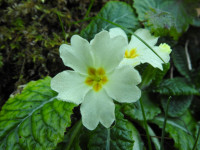
- Primula: one of the best-known genera, with many orophilous species (high mountain) widespread in temperate environments. Primula vulgaris is a well-known species.
- Androsace: includes alpine and subalpine species, often with a hemispherical cushion habit, adapted to high altitude conditions.
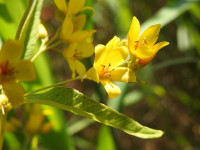
- Lysimachia: with herbaceous species also widespread in wet environments, some of which offer pollen as a reward to pollinators.
- Anagallis: with simpler flowers, close to the primitive type of the family.
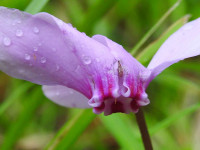
- Cyclamen: characterized by zygomorphic flowers reflexed backward, also present in Italy.
- Soldanella and Hottonia: other genera with species typical of wet and mountainous environments.
Etymology
The family name derives from the type genus Primula, whose name is a diminutive of “prima,” referring to the fact that these plants are among the first to bloom in spring. The family was formally named Primulaceae in 1794.
Sources
- Wikipedia
- Internal botanical database (description provided)

Explore
Other botanical families