Botanical species
Lysimachia arvensis
(L.) U.Manns & Anderb.
Scarlet Pimpernel
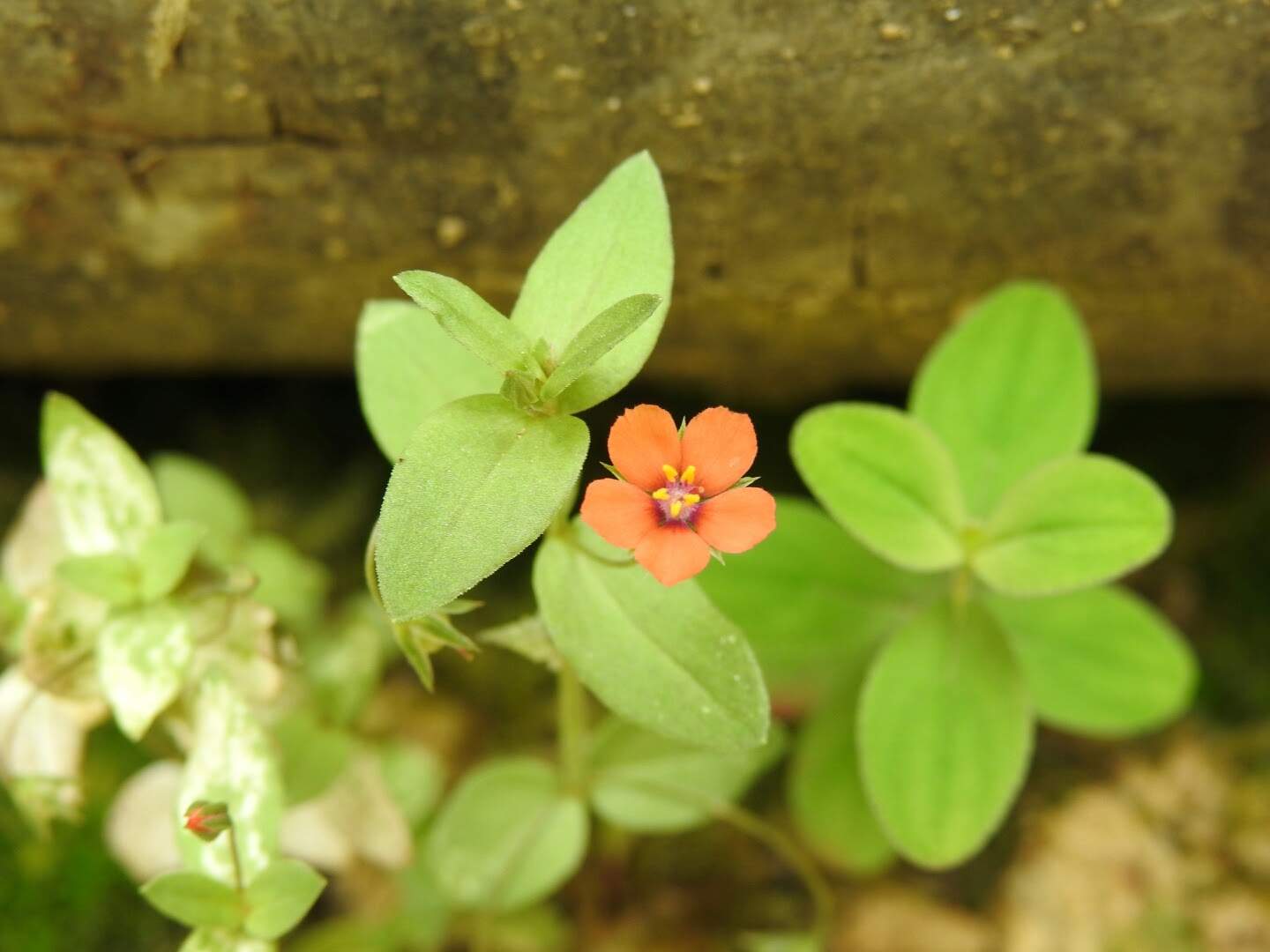
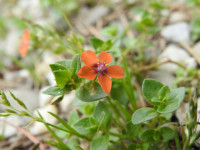
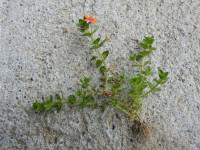
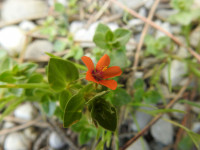
Description
Morphological description
Annual herbaceous plant of modest size, with a height ranging between 7 and 30 cm, characterized by a prostrate or prostrate-ascending habit. The stem is highly branched, glabrous, dark green in color, and has a quadrangular or angular cross-section. At the lower nodes it can root slightly, contributing to its ability to spread over the ground.
The leaves are generally opposite, sometimes the upper ones arranged in whorls of three, sessile and herbaceous in texture. The shape varies from ovate-oblong to lanceolate, with dimensions between 5-30 mm in length and 3-17 mm in width. The leaves have an entire margin and are dotted with black especially on the lower surface, a distinctive characteristic of the species.
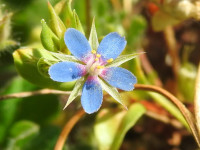
The flowers, hermaphroditic and small (about 0.5 cm in diameter), are solitary and borne on filiform peduncles that develop in the axil of the upper leaves. These peduncles, longer than the leaves themselves, tend to curve during fruiting. The corolla is rotate, composed of five obovate, cuneate lobes, with an entire or rarely slightly serrated margin, slightly longer than the sepals. The predominant color is red in various shades (brick red, orange-red, salmon red) with a characteristic purple ring at the throat; however, there are blue-flowered varieties with a red ring at the throat. The margin of the corolla is provided with numerous tricellular glandular hairs. The calyx is formed by five lanceolate, acute lobes, with a broadly scarious margin and fused at the base.
The stamens are five, with filaments covered with purple hairs or sometimes yellowish or whitish; the anthers are yellow. The ovary is superior.
The fruit is a spherical pyxidium capsule, which opens horizontally into two hemispheres, releasing between 20 and 35 small and numerous seeds, favoring dispersal. The root system is typically modest, suitable for a rapid annual cycle.
Habitat and distribution
This species is very common in Italy and the Mediterranean area, with a subcosmopolitan distribution extending to almost all temperate zones of the globe. In Italy it grows from the plains up to about 1200 meters altitude, with occasional reports up to 1700 meters.
It prefers anthropized habitats such as uncultivated lands, cultivated fields, roadsides, and dry or sandy areas. It is a typical weed of poor and well-drained soils, with sunny or partially shaded exposure. Its adaptability to different substrates and climatic conditions makes it frequent also in disturbed environments.
Flowering period
Flowering extends from May to November, with geographical and climatic variations that can influence the duration and intensity of the flowering period. In warmer climates flowering can last longer, while in areas with harsh winters the season is more limited.
Ecology and pollination
The species reproduces sexually through hermaphroditic flowers, pollinated by pollinating insects attracted by the bright color of the red or blue flowers. The habit of the peduncles, longer than the leaves and curved during fruiting, favors seed dispersal. The capsule opens releasing numerous small seeds, facilitating their spread on the surrounding ground.
The prostrate stem and the ability to root at the lower nodes give the plant a good capacity for rapid colonization of open and disturbed spaces, typical of annual weed species.
Curiosities and traditional uses
This plant is known for its toxic properties. It contains triterpenoids, saponins in the aerial parts, and cyclamine in the roots, as well as volatile oils and primin in the glandular hairs. Traditionally it has been used in folk medicine for its bechic, diaphoretic, expectorant, cholagogue, purgative, stimulant, vulnerary, diuretic, and nervine properties. However, its use is discouraged due to its toxicity, which has caused poisoning episodes, especially from accidental consumption together with other herbs in salads.
In the past it was considered a medicinal plant, but the danger of its active principles has greatly limited its practical application. Moreover, it is known in folklore as the “weather plant” or “poor man's barometer” for its tendency to close the flowers in humid or cloudy weather conditions.
Etymology
The genus name derives from Lysimachus, an ancient Greek physician. The specific epithet arvensis means “of the fields” in Latin, referring to its typical habitat in open and cultivated environments. The Italian common name Scarlet Pimpernel refers to its bright and numerous flowers, which resemble a sort of colorful “mantle” in cultivated fields and uncultivated lands.
Sources
- Acta Plantarum - Flora delle regioni italiane (actaplantarum.org)
- Acta Plantarum - Scheda di Giuliano Salvai
- Tela Botanica / H. Coste, Flore descriptive et illustrée de la France
- World Flora Online (WFO)
Characteristics
Scheda botanica
| Famiglia | Primulaceae |
|---|---|
| Fioritura | maggio – novembre |
| Forma biologica | Creeping plants |
| Habitat | with red flowers, toxic plant, annual plant |
| Tossicità | Tossica — non consumare |
| Uso officinale | Pianta officinale |
Domande frequenti
- Quando fiorisce Scarlet Pimpernel?
- Scarlet Pimpernel fiorisce maggio – novembre.
- È tossica Scarlet Pimpernel?
- Scarlet Pimpernel è una pianta tossica o velenosa. Non consumare nessuna sua parte senza aver consultato un esperto.
- Che tipo di pianta è Scarlet Pimpernel?
- Scarlet Pimpernel è una Therophytes (Creeping plants) secondo la classificazione di Raunkiaer.
- A quale famiglia appartiene Scarlet Pimpernel?
- Scarlet Pimpernel appartiene alla famiglia botanica Primulaceae.
Where I found it (9 sightings)
Classification
- Kingdom
- Plantae
- Family
- Primulaceae
- Full name
- Lysimachia arvensis (L.) U.Manns & Anderb.
- Synonyms
- Anagallis arvensis L.
- Life form
- Therophytes creeping plants
Similar species
Search for species with similar characteristicsFurther reading
Noticed an error in the identification? Write to me
Other species of the same family
Primulaceae
Explore
Other species of Primulaceae