Botanical species
Samolus valerandi
L.
Brookweed
Description
Morphological description
Perennial herbaceous plant belonging to the Primulaceae family, characterized by an erect habit with simple or slightly branched stems reaching a variable height between 15 and 50 cm, sometimes up to 64 cm. The stems are internally hollow and can root at the nodes, especially in the lower portions.
The basal leaves form a rosette, are spatulate or oblanceolate, herbaceous in texture, with entire and sometimes slightly undulate margins. The size of the basal leaves varies from 3.5 up to 20 cm in length (including the petiole), with a width between 1 and 4 cm, dark green in color and shiny surface, with reticulate venation and a prominent midrib. The cauline leaves are few, arranged alternately along the stem, progressively smaller, obovate or elliptical, subsessile, with a slightly acuminate apex.
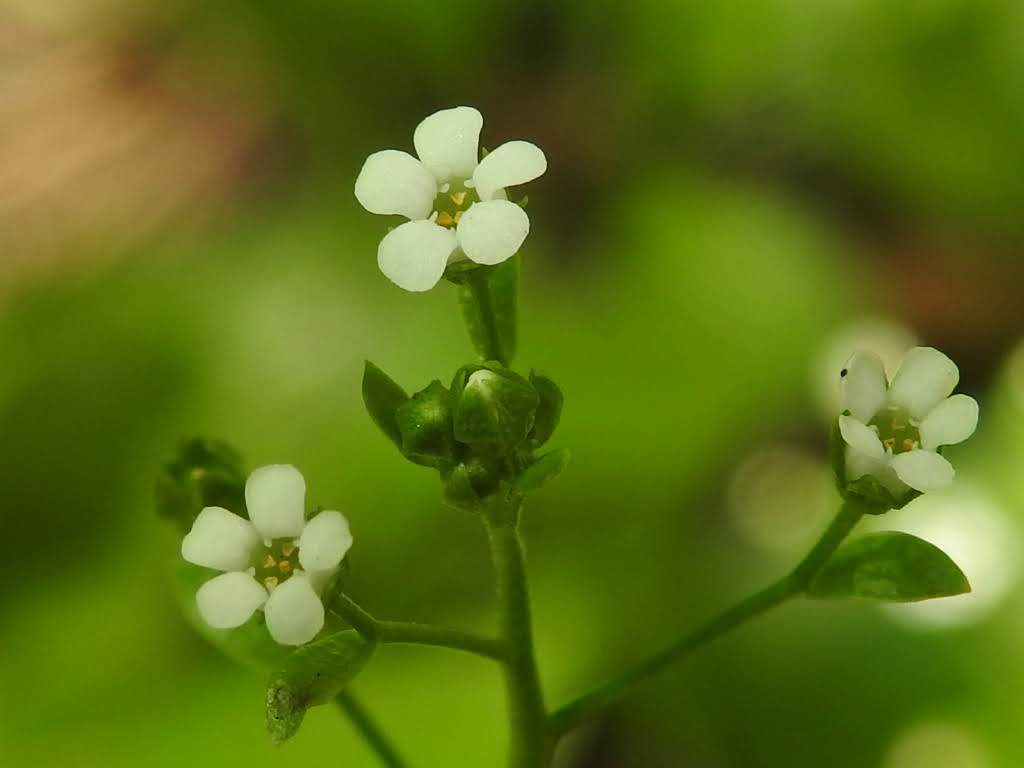
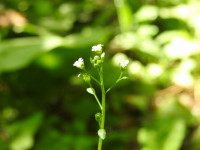
The flowers, small in size (3-4 mm in diameter), are white and pentamerous, with five rounded cup-shaped petals. They are hermaphroditic, actinomorphic, and gathered in terminal or axillary racemes, simple or slightly branched, up to 25 cm long. The peduncles are filiform, 1-2 cm long, with a lanceolate bracteole placed about halfway along and at which the peduncle bends (geniculate). The calyx is campanulate, 1.5-3 mm long, with acute triangular lobes about 1 mm, persistent and almost completely enveloping the capsule. The corolla has a short, wide, tubular tube, while the lobes, 1.5 mm long, are oblong or obovate, with entire or slightly undulate margins and a minutely papillose surface.
The stamens, inserted at the base of the corolla tube, have glabrous filaments about 0.5 mm long and ellipsoid anthers 0.3-0.4 mm, alternating with linear or triangular staminodes. The ovary is globose and fused with the calyx, equipped with a columnar style (less than 1 mm long) and a subcapitate stigma.
The fruit is a globose or ovoid capsule, included in the calyx, about 3-3.5 mm in diameter, opening into 5 strongly reflexed apical valves. The seeds, numerous and angular, are dark brown, about 0.5 mm long, minutely granulate or tuberculate. The root system is fibrous and fasciculate.
Habitat and distribution
This species is widely distributed throughout the Italian territory, although often with localized and rather rare distribution. It prefers marshy environments, temporarily waterlogged soils, muddy and wet areas such as ditches, edges of watercourses, very wet meadows, and subsaline zones. The typical habitat is therefore aquatic or semi-aquatic, with a preference for coastal environments and wetlands.
In northern Italy it is more common along coasts and plains, while in the South it tends to also move towards mountainous environments, up to about 1200 meters of altitude. It is a subcosmopolitan species, present in almost all temperate zones of the world, with some geographical gaps.
Flowering period
The flowering extends from June to September (months 6-9), with possible variations depending on latitude and altitude. In northern and coastal regions flowering occurs mainly in summer, while in more southern and mountainous areas it may be slightly anticipated or prolonged.
Ecology and pollination
The reproductive strategy is based on hermaphroditic and actinomorphic flowers, which favor cross-pollination. The plant is mainly visited by pollinating insects attracted to the small white flowers gathered in racemes. The presence of staminodes alternating with stamens may play a role in attracting or orienting pollinators.
Seed dispersal occurs both by wind, thanks to the lightness and small size of the seeds, and probably by birds, which can transport the seeds after ingesting the capsule or following contact with moist soil.
Curiosities and traditional uses
The scientific name and ethnobotanical tradition recall an ancient knowledge of the plant. The term Samolus probably derives from an ancient Celtic word composed of "san" (healthy) and "mos" (pig), indicating a plant considered beneficial for the health of pigs. According to historical accounts, Druids collected this plant in wet places as a remedy against livestock diseases, with particular ritual precautions (harvesting fasting, with the left hand and without looking back), and placed it exclusively in animal watering places.
Despite this tradition, there are no modern scientific confirmations regarding the widespread medicinal or food use of this species, but its Italian common name “Lino d’acqua” recalls the delicacy of the leaves and the wet habitat, evoking an analogy with flax.
Etymology
The genus name Samolus is mentioned by Pliny the Elder in his Historia Naturalis as a plant collected by Druids in wet locations to protect livestock from diseases, with a sacred and ritual connotation. The specific epithet valerandi is dedicated to Dourez Valerand, a 16th-century botanist mentioned by Johan Bauhin, who contributed to the species determination.
The Italian common name “Lino d’acqua” derives from the similarity of the leaves to those of flax (spatulate and thin leaves) and from its typical habitat of wet and coastal areas.
Sources
- Prof. S. Pignatti, "Flora d'Italia"
- Acta Plantarum - Flora delle regioni italiane (sheet by Patrizia Ferrari)
- World Flora Online (WFO)
Characteristics
Scheda botanica
| Famiglia | Primulaceae |
|---|---|
| Fioritura | giugno – settembre |
| Forma biologica | Tufted |
| Habitat | with white flowers |
Domande frequenti
- Quando fiorisce Brookweed?
- Brookweed fiorisce giugno – settembre.
- Che tipo di pianta è Brookweed?
- Brookweed è una Hemicryptophytes (Tufted) secondo la classificazione di Raunkiaer.
- A quale famiglia appartiene Brookweed?
- Brookweed appartiene alla famiglia botanica Primulaceae.
Where I found it (7 sightings)
Classification
- Kingdom
- Plantae
- Family
- Primulaceae
- Full name
- Samolus valerandi L.
- Life form
- Hemicryptophytes tufted
Similar species
Search for species with similar characteristicsNoticed an error in the identification? Write to me
Other species of the same family
Primulaceae
Explore
Other species of Primulaceae