Botanical species
Primula vulgaris
Huds.
Primrose
Description
Morphological description
Perennial herbaceous plant, acaulescent, with height generally ranging between 8 and 15 cm. The root system consists of an oblique or horizontal rhizome, rather short (3-5 mm thick by 30-40 mm long), from which robust secondary roots arise. It does not have a true stem, as the leaves and flowers emerge directly from the rhizome.
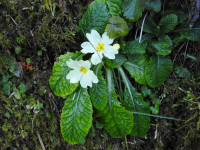
The leaves are all basal, arranged in a rosette, with an oblanceolate or spatulate shape, often with a rounded apex. The leaf blade, initially measuring about 1-2 x 5-9 cm, can grow up to double the size in more mature specimens, reaching even larger dimensions. The margin is irregularly crenate-dentate, while the texture is herbaceous. The upper surface of the leaf is glabrous, with a prominent vein and a verrucose-reticulate texture, while the lower side appears villous. The blade gradually narrows towards the base, forming a winged petiole.
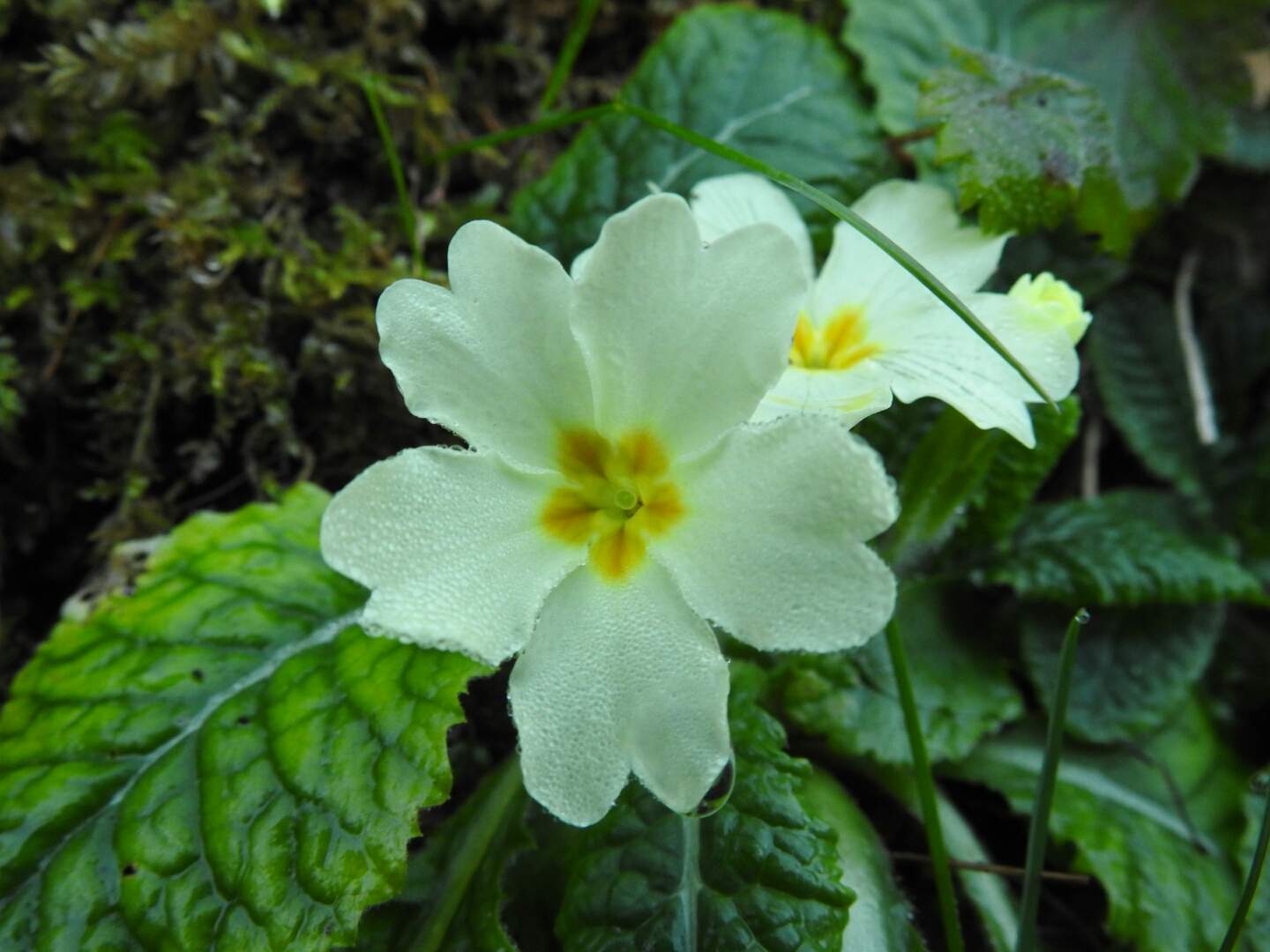
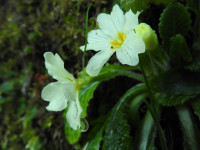
The flowers are funnel-shaped, generally numerous, borne singly on woolly radical peduncles, about 4-7 cm long, erect or slightly spreading. Each peduncle is equipped at the base with one or more lanceolate-linear bracts. The calyx is green, with a tube of 3 x 10 mm, divided almost halfway into five lanceolate-acuminate teeth, covered by a down that accentuates the roughness. The corolla is pale yellow, with orange shades inside the throat, rarely it may have reddish tones; the five lobes are obcordate, 10-15 mm wide and 7-12 mm long, with a characteristic darker spot at the base resembling an “eye”. The total diameter of the corolla can reach 2-3 cm.
The fruit is an oval capsule, which opens longitudinally by means of five teeth to release numerous seeds. These seeds are viscous due to the presence of an oily caruncle, a feature that favors dispersal by insects or other vectors.
Habitat and distribution
This species is widespread in Europe and the Caucasus area, extending also to Western Asia and North Africa. In Italy it is mainly found along the edges of broadleaf forests, in meadows, beechwoods, oakwoods, and hornbeam woods. It prefers fresh woodland environments but also clearings and path edges. It grows from near sea level up to about 2,000 meters altitude.
The preferred soil is generally well-drained, with substrates rich in organic matter, often in shaded or semi-shaded areas. The species adapts well to variable exposures but prefers cool and moist conditions typical of temperate woodland environments.
Flowering period
Flowering occurs from late winter to spring, generally between February and May. Dates may vary depending on climatic conditions and altitude: in lower and milder areas flowering can start as early as late winter, while in the mountains flowering shifts towards late spring.
Ecology and pollination
The common primrose presents an interesting reproductive strategy based on heterostyly, i.e., the presence of two distinct floral forms within the population: long-styled flowers (with style longer than stamens) and short-styled flowers (with style shorter). This characteristic, observed and described already by Darwin, promotes cross-pollination, reducing self-pollination and increasing genetic variability.
The flowers, mildly scented, are mainly pollinated by pollinating insects such as bees and bumblebees, attracted by the yellow coloration and the presence of dark spots that act as visual guides. However, since flowering is early, pollinating insects are often scarce, which can limit pollination and seed production in some years or environments.
Seed dispersal occurs through capsule dehiscence and the action of insects attracted by the oily caruncle, which facilitate seed transport even over moderate distances.
Curiosities and traditional uses
The common primrose is one of the first flowers to announce spring, which is why it has always been a symbol of renewal, youth, and precocity. In popular tradition, it is considered an auspicious and lucky plant. A historical anecdote recounts that Queen Victoria, upon receiving the Crown of India from Minister Disraeli, reciprocated with a bouquet of primroses as a sign of good luck.
From an ethnobotanical point of view, the species has been widely used in traditional medicine. The leaves were used in decoctions to combat rheumatism, while the root was used in infusions against migraines. The leaf juice has been used as a cosmetic remedy to reduce spots and skin wrinkles. Pliny the Elder suggested primrose to treat paralysis, gout, and rheumatism.
In cooking, young leaves can be eaten raw in salads or boiled as a vegetable in soups. The flowers, besides being used to prepare mildly calming herbal teas, can be candied or used to decorate sweets and savory pies.
In the language of flowers, the primrose represents early youth and the promise of new beginnings, also recalling Shakespeare’s poetic metaphor of the “pale primroses that die unmarried,” highlighting the delicacy and early flowering of this plant.
Etymology
The genus name Primula derives from the Latin primus, meaning “first,” referring to the early flowering of these species, often among the first plants to bloom after winter. The specific name vulgaris indicates that it is a common and widespread species.
The Italian common name “primula comune” emphasizes its frequent and characteristic presence in Italian meadows and woods during spring.
Sources
- Acta Plantarum - Flora delle regioni italiane (actaplantarum.org)
- Acta Plantarum - Flora delle regioni italiane (scheda di Marinella Zepigi)
- Tela Botanica / H. Coste, "Flore descriptive et illustrée de la France"
Characteristics
Where I found it (7 sightings)
Classification
- Kingdom
- Plantae
- Family
- Primulaceae
- Full name
- Primula vulgaris Huds.
- Life form
- Emicriptofite rosulate
Similar species
Search for species with similar characteristicsFurther reading
Noticed an error in the identification? Write to me
Other species of the same family
Primulaceae
Explore
Other species of Primulaceae