Botanical species
Lysimachia tenella
L.
Bog Pimpernel
Description
Morphological description
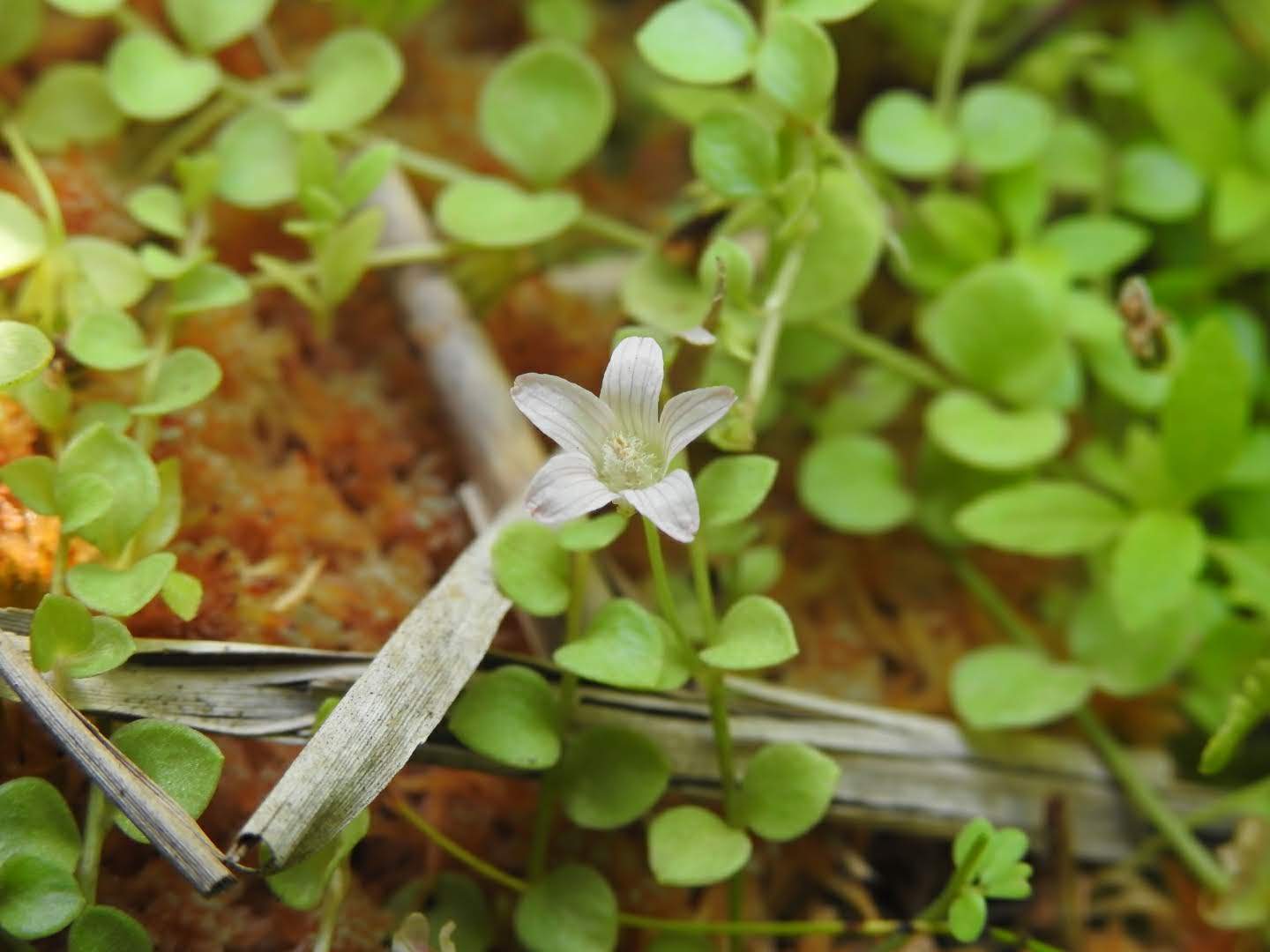
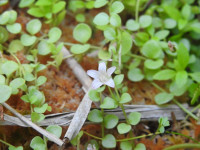
It is a small perennial herbaceous plant, reaching a height between 3 and 15 cm. The habit is mat-forming, with creeping or prostrate-ascending stems, thin and filiform, quadrangular in section, glabrous, slender and rooting at the nodes. This growth allows the plant to spread over moist ground forming small vegetative carpets.
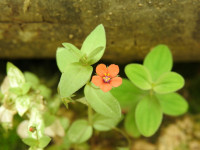
The leaves are arranged mostly oppositely, rarely alternately, and shortly petiolate with a petiole 0-2 mm long. The leaf blade is membranous, dull, suborbicular (almost round) in shape, with variable dimensions between 3.5 and 7.5 mm in length and 3-7 mm in width. The leaf apex is obtuse or rounded, while the margin is entire.
The flowers are hermaphroditic, actinomorphic (radially symmetrical) and appear singly or in pairs in the leaf axils, on erect filiform peduncles measuring between 10 and 37 mm, generally longer than the subtending leaf. These peduncles tend to curve during fruiting. The calyx is gamosepalous, 2.5-4 mm long, with five lanceolate-linear acuminate lobes.
The corolla is gamopetalous, pink veined with purple, campanulate or rotate, with a diameter of 6-10 mm, thus about 2-3 times longer than the calyx. It has five deep lobes, erect or erect-patent, with obtuse or emarginate apices. The stamens are five, with very hairy filaments, and the ovary is superior with a persistent style.
The fruit is a globose circumscissile capsule, called a pyxidium, 2.5-4 mm in diameter, containing numerous small seeds. The root system consists of roots that also develop from the nodes of the creeping stems, favoring vegetative propagation.
The chromosome number of the species is 2n = 22.
Habitat and distribution
This species is typical of moist and hygrophilous environments, typically found in low peat bogs, periodically flooded marshy meadows, riparian zones, embankments and other wet places. It generally grows from 0 up to 500 meters in altitude.
Its distribution is mainly centered on the Atlantic coasts of Europe, with presence also in the humid Italian and Mediterranean regions, where it finds favorable conditions in fresh, permeable and often acidic or peaty soils. It prefers full sun or partially shaded exposures, typical of marshy areas or the edges of watercourses.
Flowering period
Flowering mainly occurs between June and July. No significant geographical variations in the flowering period have been reported, which remains concentrated in summer.
Ecology and pollination
The flowers, with delicate structure and colors, are visited by pollinating insects that favor pollination; however, specific data on pollinating insects are not available in the consulted sources. The plant has a reproductive strategy that includes both seed production contained in the circumscissile capsule and vegetative propagation through rooting at the nodes of the creeping stems.
Seed dispersal, given the small size and nature of the capsule, could mainly occur by falling and water transport in wet areas, although no explicit data are available on this.
Curiosities and traditional uses
No specific information on traditional, medicinal or food uses of the species has been found. The common name “Bog Pimpernel” refers to its typical habitat and the delicate habit of the plant. No particular folkloric or ethnobotanical references are found in the consulted sources.
Etymology
The genus name Lysimachia derives from Lysimachus, a physician of ancient Greece, while the specific epithet tenella is a diminutive of tener, meaning “tender, delicate, soft,” recalling the slender and delicate appearance of the plant.
The Italian common name “centonchio palustre” indicates the marshy nature (i.e., of wet and aquatic environments) of the plant, while “centonchio” is a traditional term referring to herbaceous plants with small and delicate flowers, often belonging to related genera.
Sources
- Acta Plantarum - Flora delle regioni italiane (actaplantarum.org)
- Acta Plantarum - Flora delle regioni italiane (scheda di Anja Michelucci)
- World Flora Online (WFO)
Characteristics
Scheda botanica
| Famiglia | Primulaceae |
|---|---|
| Fioritura | giugno – luglio |
| Forma biologica | Tufted |
| Habitat | with white flowers, creeping plant, with pink flowers |
Domande frequenti
- Quando fiorisce Bog Pimpernel?
- Bog Pimpernel fiorisce giugno – luglio.
- Che tipo di pianta è Bog Pimpernel?
- Bog Pimpernel è una Hemicryptophytes (Tufted) secondo la classificazione di Raunkiaer.
- A quale famiglia appartiene Bog Pimpernel?
- Bog Pimpernel appartiene alla famiglia botanica Primulaceae.
Where I found it (7 sightings)
Classification
- Kingdom
- Plantae
- Family
- Primulaceae
- Full name
- Lysimachia tenella L.
- Synonyms
- Anagallis tenella (L.) L.
- Life form
- Hemicryptophytes tufted
Similar species
Search for species with similar characteristicsNoticed an error in the identification? Write to me
Other species of the same family
Primulaceae
Explore
Other species of Primulaceae