Botanical species
Lobularia maritima
(L.) Desv.
Sweet Alison
Description
Morphological description
Perennial herbaceous suffrutescent plant, 15 to 40 cm tall, with erect or ascending habit. The stems are woody at the base, highly branched, glabrous or with persistent silvery hairs on young parts, and may have a branched-ascending appearance. The stem base is robust, sometimes with underground roots developed even at depth.
The leaves are small, herbaceous in texture and tomentose in young specimens. The basal leaves are subspatulate in shape, up to 5 × 15 mm in size, often with an attenuated base that extends into a short petiole; the cauline leaves are lanceolate-linear, acute, 1.5-3 × 6-30 mm, arranged alternately along the stem. The leaf color ranges from green to green-grayish, due to a dense tomentose pubescence of shuttle-shaped hairs, which appear simple under the microscope.
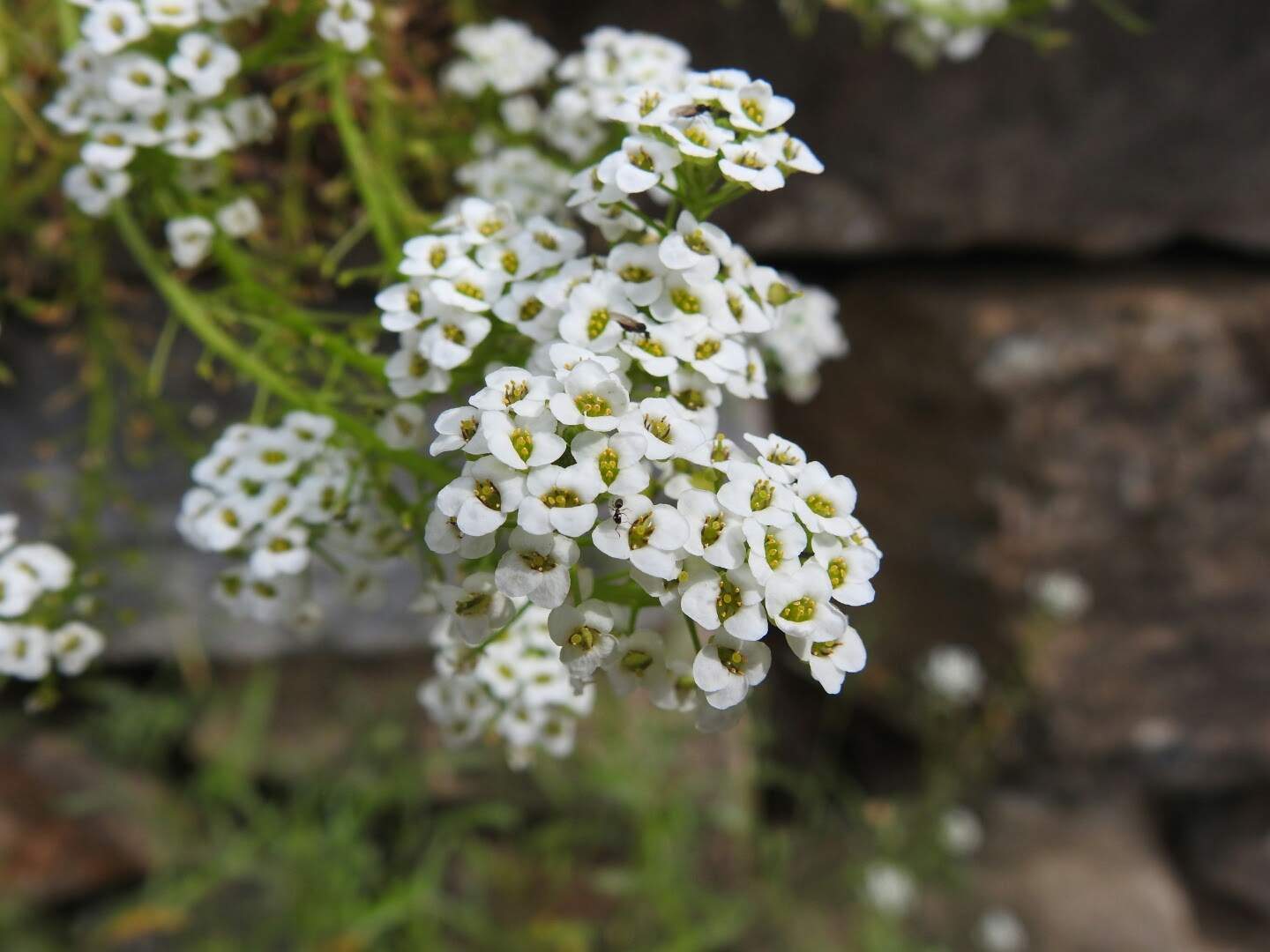
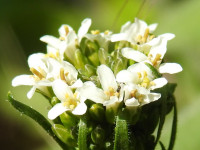
The hermaphroditic flowers are gathered in elongated and sparsely leafy racemes at the apex of the flowering branches. They have four white petals, sometimes streaked with pink or with whitish-yellowish tones, suborbicular in shape and about 2-3 mm in size. The sepals are small, about 1-1.8 mm long, green or sometimes tending to purple, oblong-lanceolate. The stamens are six, four long and two shorter, with yellow anthers. The pistil is thin and barely visible inside the flower. The flowers emit a pleasant honey-like fragrance.
The fruit is a siliquette (silique) elliptical or spherical in shape, 2.3-4 mm wide, with a convex valve and a persistent silvery septum that remains attached even after maturation. It contains a single seed per locule, lenticular, ovate or suborbicular, light red or reddish-brown in color, about 1.2-1.5 mm long, with a very thin marginal wing (about 0.1 mm). The fruit peduncles are patent, 4-7 mm long.
The root system is robust, with underground roots that sometimes extend deeply, contributing to anchoring the plant in sandy and rocky environments.
Habitat and distribution
A typical species of Mediterranean coastal areas, it is mainly present along the western Italian coasts, from Liguria to Calabria, including some Ionian and Adriatic areas up to Gargano, as well as in the major islands. It grows in marine environments, particularly on sandy soils, dunes, beaches, rubble, walls, and rocky grounds, up to an altitude of about 300 meters above sea level.
The preferred habitat consists of well-drained soils, often poor and sandy, with sunny exposure and conditions of high salinity and sea wind. It is not uncommon to find it also in anthropized environments, such as old walls and cultivated areas, where it can behave as a weed. The species is widely cultivated in gardens for its ornamental appearance and fragrance, and tends to naturalize, sometimes making it difficult to distinguish the original natural range.
Flowering period
The flowering is particularly prolonged, extending practically throughout the year (from January to December), with more intense peaks in the spring and summer months. The ability to flower almost continuously contributes to its popularity as an ornamental plant and its ability to naturalize in various coastal habitats.
Ecology and pollination
Sweet Alison produces hermaphroditic and fragrant flowers, a characteristic that favors the attraction of pollinating insects, particularly bees and other hymenopterans, attracted by nectar and the sweet honey-like scent. The open shape and arrangement in racemes facilitate visits by pollinating insects.
Seed dispersal occurs mainly through light and small siliquettes, with single seeds per locule equipped with a thin wing, which can favor limited anemochory (wind dispersal). Moreover, the presence in sandy and marine environments suggests possible secondary dispersal via water or anthropic agents.
Curiosities and traditional uses
The species is appreciated not only for its ornamental value but also for some medicinal and food properties. Traditionally, it has been used as a medicinal plant for astringent, diuretic, and antiscorbutic purposes, especially in some regions of Spain, where it is still employed in popular phytotherapy.
The young leaves and flowers are sometimes consumed in cooking as a seasoning for salads and other preparations, thanks to the slightly pungent flavor reminiscent of other Brassicaceae. These alimurgic uses are to be considered traditional and do not replace professional medical advice.
The common name "Sweet Alison" recalls the delicacy and lightness of the white flowers, which in some environments resemble thin silver threads, while the reference "marittima" clearly indicates its typical habitat along the coasts.
Etymology
The generic name Lobularia derives from the Latin globulus, meaning “small sphere,” referring to the characteristic shape of the siliquettes, small rounded capsules containing the seeds. The specific epithet maritima indicates its prevalent presence in maritime and coastal environments.
The Italian common name “filigrana marittima” alludes to the fineness and delicacy of the small white flowers, similar to filigree embroidery, and to its natural habitat on the coasts.
Sources
- Prof. S. Pignatti, "Flora d'Italia"
- Acta Plantarum - Flora delle regioni italiane (scheda di Giuliano Salvai)
- Tela Botanica / H. Coste, "Flore descriptive et illustrée de la France"
- World Flora Online (WFO)
Characteristics
Scheda botanica
| Famiglia | Brassicaceae |
|---|---|
| Fioritura | tutto l'anno |
| Forma biologica | Scapose |
| Habitat | with white flowers, Perennial plant |
Domande frequenti
- Quando fiorisce Sweet Alison?
- Sweet Alison fiorisce tutto l'anno.
- Che tipo di pianta è Sweet Alison?
- Sweet Alison è una Hemicryptophytes (Scapose) secondo la classificazione di Raunkiaer.
- A quale famiglia appartiene Sweet Alison?
- Sweet Alison appartiene alla famiglia botanica Brassicaceae.
Where I found it (2 sightings)
Classification
- Kingdom
- Plantae
- Family
- Brassicaceae
- Full name
- Lobularia maritima (L.) Desv.
- Synonyms
- Clypeola maritima L.; Hormathophylla halimifolia (L.) P.Küpfer
- Life form
- Hemicryptophytes scapose
Similar species
Search for species with similar characteristicsFurther reading
Noticed an error in the identification? Write to me
Other species of the same family
Brassicaceae
Explore
Other species of Brassicaceae