Botanical species
Pseudoturritis turrita
(L.) Al-Shehbaz
Tower Cress
Description
Morphological description
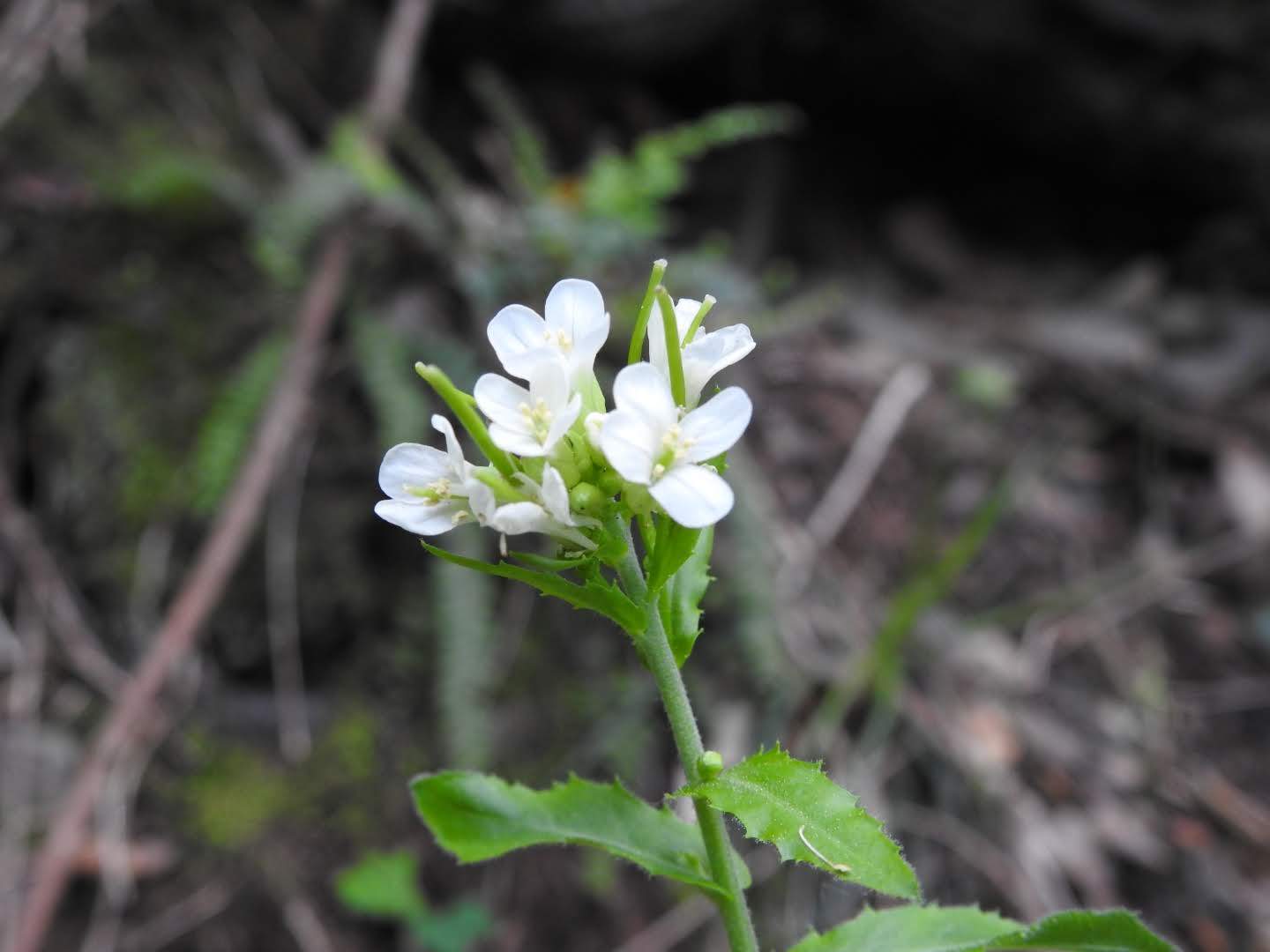
Biennial or sometimes perennial plant, Tower Cress has an erect habit and a variable height between 10 and 90 cm. The stem is robust, simple or branched in the upper part, covered by a dense hirsute and tomentose pubescence that often gives it a reddish coloration. This velvety indumentum is due to a fine tomentum of hairs that also covers the leaves.
The basal leaves are arranged in a rosette, ovate in shape and tapered at the base into a long petiole; the margins are irregularly and weakly dentate. The cauline leaves are alternate, lanceolate, with a cordate base that embraces the stem through two lateral auricles. The leaves are also velvety due to the presence of a thin layer of hairs.
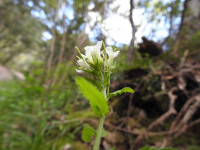
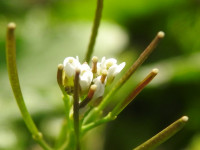
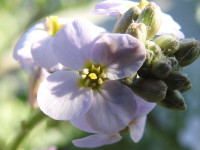
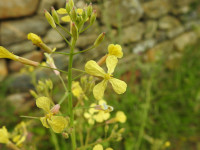
The inflorescence consists of numerous white or pale yellow flowers, gathered in racemes that retain leaves along the axis. The flowers are characteristic of Brassicaceae, presenting four linear-cuneate petals between 6 and 10 mm long and four small sepals, as long as the pedicel. This species is distinguished by the presence of leafy inflorescences, a key element to avoid confusion with related species such as Arabis alpina or Arabis hirsuta.
The fruits are unilateral siliques, elongated and curved at maturity, which can reach up to 15 cm in length. These fruits lack a median nerve and can be glabrous or sparsely hairy. They contain winged seeds, whose dissemination mainly occurs through the wind, thus facilitating the species' dispersal.
The root system is rhizomatous, contributing to the plant's ability to persist as a biennial hemicryptophyte or as a perennial.
Habitat and distribution
Tower Cress is mainly widespread in southern Europe and Italy, where it grows in woodland environments, clearings, rocky slopes, and shady places. It prefers calcareous substrates and is commonly found from the plains up to about 1600 meters of altitude. It is frequent at the edges of roads and in disturbed areas, always in positions with exposure ranging from shaded to semi-sunny.
This species adapts well to well-drained soils rich in calcium carbonate, typical of Mediterranean and sub-Mediterranean ecosystems, where it contributes to the biodiversity of herbaceous and shrubby flora.
Flowering period
Flowering mainly occurs between February and July, with some variability linked to altitude and latitude. In milder climates and at low altitudes, flowering can begin as early as late winter, while in cooler or mountainous areas it tends to shift later into late spring.
Ecology and pollination
Like many Brassicaceae, Tower Cress relies on insect pollinators for sexual reproduction. The flowers, with their white or pale yellow petals, mainly attract bees, bumblebees, and other hymenopterans that facilitate cross-pollination. The presence of numerous flowers in leafy racemes increases pollination efficiency.
Seed dispersal occurs through the wind, favored by the presence of winged seeds inside the siliques. This anemochorous dispersal mechanism allows the species to colonize suitable new habitats, maintaining a good capacity for territorial expansion.
Curiosities and traditional uses
There are no specific documented uses for food, medicinal, or folkloric purposes for this species. However, like many Brassicaceae, it may have had a marginal role in local herbal traditions, especially for plants with similar characteristics. Its presence in woods and road margins makes it an important component of spontaneous ecosystems, contributing to soil stability and biodiversity.
Etymology
The scientific name derives from two Greek terms: "pseudo-" means false or deceptive, while "turritis" refers to the genus Turritis, indicating a similarity but also a distinction from this plant. The specific name "turrita" refers to the vertical and slender habit of the plant, similar to a tower.
The Italian common name, Arabetta maggiore, derives from the ancient genus Arabis to which the species was historically associated, with the addition of "maggiore" to distinguish it from other related species of smaller size or different characteristics.
Sources
- Acta Plantarum - Flora delle regioni italiane (scheda di Giuliano Salvai)
Characteristics
Scheda botanica
| Famiglia | Brassicaceae |
|---|---|
| Fioritura | febbraio – luglio |
| Forma biologica | Biennials |
| Habitat | with white flowers, Perennial plant, biennial plant |
Domande frequenti
- Quando fiorisce Tower Cress?
- Tower Cress fiorisce febbraio – luglio.
- Che tipo di pianta è Tower Cress?
- Tower Cress è una Hemicryptophytes (Biennials) secondo la classificazione di Raunkiaer.
- A quale famiglia appartiene Tower Cress?
- Tower Cress appartiene alla famiglia botanica Brassicaceae.
Where I found it (7 sightings)
Classification
- Kingdom
- Plantae
- Family
- Brassicaceae
- Full name
- Pseudoturritis turrita (L.) Al-Shehbaz
- Synonyms
- Arabis turrita L.
- Life form
- Hemicryptophytes biennials
Similar species
Search for species with similar characteristicsNoticed an error in the identification? Write to me
Other species of the same family
Brassicaceae
Explore
Other species of Brassicaceae