Botanical species
Mutarda nigra
(L.) Bernh.
Black mustard
Description
Morphological description
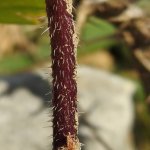
Annual herbaceous plant belonging to the Brassicaceae family, with an erect habit and height varying between 30 and 150 cm. The stem is grooved, angular and hollow, covered with a rough and wrinkled pubescence, a characteristic that gives the plant a rough feel to the touch. The stem section is markedly angular.
The leaves are all petiolate and also rough. The lower ones are lyrate-pinnatisect, with one or more lateral segments (from 1 to 3 pairs) and a much larger terminal segment, with an irregularly toothed margin. The upper leaves, on the other hand, are generally entire or with a slightly dentate margin, lanceolate and elongated in shape.
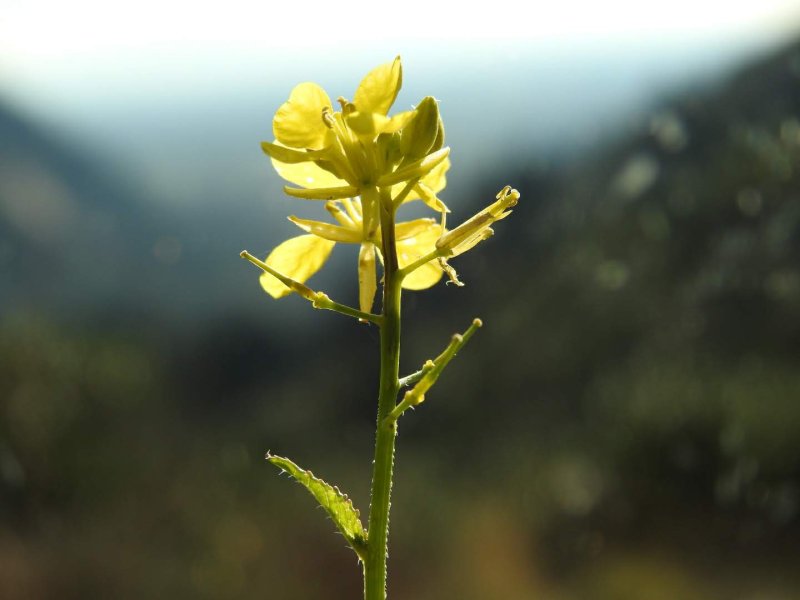
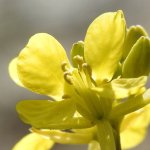
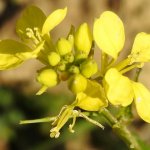
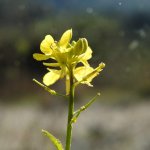
The flowers are gathered in elongated terminal racemes with many flowers. Each flower has a corolla about 1 cm in diameter, composed of four entire yellow petals, arranged in a cross, typical of Brassicaceae. The sepals, erect and spreading, are glabrous and light green in color. There are six stamens, of which two are shorter, with free filaments and bilocular anthers of oblong shape.
The fruit is a siliqua of elongated shape with a quadrangular section, glabrous, erect and sessile, with keeled valves tapered into a short beak. The fruiting pedicels are appressed to the fruit axis. Each locule contains from 3 to 5 globose seeds of brown-black color.
The root system is not described in specific sources, but as with many Brassicaceae, a fibrous root system is assumed.
Habitat and distribution
Black mustard is widespread in almost all Italian regions, although not always common. It prefers ruderal environments such as road edges, paths, riverbanks, and cultivated or uncultivated fields. It grows from the plains up to about 1000 meters of altitude.
It is a eurymediterranean species, with a range centered on the coasts of the Mediterranean basin and extensions towards the north and east. Although cultivated, it easily naturalizes in anthropized environments. It prefers well-drained and generally rich soils, with direct sunlight exposure, typical of ruderal and open areas.
Flowering period
Flowering occurs from February to May, with possible geographical variations linked to the local climate. In milder climates and lower positions, it tends to flower early, while in the mountains flowering may be later.
Ecology and pollination
The plant is nectariferous and attracts various pollinating insects, including bees and other hymenopterans, which pollinate it favoring fertilization. The production of numerous yellow flowers, together with the characteristic spicy odor and taste, facilitates the attraction of pollinating insects.
Seed dispersal occurs through the natural fall of mature siliquae, which release globose and heavy seeds. No specific long-distance dispersal strategies are known; presumably, the seeds settle in the immediate vicinity of the mother plant, favoring the colonization of surrounding ruderal habitats.
Curiosities and traditional uses
Black mustard is a medicinal and food plant with a long tradition. Its seeds, dark at maturity, contain glucosides such as sinigrin and the enzyme myrosinase, responsible for the characteristic spicy flavor and penetrating odor. These compounds activate chemical reactions with water that produce volatile irritating but aromatic substances, used for the preparation of mustard, a condiment known since antiquity.
The young leaves and flowers are sometimes used to flavor salads and soups, giving a spicy taste. Whole seeds are used in spicy dishes such as curry, while ground seeds form the base of mustard sauce.
In popular medicine, black mustard is used for its revulsive and stimulating properties: poultices and baths based on seeds or essential oil are used to relieve muscle pain, rheumatism, chilblains, and respiratory infections. However, it is a remedy to be handled with caution, as the plant can irritate skin and mucous membranes, being vesicant in high doses.
Traditionally, in Eastern Europe, the seeds combined with honey are used against cough, while a footbath with mustard seeds is a home remedy against smelly feet and colds. The oil extracted from the seeds is used in soaps, lighting, and as a lubricant.
The plant is also appreciated for honey production, being a source of nectar for pollinating insects.
Etymology
The genus name “Mutarda” derives from the Old French “moutarde”, itself from the Latin “mustum” (must) and “ardeo” (to burn), alluding to the use of spicy seeds combined with must or vinegar for the preparation of mustard. The specific epithet “nigra” refers to the dark color of the mature seeds.
The Italian common name “senape nera” highlights the dark coloration of the seeds, distinguishing it from other mustard species with lighter seeds.
Sources
- Acta Plantarum - Flora delle regioni italiane (actaplantarum.org)
- Acta Plantarum - Flora delle regioni italiane (scheda di Marinella Zepigi)
Characteristics
Scheda botanica
| Famiglia | Brassicaceae |
|---|---|
| Fioritura | gennaio – maggio |
| Forma biologica | Scapose |
| Habitat | with yellow flowers, annual plant |
| Uso officinale | Pianta officinale |
Domande frequenti
- Quando fiorisce Black mustard?
- Black mustard fiorisce gennaio – maggio.
- Che tipo di pianta è Black mustard?
- Black mustard è una Therophytes (Scapose) secondo la classificazione di Raunkiaer.
- A quale famiglia appartiene Black mustard?
- Black mustard appartiene alla famiglia botanica Brassicaceae.
Where I found it (14 sightings)
Classification
- Kingdom
- Plantae
- Family
- Brassicaceae
- Full name
- Mutarda nigra (L.) Bernh.
- Synonyms
- Brassica nigra (L.) W.D.J.Koch; Sinapis nigra L.; Rhamphospermum nigrum (L.) Al-Shehbaz
- Life form
- Therophytes scapose
Similar species
Search for species with similar characteristicsFurther reading
Noticed an error in the identification? Write to me
Other species of the same family
Brassicaceae
Explore
Other species of Brassicaceae