Botanical species
Ophrys bombyliflora
Link
Ofride fior di bombo
Description
Morphological description
Perennial herbaceous plant belonging to the family Orchidaceae, it has an erect habit and reaches a height between 5 and 25 cm. The root system consists of deep tubers, typical of bulbous geophytes, which serve as a perennial organ and allow the plant to survive adverse conditions.
The leaves, herbaceous in texture, are gathered in a basal rosette pressed to the ground. They have a lanceolate shape, with sizes ranging from 3 up to about 10 cm in length and 1.5-3 cm in width. The upper surface is glaucous green, while the lower one is shinier; the leaves are crossed by well-evident longitudinal veins and end with a mucronulate apex. In addition to the basal rosette, there is generally a cauline leaf, sheathing the floral scape at the base, of yellowish-green color.
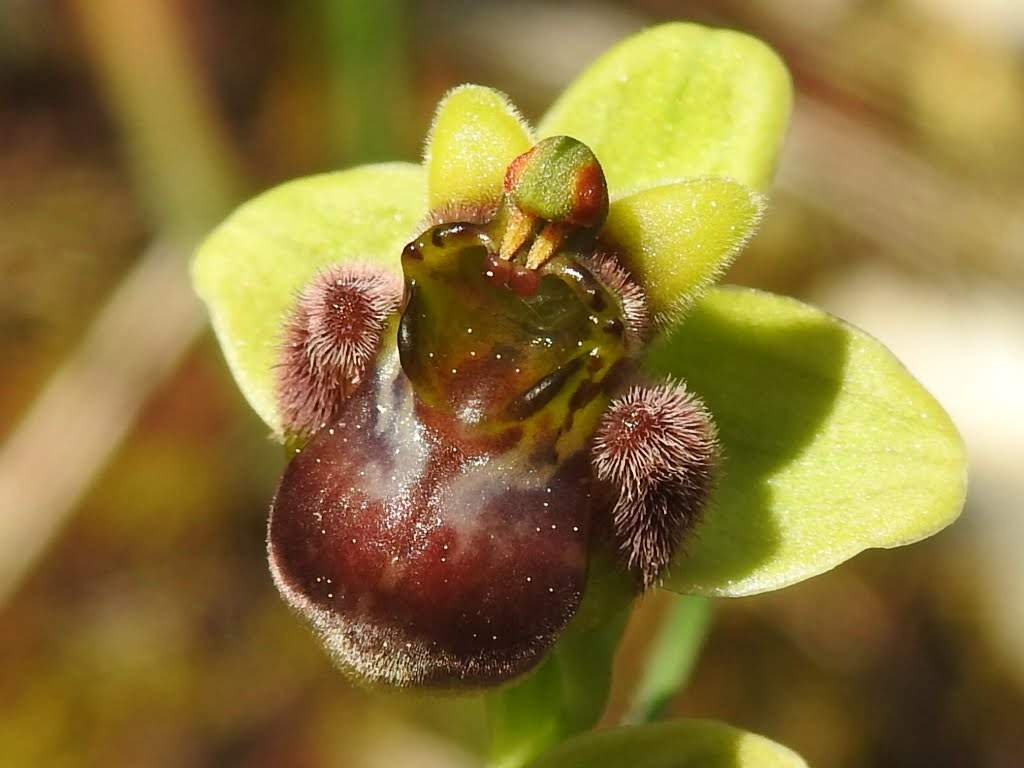
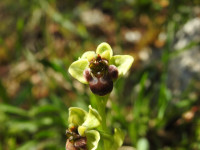
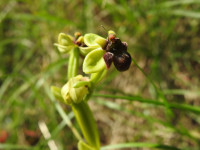
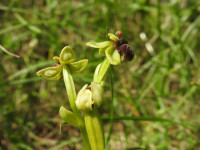
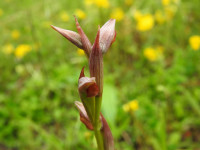
The stem is erect and bears from 2 to 6 close flowers, which are the smallest in the genus Ophrys present in Italy. The inflorescence is lax and composed of small-sized flowers. The bracts accompanying the flowers are ovate-lanceolate, concave, light green in color and shorter than the ovary.
The outer sepals are light green with dark green longitudinal stripes, concave and glabrous, with margins slightly turned inward and rounded apex. They are arranged so that the two lateral ones are approximately at 90° to the central one, which is ovate-oblong, curved backward and placed above the gynostemium. Sepal sizes vary between 7-12 mm in length and 5-8 mm in width.
The petals, two in number, are short, triangular with rounded apex and green-brown at the base, while the terminal part is greenish and slightly pubescent. The dimensions are small, generally between 3 and 4.5 mm in length.
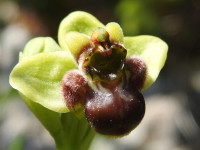
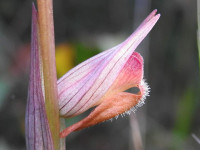
The labellum is the most characteristic part and measures from 6 to 10 mm in length and 5.5-12 mm in width. It is trilobed, with the median lobe strongly convex and velvety, of an intense brown color. This central lobe has incurved margins and a central glabrous and papillose macula, varying from green-grayish to gray-violet, often surrounded by a thin whitish line. The basal surface is flat and furrowed by darker ridges, which extend both inside and outside the labellum. The lateral lobes are covered by long pubescence and present swellings ending in sharp points directed downward; the central lobe is largely glabrous and strongly revolute, with an appendage directed downward and lateral parts not visible from above.
Habitat and distribution
The species is widespread in the western Mediterranean basin, with a distribution ranging from Liguria in Italy to Spain and Algeria. In the Italian territory it is mainly found in mountainous and hilly environments, up to about 1000 meters of altitude.
It prefers open habitats such as meadows, garrigues and forest clearings, adapting to predominantly calcareous, dry and well-drained soils, but can also grow on acidic and moist soils. The preferred exposure is sunny or semi-shaded, in places characterized by sparse vegetation allowing good illumination.
Flowering period
Flowering generally occurs between March and May, with possible variations related to altitude and latitude. In more temperate climates and lower areas the flowering period tends to be earlier, while in mountainous or more northern areas it can extend until May.
Ecology and pollination
The bee orchid reproduces both sexually, through entomophilous pollination, and vegetatively from tubers. The main pollinating insects belong to the genus Eucera, particularly the species Eucera orianensis and Eucera nigrescens subp. continensis. These hymenopterans are attracted by the particular morphology and coloration of the labellum, which mimics the appearance and hairiness of a bumblebee, exploiting a sexual mimicry strategy to promote pollination.
Seed dispersal occurs by wind, as in many other orchids, given the production of very small and light seeds.
Curiosities and traditional uses
This species often occurs in dense populations, also thanks to its ability to reproduce vegetatively through tubers. The family Orchidaceae, to which it belongs, is subject to absolute protection throughout the Italian national territory, therefore collection or damage to plants in nature is prohibited.
No specific traditional medicinal or food uses are documented for this species, nor particular references in local folklore. However, the genus Ophrys has been known since ancient times and has fascinated for its particular mimicry ability and its singular beauty.
Etymology
The generic name "Ophrys" derives from Greek and means "eyebrow". This term was used by Pliny the Elder to indicate a plant from which a dye for eyebrows was obtained, but it could also refer to the shape of the internal lobes of the perigonium, similar to an arched eyebrow.
The specific epithet "bombyliflora" derives from the Latin "bombyx", which indicates a genus of nocturnal butterflies (Lesiocampa), and "flos" meaning "flower". This denomination refers to the swollen and hairy shape of the labellum, which resembles the appearance of a bumblebee.
The Italian common name "Ofride fior di bombo" precisely recalls this morphological characteristic that distinguishes the species within the genus.
Sources
- Prof. S. Pignatti, "Flora d'Italia"
- Acta Plantarum - Flora delle regioni italiane (sheet by Marinella Zepigi)
Characteristics
Where I found it
The sighting locations of this species are not public for conservation reasons.
Classification
- Kingdom
- Plantae
- Family
- Orchidaceae
- Full name
- Ophrys bombyliflora Link
- Life form
- Geofite bulbose
Similar species
Search for species with similar characteristicsFurther reading
Noticed an error in the identification? Write to me
Other species of the same family
Orchidaceae
Explore
Other species of Orchidaceae