Botanical species
Verbascum thapsus
L.
Common Mullein
Description
Morphological description
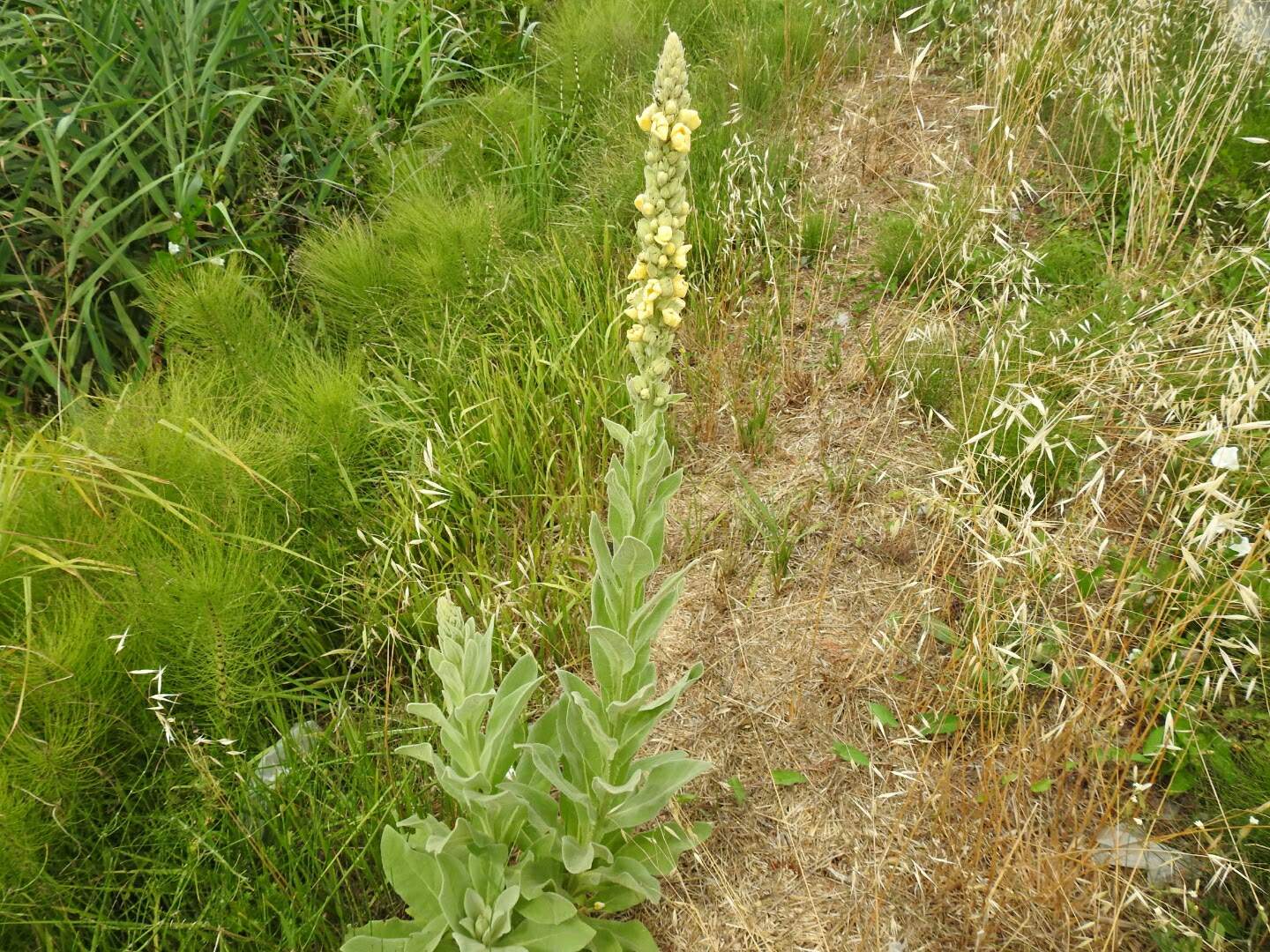
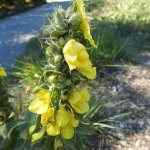
Biennial herbaceous plant, the Common Mullein has an erect and robust habit with a height ranging from 50 to 200 cm. The stem is cylindrical, simple or sometimes slightly branched, and is characterized by a dense white-yellowish woolliness that gives it a velvety and tomentose appearance. The stem often appears winged, as the cauline leaves are long-decurrent, forming wings 2-3 cm wide along the internode.
The root system consists of a fusiform and cylindrical root, which in the first year of life produces a basal rosette of large leaves.
The basal leaves are large, up to 45 cm long, obovate or ovate-lanceolate in shape, with finely serrated or crenulate margins. They are very tomentose, soft to the touch, sessile or almost so, and persist during the winter. The cauline leaves are progressively smaller, oblong-lanceolate, acute at the apex and long-decurrent on the stem, giving the entire plant a winged and dense appearance.
The inflorescence appears as a long cylindrical spike, simple and compact, which can measure from 20 to 50 cm in length and about 3 cm in width. The flowers, grouped in clusters of 6-7 elements in the axil of woolly and lanceolate-acuminate bracts, are subsessile, with a calyx 7-12 mm long, white-woolly and divided into five lanceolate lobes. The corolla is pale yellow or milky yellow, gamopetalous with a short tube and a wide funnel-shaped opening, varying in size between 15 and 25 mm in diameter. The outer surface of the corolla is pubescent.
The stamens are dimorphic: the three upper ones are short, with densely white-yellowish woolly filaments, while the two lower ones are longer, glabrous or almost so, and bear yellow anthers about 1 mm long. The stigma is capitate.
The flowers last only one day, but are constantly replaced by new flowers along the inflorescence over a long flowering period.
The fruit is an oval, tomentose capsule, 7-10 mm long, with a short beak and an erect apiculus about 0.5 mm long. It contains numerous small, wrinkled, brown, obconic-prismatic seeds, equipped with longitudinal rows of alveoli. The seeds are toxic and contain saponins, coumarin, and rotenone.
Habitat and distribution
The Common Mullein is a species native to Europe and the Caucasus, widespread throughout the Italian peninsula and the Mediterranean basin, extending to temperate areas of North America where it has been introduced. It commonly grows in ruderal environments, along roadsides, in uncultivated, rocky, and dry soils, demonstrating remarkable tolerance to harsh environmental conditions.
It is generally found from the plains up to 1700 m altitude, with sporadic reports up to 2200 m. It prefers sunny exposures and well-drained soils, often poor in nutrients, where competition with other herbaceous species is reduced.
Flowering period
Flowering extends from May to November, peaking in the summer season. The long duration of the flowering period is favored by the continuous replacement of flowers, each lasting only one day, allowing the plant to maintain a flowering appearance for several months.
Ecology and pollination
The Common Mullein is a thermophilic and xerophilous plant, adapted to temperate climates and sunny environments, with a preference for stony places and dry soils. The reproductive strategy is based on hermaphroditic flowers with a long overall duration, although each flower lives only one day.
Pollination is mainly entomogamous, favored by pollinating insects attracted by the bright yellow color and the presence of nectar. The erect habit and compact structure of the inflorescence facilitate visits by pollinating insects.
Seed dispersal occurs mainly by falling near the mother plant, but their small size and lightness can favor some secondary dispersal by wind or animals.
Curiosities and traditional uses
The Common Mullein has a long history of ethnobotanical and medicinal uses. Its leaves and flowers are rich in active principles such as mucilages, saponins, verbascoside, sugars, essential oils, and phytosterols. These compounds confer expectorant, decongestant, antiseptic, diuretic, and analgesic properties to the plant.
Traditionally, the plant has been used to treat respiratory tract ailments such as cough, bronchitis, laryngitis, and whooping cough, thanks to its ability to fluidify mucous secretions and reduce inflammation. The leaves were used in the form of decoctions or poultices for the treatment of wounds, sores, burns, boils, hemorrhoids, and chilblains. The flowers, moreover, have been used to lighten hair and as a yellow or green dye.
Historically, in ancient Rome, the sturdy stems were used as torches (hence the name “candela regia”), due to their ability to burn for a long time after being dipped in tallow. The dried leaves were used as wicks and insulators in footwear.
The seeds are toxic and contain substances also used as fish poison in traditional fishing.
Etymology
The generic name Verbascum derives from the Latin “barbascum”, probably referring to the hairy filaments of the stamens that resemble a beard. The specific name thapsus refers to the ancient locality of Thapsos, in eastern Sicily, a well-known archaeological site.
The Italian common name “Common Mullein” recalls the woolly and “bearded” appearance of the stamens and the plant in general. The term “candela regia”, used in the past, derives from the traditional use of the stems as torches during ceremonies and funerals in ancient Rome.
Sources
- Prof. S. Pignatti, "Flora d'Italia"
- Acta Plantarum - Flora delle regioni italiane (scheda di Marinella Zepigi)
- Tela Botanica / H. Coste, "Flore descriptive et illustrée de la France"
- World Flora Online (WFO)
Characteristics
Scheda botanica
| Famiglia | Scrophulariaceae |
|---|---|
| Fioritura | maggio – dicembre |
| Forma biologica | Biennials |
| Habitat | with yellow flowers |
| Tossicità | Tossica — non consumare |
| Uso officinale | Pianta officinale |
Domande frequenti
- Quando fiorisce Common Mullein?
- Common Mullein fiorisce maggio – dicembre.
- È tossica Common Mullein?
- Common Mullein è una pianta tossica o velenosa. Non consumare nessuna sua parte senza aver consultato un esperto.
- Che tipo di pianta è Common Mullein?
- Common Mullein è una Hemicryptophytes (Biennials) secondo la classificazione di Raunkiaer.
- A quale famiglia appartiene Common Mullein?
- Common Mullein appartiene alla famiglia botanica Scrophulariaceae.
Where I found it (13 sightings)
Classification
- Kingdom
- Plantae
- Family
- Scrophulariaceae
- Full name
- Verbascum thapsus L.
- Life form
- Hemicryptophytes biennials
Similar species
Search for species with similar characteristicsFurther reading
Noticed an error in the identification? Write to me
Other species of the same family
Scrophulariaceae
Explore
Other species of Scrophulariaceae