Botanical species
Scrophularia canina
L.
French Figwort
Description
Morphological description
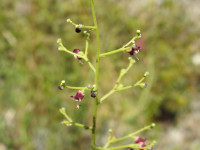
Perennial herbaceous plant, generally 20 to 125 cm tall, characterized by an unpleasant odor similar to that of a stink bug. The stem is erect, glabrous except in the inflorescences where it has sessile glands, glaucous in color and markedly angular with a slightly pronounced quadrangular section. The plant is branched from the base, with a scapose habit, meaning with an elongated floral axis often leafless.
The basal leaves are petiolate, with a petiole about 2.5-4 cm long, with a triangular or subtriangular lamina outline, varying in size between 3-5 cm in width and 5-10 cm in length. These leaves are pinnately parted or pinnatifid, divided into 7-9 main segments which are further divided into secondary toothed or incised segments, with a trilobed or toothed margin and 2-3 mm wide. The upper leaves tend to be simpler, often undivided or trilobed, with toothed margins. The texture is herbaceous and the plant is evergreen.
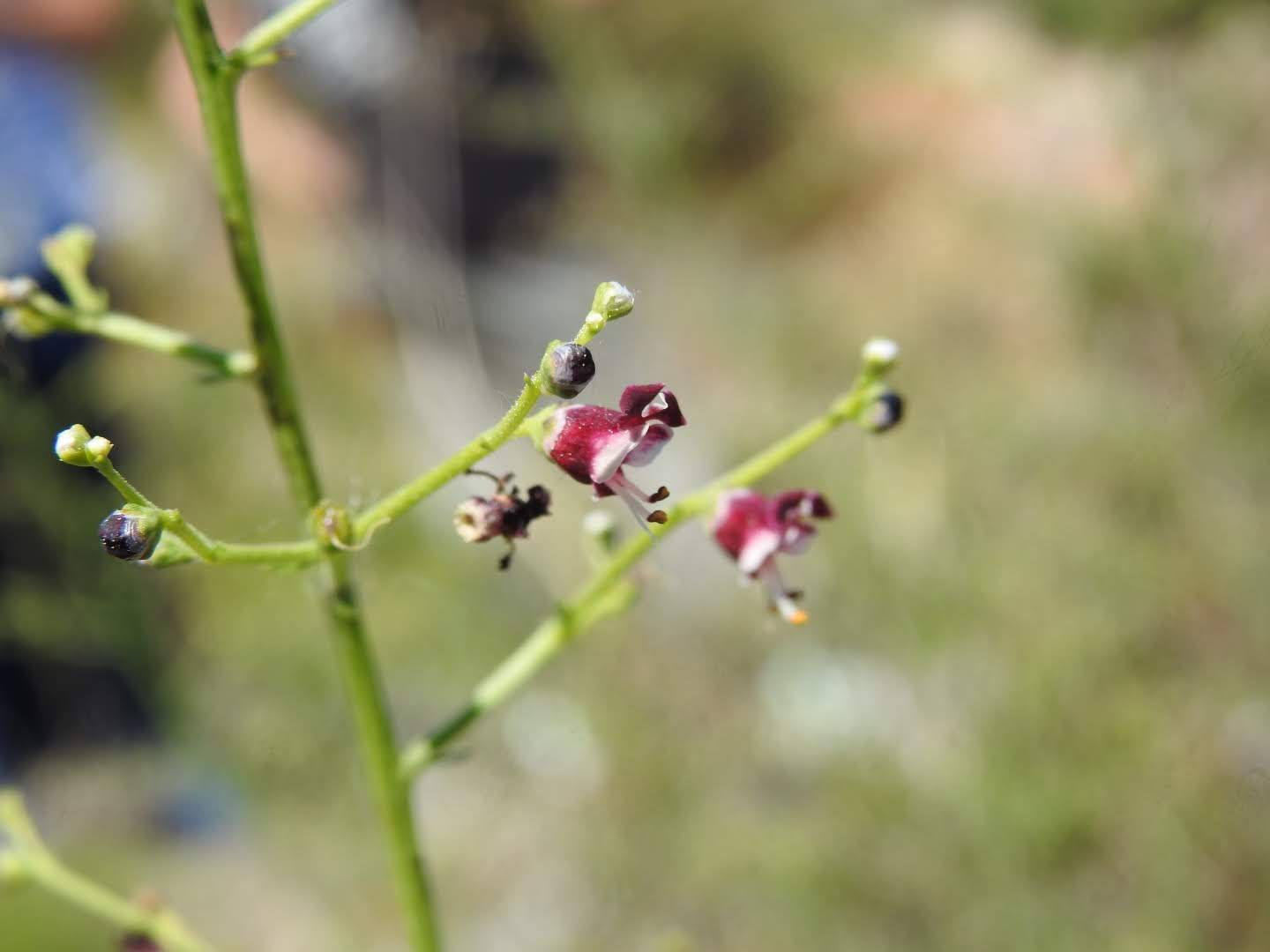
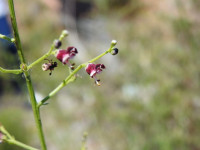
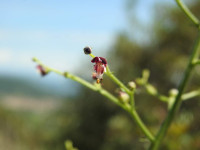
The inflorescence appears as a terminal panicle of variable size (5-82 cm), consisting of cymes composed of 3-25 subsessile flowers located in the axils of reduced leaves. The flowers have a small calyx (1-3 mm), with 5 oval or suborbicular lobes with a white membranous edge, entire or slightly toothed. The corolla is brown-reddish or amaranth with whitish margins and measures about 5-6 mm in length; the upper lip is bilobed and about one third the length of the corolla tube, while the lower lip is short and reflexed. The fertile stamens are four, with violet anthers, and one linear staminode (0.4-1 mm), whitish or purplish. The ovary is superior.
The fruit is a bilocular, septicidal capsule, ovoid, suborbicular or subconical in shape, 3-6 mm long and 2-5 mm wide, apiculate. The seeds are brown-blackish, sized 0.9-1.5 x 0.5-1 mm, with transverse alveoli on the surface.
Habitat and distribution
The species is widespread throughout the Italian territory and much of the Euro-Mediterranean area, with a range centered on the Mediterranean coasts but also extending northwards and eastwards, including some mountainous regions. It prefers dry and nutrient-poor environments, typical of gravel, scree, uncultivated soils, road margins, and flood zones, from sea level up to about 1500 meters altitude.
The plant grows on gravelly or rocky soils, preferably in sunny exposure and rather arid ecological conditions. It is frequently found in hilly and mountainous environments, even on substrates poor in organic matter.
Flowering period
Flowering extends from March to September, with possible geographic variations related to altitude and latitude. In warmer Mediterranean areas, flowering may begin as early as March, while in cooler or mountainous zones flowers are more commonly observed between May and August.
Ecology and pollination
The plant has a reproductive strategy suited to arid environments, with hermaphroditic flowers and a structure adapted to entomophilous pollination. The flowers, with brown-reddish colors bordered by white, attract pollinating insects that promote cross-fertilization. The violet anthers and the presence of the staminode suggest a specialized pollination mechanism.
Seed dispersal occurs through the capsule which opens at maturity to release small brown-blackish seeds, presumably dispersed mainly by abiotic agents such as wind or water, or secondarily by animals. The plant is a scapose hemicryptophyte, i.e., perennial with buds at ground level, capable of regenerating each year even under environmental stress conditions.
Curiosities and traditional uses
The species name recalls its ancient medicinal properties, particularly its traditional use against dog scabies, from which the Italian common name "French Figwort" derives. The unpleasant odor of the plant is instead a characteristic that signals its presence and may act as a deterrent to herbivores.
The plant is known for its medicinal properties, although it is considered toxic if used improperly. The parts used are the rhizome and flowering tops, containing saponins, glucosides, organic acids such as malic, butyric, and palmitic acids, as well as vitamins C and D. These compounds confer to the plant healing, choleretic, purifying, and hypoglycemic properties, similar to those of other species in the genus Scrophularia, particularly S. nodosa.
Despite these properties, pharmaceutical and food uses should be considered with caution and under medical supervision, as the plant is potentially toxic. No significant traditional edible uses are known.
Etymology
The genus name derives from the Latin "scrophulae," a term used to indicate a disease of the skin and mucous membranes (scrofula), which in the past was treated with plants of this family. The specific epithet "canina" refers to the traditional use of the plant against dog scabies, highlighting its historical medicinal value.
The Italian common name "French Figwort" directly refers to this traditional therapeutic association and the family to which it belongs.
Sources
- Prof. S. Pignatti, "Flora d'Italia"
- Acta Plantarum - Flora delle regioni italiane (scheda di Marinella Zepigi)
- World Flora Online (WFO)
Characteristics
Scheda botanica
| Famiglia | Scrophulariaceae |
|---|---|
| Fioritura | marzo – settembre |
| Forma biologica | Scapose |
| Habitat | with amaranth flowers, Perennial plant, plant with a scapose habit |
Domande frequenti
- Quando fiorisce French Figwort?
- French Figwort fiorisce marzo – settembre.
- Che tipo di pianta è French Figwort?
- French Figwort è una Hemicryptophytes (Scapose) secondo la classificazione di Raunkiaer.
- A quale famiglia appartiene French Figwort?
- French Figwort appartiene alla famiglia botanica Scrophulariaceae.
Where I found it (9 sightings)
Classification
- Kingdom
- Plantae
- Family
- Scrophulariaceae
- Full name
- Scrophularia canina L.
- Synonyms
- Scrophularia bicolor Sm.; Scrophularia canina L. subsp. bicolor (Sm.) Greuter
- Life form
- Hemicryptophytes scapose
Similar species
Search for species with similar characteristicsFurther reading
Noticed an error in the identification? Write to me
Other species of the same family
Scrophulariaceae
Explore
Other species of Scrophulariaceae