Botanical species
Verbascum phoeniceum
L.
Purple Mullein
Description
Morphological description
Perennial herbaceous plant belonging to the family Scrophulariaceae, with a scapose habit, reaching a height between 30 and 100 cm. The stem is generally erect, simple or sometimes branched in the upper part, characterized by a striated surface. The lower part is covered with a dense white woolly pubescence, while the upper part has violet-colored glandular hairs.
The leaves are mainly basal, arranged in a rosette, sessile or with a short petiole up to 3 cm long. The leaf blade is ovate-lanceolate or elliptical, with variable dimensions generally between 3-5 cm in width and 6-10 cm in length, but can also reach 11 cm in width and 16 cm in length. The leaf surface can be glabrous or pubescent, dark green on the upper side, with a wavy and slightly crenate or entire margin. The cauline leaves are few, smaller (about 5x2 cm), sessile and reduced.
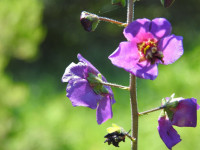
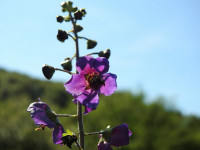
The inflorescence consists of simple, sparse, scapose racemes, with solitary flowers borne in the axil of lanceolate or linear bracts measuring 1x4-5 mm. The floral peduncles are 11 to 15 mm long, up to 22 mm in fruit. The calyx is 4-6 mm long, with ovate or elliptical lobes covered with glandular hairs.
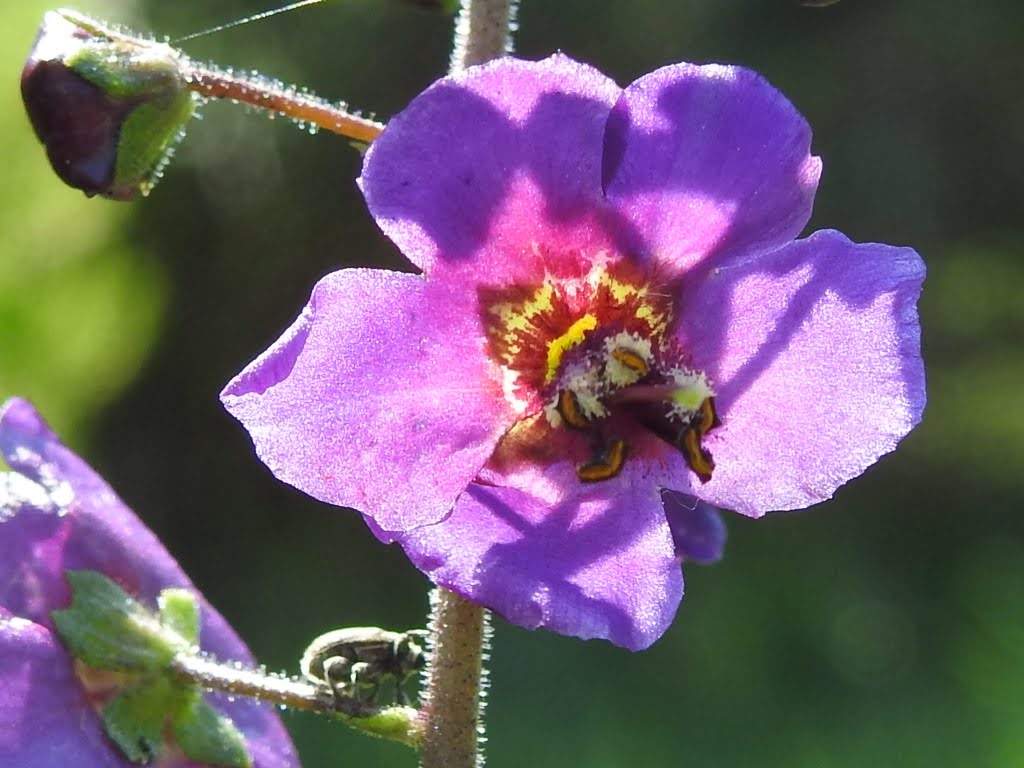
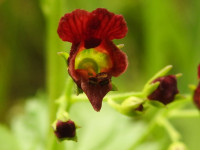
The flowers are hermaphroditic, actinomorphic and gamopetalous, with a corolla of purple color, whose diameter varies from 20 to 30 mm (up to 3.5 cm). The corolla is pentamerous, with a very short tube and patent lobes. The stamens are 5, all with reniform anthers not extending beyond; the filaments are covered with violet-reddish tomentum at the base and whitish at the apex. The style is clavate, 5-8 mm long, with a subglobose stigma.
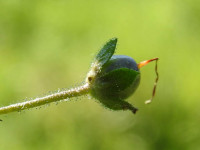
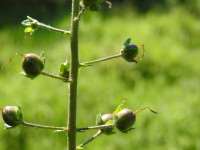
The fruit is an ovoid, bivalve and apiculate capsule, 6-8 mm long, longer than the persistent calyx, with a slightly glandular apical surface. It contains numerous subcylindrical, prismatic and brownish seeds.
The root system is not specifically described in the sources, but as with many species of the genus, it is presumed to consist of fibrous roots.
Habitat and distribution
This species is typical of thermophilous and xerophilous areas of southeastern Europe and the steppe belt of southern Siberia, with a range defined as S-Europ.-S-Siber. In Italy it is considered rare and localized, mainly present in the southern Alpine belt (from the Trieste Karst to Piedmont), in Liguria (where it now seems extinct in the wild), in Central Italy up to Abruzzo and Puglia (Gargano).
It prefers dry meadows and pastures, clearings and uncultivated places, from plains up to about 800 m altitude, with typically heliophilous (sunny) exposure. It adapts to calcareous soils but can also live on ophiolitic substrates (ultrabasic rocks), as known in the Emilia stations of Monte Prinzera and in Piacenza. Its ecology is curious: it can behave both as a serpentinophyte (calcifuge) and as a calcicole, suggesting a preference for thermoxeric environments with good sun exposure.
Flowering period
Flowering generally extends from May to July, with possible local variations related to altitude and climatic conditions. Fruiting follows in the period from June to August.
Ecology and pollination
The species is entomophilous, i.e. pollinated by insects that visit the flowers attracted by the purple color and the morphology of the corolla. The presence of woolly and glandular hairs could contribute to protecting the flowers and attracting specific pollinating insects. Seed dispersal occurs through the bivalve capsule which releases numerous small seeds, favoring colonization of suitable environments.
Curiosities and traditional uses
Purple Mullein is cultivated in gardens for its showy violet-purple flower and for its hardiness. Numerous hybrids artificially obtained from this species are known.
No specific traditional medicinal or food uses are reported for this species in the consulted sources, but the genus Verbascum in general is known for mucilaginous properties and medicinal uses in respiratory tract ailments.
No particular folklore references linked to this species emerge.
Etymology
The genus name Verbascum probably derives from an alteration of the Latin "barbascum," meaning "bearded," referring to the villous stamens and dense pubescence characterizing these plants. The specific epithet phoeniceum derives from the Greek "phóinix," meaning "red purple" or "purple," recalling the color of the corolla.
The Italian common name "Purple Mullein" clearly refers to the purple shade of the flowers, distinguishing it from other mullein species with corollas of different colors.
Sources
- Prof. S. Pignatti, Flora d'Italia
- Acta Plantarum - Flora delle regioni italiane (scheda di Patrizia Ferrari)
- World Flora Online (WFO)
Characteristics
Scheda botanica
| Famiglia | Scrophulariaceae |
|---|---|
| Fioritura | maggio – luglio |
| Forma biologica | Scapose |
| Habitat | with purple flowers, Perennial plant, plant with a scapose habit |
Domande frequenti
- Quando fiorisce Purple Mullein?
- Purple Mullein fiorisce maggio – luglio.
- Che tipo di pianta è Purple Mullein?
- Purple Mullein è una Hemicryptophytes (Scapose) secondo la classificazione di Raunkiaer.
- A quale famiglia appartiene Purple Mullein?
- Purple Mullein appartiene alla famiglia botanica Scrophulariaceae.
Where I found it (6 sightings)
Classification
- Kingdom
- Plantae
- Family
- Scrophulariaceae
- Full name
- Verbascum phoeniceum L.
- Life form
- Hemicryptophytes scapose
Similar species
Search for species with similar characteristicsFurther reading
Noticed an error in the identification? Write to me
Other species of the same family
Scrophulariaceae
Explore
Other species of Scrophulariaceae