Botanical family
Scrophulariaceae
Description
Botanical characteristics
The plants belonging to this family have a very varied habit, ranging from annual, biennial or perennial herbs, to suffrutices and small shrubs, up to rare cases of lianas and trees. The surface of the stems can be glabrous or covered with simple, branched or stellate hairs, sometimes giving a villous appearance. The stems are often erect or ascending, with a quadrangular section due to the presence of collenchyma bundles at the edges.
The leaves are arranged oppositely, alternately or whorled, and sometimes form basal rosettes. They are without stipules and vary from lanceolate to orbicular, with toothed or serrated margins. The leaf surface can be glabrous or pubescent, with specialized tissues in some species.
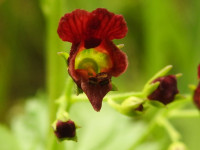
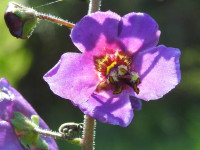
The inflorescences are indeterminate, generally racemose or thyrsoid, often provided with bracts. The flowers are hermaphroditic, zygomorphic and pentamerous, with a gamosepalous calyx that takes cylindrical or campanulate shapes, sometimes bilabiate. The corolla is gamopetalous, bilabiate, with five lobes arranged to form an upper and a lower lip; colors vary from orange, pink, yellow, red, white to violet, with some species having a greenish or brown color.
The androecium typically consists of four didynamous stamens, with a possible fifth sterile staminode. The anthers are reniform, with distal slit opening. The gynoecium is syncarpous, bicarpellate, with a superior bilocular ovary containing one or more pendulous ovules. The fruit is usually a dehiscent capsule, with numerous seeds often having a wrinkled or reticulate surface. In rare cases the fruit can be a dry berry or drupe-like.
These plants contain chemical compounds such as iridoids and, in some species, have a characteristic odor. Their reproduction mainly occurs through entomogamous pollination or, in some species, ornithogamous. Seed dispersal initially occurs by wind action, followed by secondary dispersal through insects such as ants.
Distribution and diversity
This family has a cosmopolitan distribution, adapting to numerous different habitats. It includes about 59 genera divided into 10 tribes, with remarkable diversity of forms and ecological adaptations. Originally rich in genera (over 210), the family has undergone taxonomic revision with a significant reduction in the number of assigned genera, following phylogenetic analyses that led to the transfer of many taxa to related families within the order Lamiales.
Main genera and representative species
Among the most important genera is the type genus, known for species such as Scrophularia nodosa, characterized by bilabiate flowers and entomogamous pollination. Other genera present in Italy include herbaceous and shrubby species typical of the Mediterranean spontaneous flora, often recognizable by their bilabiate corolla and the particular structure of the flowers.
Etymology
The family name derives from the type genus, which in turn was named Scrophularia by an Italian physician. The term refers to a disease called scrofula, an infection of the lymph nodes; some species of this genus indeed presented glands similar to those affected by the disease, hence the name.
Sources
- Wikipedia
Explore
Other botanical families