Botanical species
Scrophularia peregrina
L.
Nettle-leaved Figwort
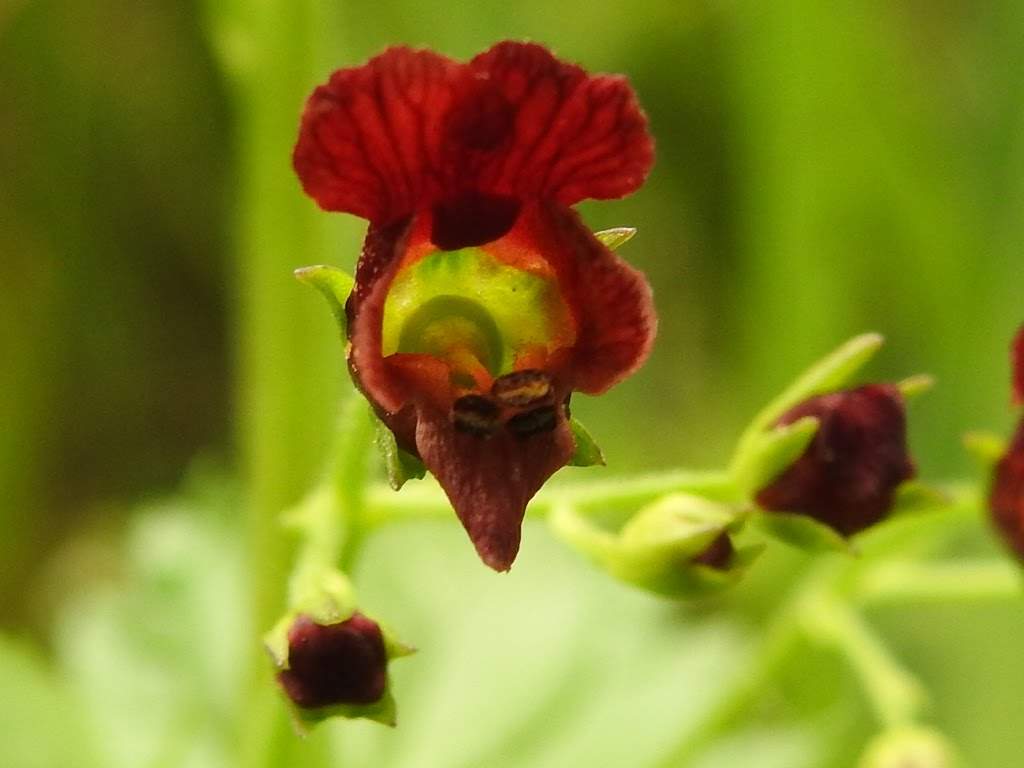
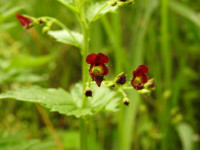
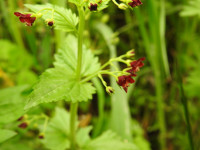
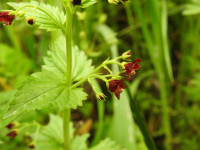
Description
Morphological description
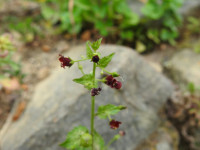
Annual herbaceous plant with an erect and branched habit, with a height ranging from 30 to 80 cm. The stem is quadrangular, often reddish in color, hollow inside and generally glabrous with scattered glandular hairs. The plant has a root system consisting of a thin, taproot.
The lower leaves have a petiole 6 to 10 cm long and feature a triangular blade with a cordate base, measuring about 3-5 cm wide by 4-6 cm long; the margin is irregularly toothed. The lower cauline leaves are arranged oppositely, while the upper ones are alternate, sessile, and similar to the basal leaves but smaller and progressively reduced towards the stem apex.
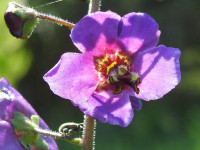
The flowers are gathered in scapose inflorescences, that is, elongated racemes often leafless. They have a calyx 4-5 mm long with lanceolate, acute lobes, lacking a membranous margin. The corolla is purplish-amaranth or brown-reddish in color, 5 to 7 mm long, with a dilated throat. The staminode is spatulate or suborbicular, and the stamens are included within the corolla. The flowers are arranged in rather sparse axillary cymes, forming a long leafy panicle.
The fruit is a bivalve septicidal capsule, subspherical, smooth, about 4-5 mm in diameter, with an apical mucro about 1 mm long.
Habitat and distribution
This is a species with a steno-Mediterranean distribution, mainly present along the coasts of the Mediterranean basin, particularly in the Olive region. In Italy, it is reported in coastal and subcoastal areas, up to an altitude of about 900 meters.
It grows mainly in uncultivated environments, along hedges, vineyards, and fresh grassy areas typical of Mediterranean zones. It prefers well-drained soils and sunny or partially shaded exposures.
Flowering period
Flowering mainly occurs between April and June, with possible variations linked to local climatic conditions. In warmer Mediterranean territories, flowering may start earlier and end within the summer months.
Ecology and pollination
The plant adopts a reproductive strategy based on entomophilous pollination, favored by the presence of flowers colored in amaranth and brown-reddish tones, which attract pollinating insects. The most common pollinating insects are probably hymenopterans and dipterans, attracted by the shape and colors of the corolla.
Seed dispersal occurs through the bivalve capsule which, upon maturation, opens releasing seeds into the surrounding environment, facilitating colonization of suitable new habitats.
Curiosities and traditional uses
The genus name recalls ancient beliefs related to scrofula, a disease causing lymphatic swellings in the neck. It was believed that plants of this genus had therapeutic properties against this pathology. However, no specific and documented food uses or medicinal applications are known for this species in Italy.
Etymology
The generic name derives from the Latin scrōfŭlae, a term indicating scrofula, a disease of the lymphatic glands of the neck. The plant was traditionally associated with healing properties against this pathology. The Italian name "Nettle-leaved Figwort" refers to its nature as an annual plant belonging to the genus Scrofularia.
Sources
- Prof. S. Pignatti, "Flora d'Italia"
- Acta Plantarum - Flora delle regioni italiane (scheda di Gianluca Nicolella)
- Tela Botanica / H. Coste, "Flore descriptive et illustrée de la France"
Characteristics
Scheda botanica
| Famiglia | Scrophulariaceae |
|---|---|
| Fioritura | maggio – luglio |
| Forma biologica | Scapose |
| Habitat | with amaranth flowers, annual plant |
Domande frequenti
- Quando fiorisce Nettle-leaved Figwort?
- Nettle-leaved Figwort fiorisce maggio – luglio.
- Che tipo di pianta è Nettle-leaved Figwort?
- Nettle-leaved Figwort è una Therophytes (Scapose) secondo la classificazione di Raunkiaer.
- A quale famiglia appartiene Nettle-leaved Figwort?
- Nettle-leaved Figwort appartiene alla famiglia botanica Scrophulariaceae.
Where I found it (7 sightings)
Classification
- Kingdom
- Plantae
- Family
- Scrophulariaceae
- Full name
- Scrophularia peregrina L.
- Life form
- Therophytes scapose
Similar species
Search for species with similar characteristicsFurther reading
Noticed an error in the identification? Write to me
Other species of the same family
Scrophulariaceae
Explore
Other species of Scrophulariaceae