Botanical species
Verbascum sinuatum
L.
Wavyleaf Mullein
Description
Morphological description
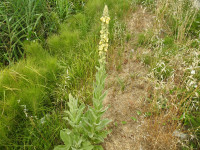
Biennial herbaceous plant, robust and branched, with an erect habit that can reach a variable height from 50 cm up to over one meter, and occasionally up to 1-2 meters. The stem is cylindrical, rigid and reddish-brown in color, covered by a dense tomentose pubescence of gray or pale yellow color, which gives a rough and velvety texture. The branches are numerous, arcuate and ascending, forming a large widely branched pyramidal inflorescence.
The basal leaves are large, oblong-spatulate, with dimensions ranging from 4-10 cm wide up to 12-35 cm long, sessile or with a very small petiole. They have wavy margins with lobed or parted incisions, generally with 4-5 lobes per side, and large irregular teeth. The leaf surface is tomentose, with a greenish-yellow lower side and a very evident central vein. The cauline leaves are smaller (3-4 cm), ovate-acuminate or lanceolate, sessile and slightly decurrent on the stem, with simpler margins and also tomentose.
The flowers are arranged in clusters of 2 to 7 per bract, with the apical ones more often solitary or nearly so. The inflorescence is a large pyramidal panicle formed by numerous thin, ascending and spaced branches. The bracts are small (3-8 mm), semiamplexicaul, with a cordate base and elongated and thin apex, tomentose and entire or slightly toothed.
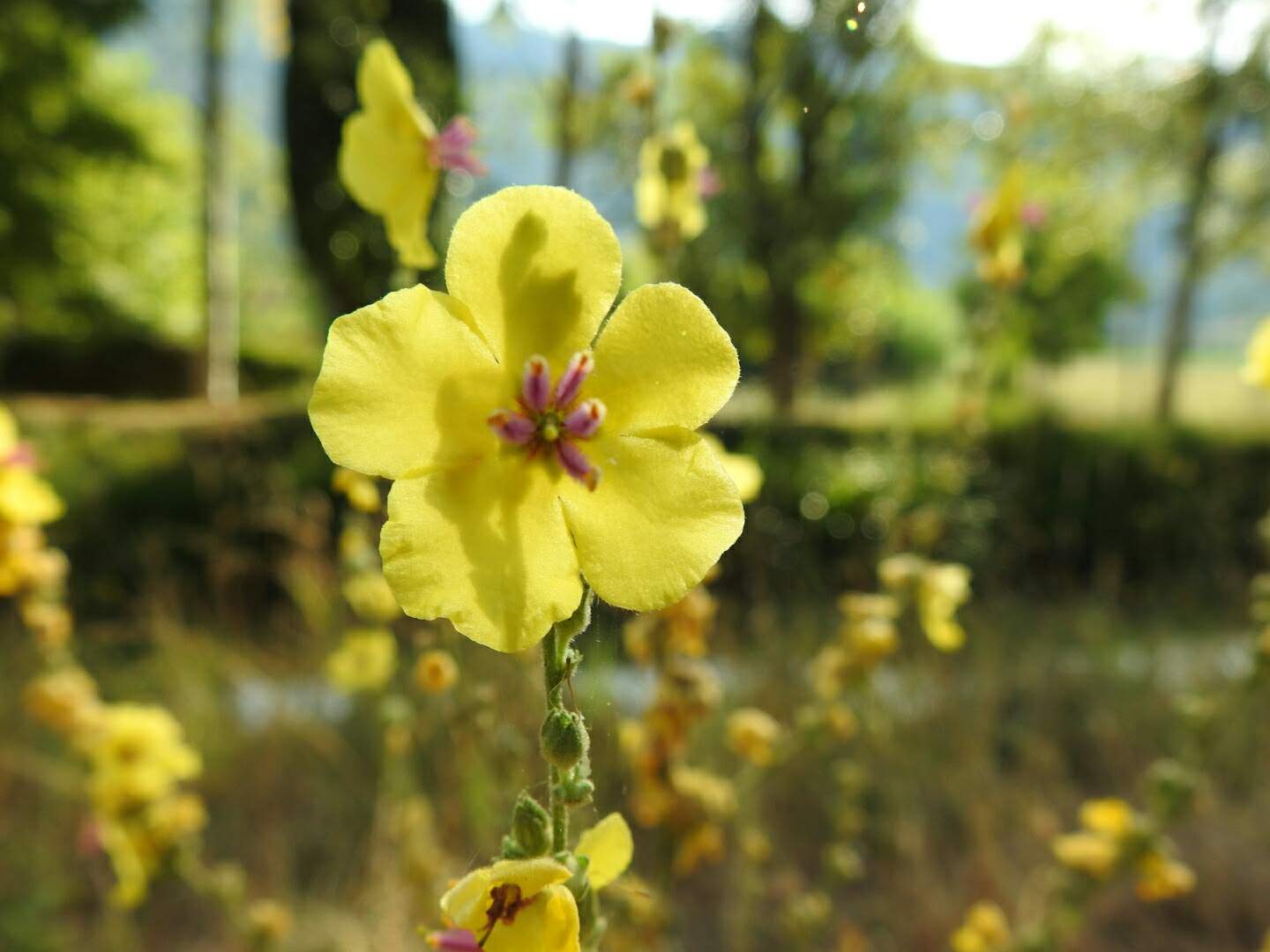
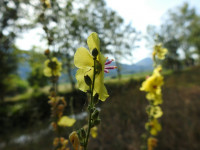
The calyx is gamosepalous, 2 to 5 mm long, densely tomentose with five triangular, acute and entire lobes. The corolla, gamopetalous and rotate, has a diameter between 15 and 30 mm, bright yellow in color with a more orange throat and often a purple ring-shaped line at the base of the petals. The five lobes of the corolla are obovate and slightly unequal in size. The stamens, all fertile, have reniform anthers and filaments covered by long violet-purple hairs, which give the center of the flower a striking violet color. The style is subclavate, with a hemispherical stigma.
The fruit is a septicidal capsule with two valves, elliptical or subglobose, slightly tomentose, about 2.5-4 mm long and slightly larger than the calyx. It opens to release numerous obconic-prismatic seeds, which represent the main dispersal unit. The root system is not specifically described in the sources but is presumably composed of taproots suitable for loose and dry soils.
Habitat and distribution
Species typical of the Mediterranean region, with a range extending along the coasts of the central and southern European basin, up to Southern Europe. In Italy it is common throughout almost the entire territory, especially along the coasts, but can also grow inland up to 800 meters altitude, while in Sicily it is found up to 1300 m. It preferably grows on loose, sandy or gravelly soils, in dry environments such as uncultivated areas, field margins, dunes and degraded places. It prefers sunny exposures and warm environments typical of the Mediterranean maquis.
Flowering period
It blooms from May to September, with a peak during the summer months. In some Mediterranean areas flowering can start as early as June and continue until late summer, adapting to local climatic conditions.
Ecology and pollination
Biennial hemicryptophyte plant, with buds at ground level during the first year and flowering in the second. The yellow flowers, showy and with colored elements (violet hairy anthers and filaments), attract pollinating insects, particularly bees and other hymenopterans, which favor entomogamous pollination. The structure of the inflorescence and the presence of multiple flowers per bract facilitate visitation and pollen transfer.
Seed dispersal occurs mainly by falling and subsequent secondary dispersal by wind or animals. The seeds are numerous and small, contained in capsules that open at maturity.
Curiosities and traditional uses
This species is known for its medicinal properties. Traditionally it has been used for its astringent, emollient, antispasmodic and diaphoretic virtues. In the past it was used in the treatment of gout and, for external use, as an anti-inflammatory and soothing agent for the skin and mucous membranes, as well as a healing agent for wounds and a remedy for hemorrhoids.
The leaves and flowers, used in infusions, are appreciated as antitussive and expectorant remedies. Furthermore, the flowers are used in the preparation of lotions to lighten hair. Although such uses are widespread in popular tradition, it is important to emphasize that they do not replace official medical therapies.
Etymology
The genus name Verbascum derives from the Latin barbascum, meaning “bearded”, referring to the dense pubescence that covers the plant. The specific epithet sinuatum refers to the sinuous and wavy shape of the leaves, a distinctive characteristic of the species. The Italian common name “verbasco sinuato” refers precisely to this particular leaf shape, with strongly wavy and lobed margins.
Sources
- Prof. S. Pignatti, "Flora d'Italia"
- Acta Plantarum - Flora delle regioni italiane (scheda di Giuliano Salvai)
- Tela Botanica / H. Coste, "Flore descriptive et illustrée de la France"
Characteristics
Scheda botanica
| Famiglia | Scrophulariaceae |
|---|---|
| Fioritura | maggio – agosto |
| Forma biologica | Biennials |
| Habitat | with yellow flowers |
| Uso officinale | Pianta officinale |
Domande frequenti
- Quando fiorisce Wavyleaf Mullein?
- Wavyleaf Mullein fiorisce maggio – agosto.
- Che tipo di pianta è Wavyleaf Mullein?
- Wavyleaf Mullein è una Hemicryptophytes (Biennials) secondo la classificazione di Raunkiaer.
- A quale famiglia appartiene Wavyleaf Mullein?
- Wavyleaf Mullein appartiene alla famiglia botanica Scrophulariaceae.
Where I found it (8 sightings)
Classification
- Kingdom
- Plantae
- Family
- Scrophulariaceae
- Full name
- Verbascum sinuatum L.
- Life form
- Hemicryptophytes biennials
Similar species
Search for species with similar characteristicsFurther reading
Noticed an error in the identification? Write to me
Other species of the same family
Scrophulariaceae
Explore
Other species of Scrophulariaceae