Botanical species
Buddleja davidii
Franch.
Butterfly-Bush
Description
Morphological description
Buddleja davidii is a deciduous shrub or small tree that can reach a height between 0.5 and 5 meters, with a bushy and ascending-branched habit. Young branches are characterized by an almost quadrangular section, often subtetragonal or angular, and have a pubescent, tomentose, or hirsute surface, with often stellate hairs.
The leaves are arranged oppositely, sometimes subopposite, with short petioles (1-5 mm) and sometimes subsessile in the upper parts. The blade is ovate-lanceolate or narrowly ovate, with variable dimensions from 4 to 20 cm in length and from 0.3 to 7.5 cm in width. The margin is serrated or crenate-dentate. The upper surface is glabrous or subglabrous, dark green, with impressed veins, while the lower surface is white-cottony, tomentose, or pubescent, with prominent veins and evident reticulation. Linear or suborbicular stipules, 1-6 mm long, are often present, especially on the main branches.
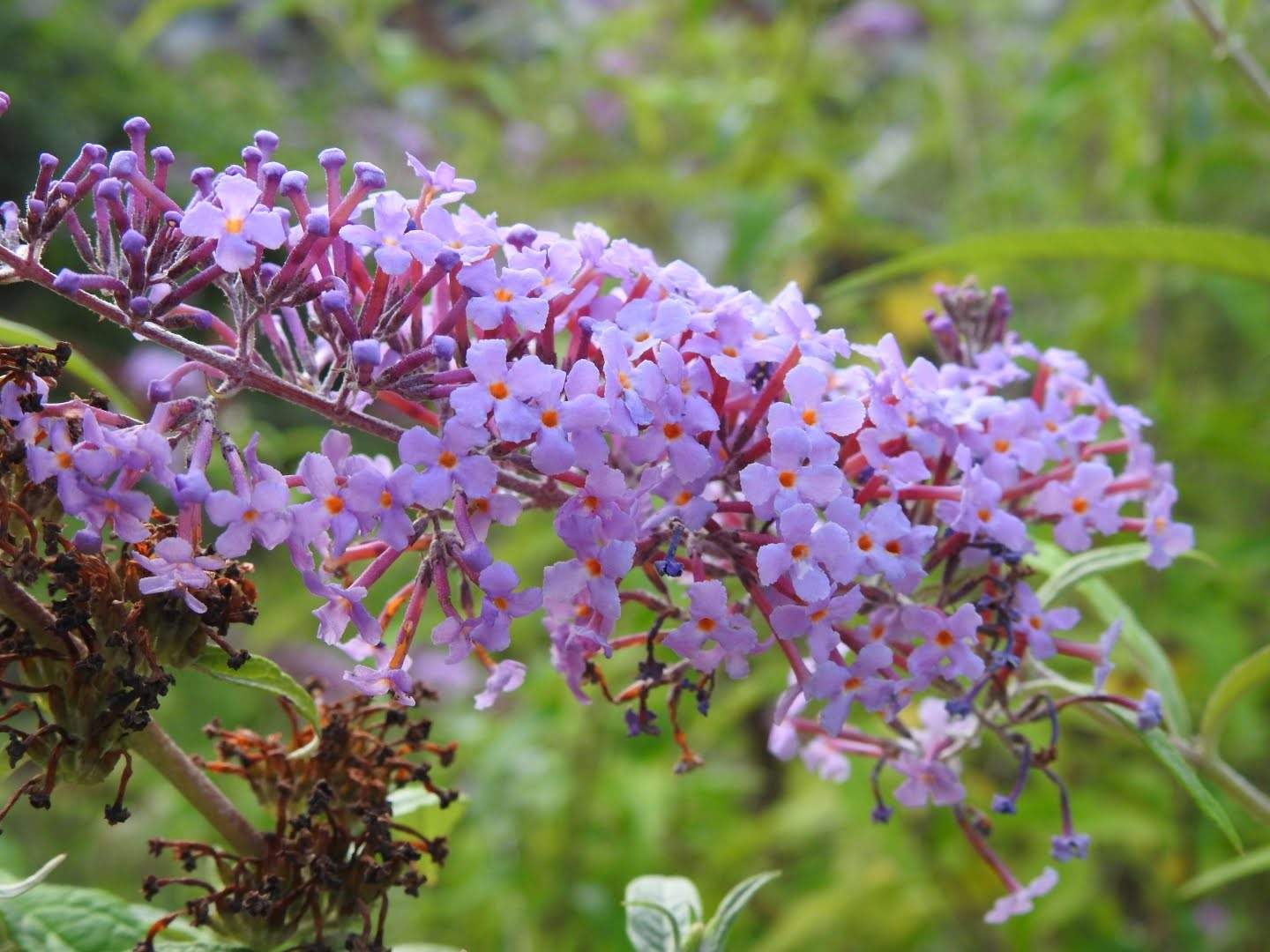
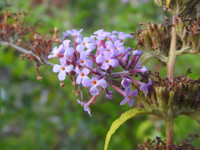
The inflorescences are terminal or axillary panicles, cylindrical in shape, 10 to 50 cm long, often pendulous but sometimes erect, composed of numerous small hermaphroditic and actinomorphic flowers. The flowers are grouped in multiflorous cymes, each borne on a short peduncle or sometimes sessile. The bracts are linear and hairy.
The calyx is campanulate, 2-3.5 mm long, externally tomentose or stellate-pubescent and often with tiny glandular hairs internally; the calyx lobes are narrowly triangular, acute, 0.5-2 mm long, and shorter than the corolla tube.
The corolla is tubular, 7.5-14 mm long, with a narrow cylindrical tube 6-11.5 mm long and 0.9-1.5 mm in diameter below the throat, which widens abruptly outward. The color varies from violet to lilac, passing through shades of pink and white, with a characteristic orange or yellow-orange throat. The four final lobes, suborbicular and slightly crenellated, are 1.5-3 mm long and patent.
The stamens (four), generally inserted at mid-length or towards the base of the tube, have oblong anthers (0.8-1.2 mm), glabrous and deeply cordate at the base. The ovary is ovoidal, 1.2-2 mm long, glabrous or weakly pubescent, with two locules containing 20-50 ovules each; the stigma is bifid and claviform.
The fruit is a septicidal capsule, strictly ellipsoid or ovoid in shape, 5-9 mm long and 1.5-2 mm wide, glabrous or with sparse stellate pubescence. The seeds are ellipsoid, 2-4 mm long, provided with thin wings at both ends that facilitate wind dispersal.
The root system is characterized by numerous underground stolons that contribute to the rapid expansion of the plant.
Habitat and distribution
Native to eastern China, this species was introduced to Europe in 1893 as an ornamental plant for gardens and parks. It is currently widely naturalized and expanding in many Italian and European regions, particularly in Alpine valleys and the northern Po Plain, from Friuli to the Susa Valley, as well as in more southern areas such as Lazio.
It prefers open and disturbed habitats such as cliffs, uncultivated areas, river floodplains, river and lake banks, forest clearings, and railway embankments. It is particularly widespread in environments with calcareous soils but adapts easily to various soil types, including poor and rocky soils. It can grow from the plains up to over 1300 meters of altitude.
In some areas, such as the marble quarries of the Apuan territory, it has established massively, colonizing trail edges and mineral debris accumulations. Its cold tolerance is high, enduring temperatures down to -15 °C.
Flowering period
Flowering mainly occurs from May to October, with some variability depending on altitude and latitude. In milder climates, the period can be longer, while in alpine or cooler temperate zones it tends to concentrate in the summer months.
Ecology and pollination
The flowers, hermaphroditic and actinomorphic, are highly fragrant and produce nectar that attracts numerous pollinating insects, particularly butterflies, hence the common name “Butterfly-Bush.” Pollination is entomophilous and mainly relies on butterflies and other flying pollinators attracted by the violet-lilac color and delicate scent of the corollas.
The species has an effective reproductive strategy: it produces a very high number of seeds (up to 3 million per plant), which are mainly dispersed by the wind thanks to the wings present at the seed ends. Furthermore, the ability to emit underground stolons contributes to its rapid spread and invasiveness in anthropized and natural environments.
Curiosities and traditional uses
This plant is highly appreciated in gardening for the beauty and fragrance of its flowers, as well as for its resistance to cold and drought. It is often used to beautify parks, public and private gardens, and urban green areas.
No particular medicinal or traditional food applications related to this species are known in the Italian or Mediterranean context. Its main value lies in its attraction for butterflies and, in general, for pollinating fauna, contributing to local biodiversity.
However, Buddleja davidii is considered an invasive species in many areas, where it can compete with native flora and alter natural ecosystems. For this reason, control measures are adopted in some regions to limit its spread.
Etymology
The genus name, Buddleja, is dedicated to Adam Buddle (1660-1715), an English pastor and amateur botanist. The species davidii was named in honor of Father Armand David (1826-1900), a French missionary and naturalist, known for his explorations and the discovery of numerous species in eastern China.
The Italian common name “Buddleja di David” directly recalls this dedication to the missionary naturalist, while other vernacular names such as “albero delle farfalle” emphasize the important ecological role of the species as a plant attractive to pollinating insects.
Sources
- Prof. P.V. Arrigoni, "Flora analitica della Toscana", "Flora dell'Isola di Sardegna"
- Acta Plantarum - Flora delle regioni italiane (scheda di Giuliano Salvai)
- World Flora Online (WFO)
Characteristics
Scheda botanica
| Famiglia | Scrophulariaceae |
|---|---|
| Fioritura | maggio – settembre |
| Forma biologica | Shrubby |
| Habitat | with purple flowers, plant with a prostrate-ascending habit, plant with a spreading bushy habit |
Domande frequenti
- Quando fiorisce Butterfly-Bush?
- Butterfly-Bush fiorisce maggio – settembre.
- Che tipo di pianta è Butterfly-Bush?
- Butterfly-Bush è una Phanerophytes (Shrubby) secondo la classificazione di Raunkiaer.
- A quale famiglia appartiene Butterfly-Bush?
- Butterfly-Bush appartiene alla famiglia botanica Scrophulariaceae.
Where I found it (7 sightings)
Classification
- Kingdom
- Plantae
- Family
- Scrophulariaceae
- Full name
- Buddleja davidii Franch.
- Synonyms
- Buddleja variabilis Hemsl.
- Life form
- Phanerophytes shrubby
Similar species
Search for species with similar characteristicsFurther reading
Noticed an error in the identification? Write to me
Other species of the same family
Scrophulariaceae
Explore
Other species of Scrophulariaceae