Botanical species
Umbilicus rupestris
(Salisb.) Dandy
Navelwort
Description
Morphological description
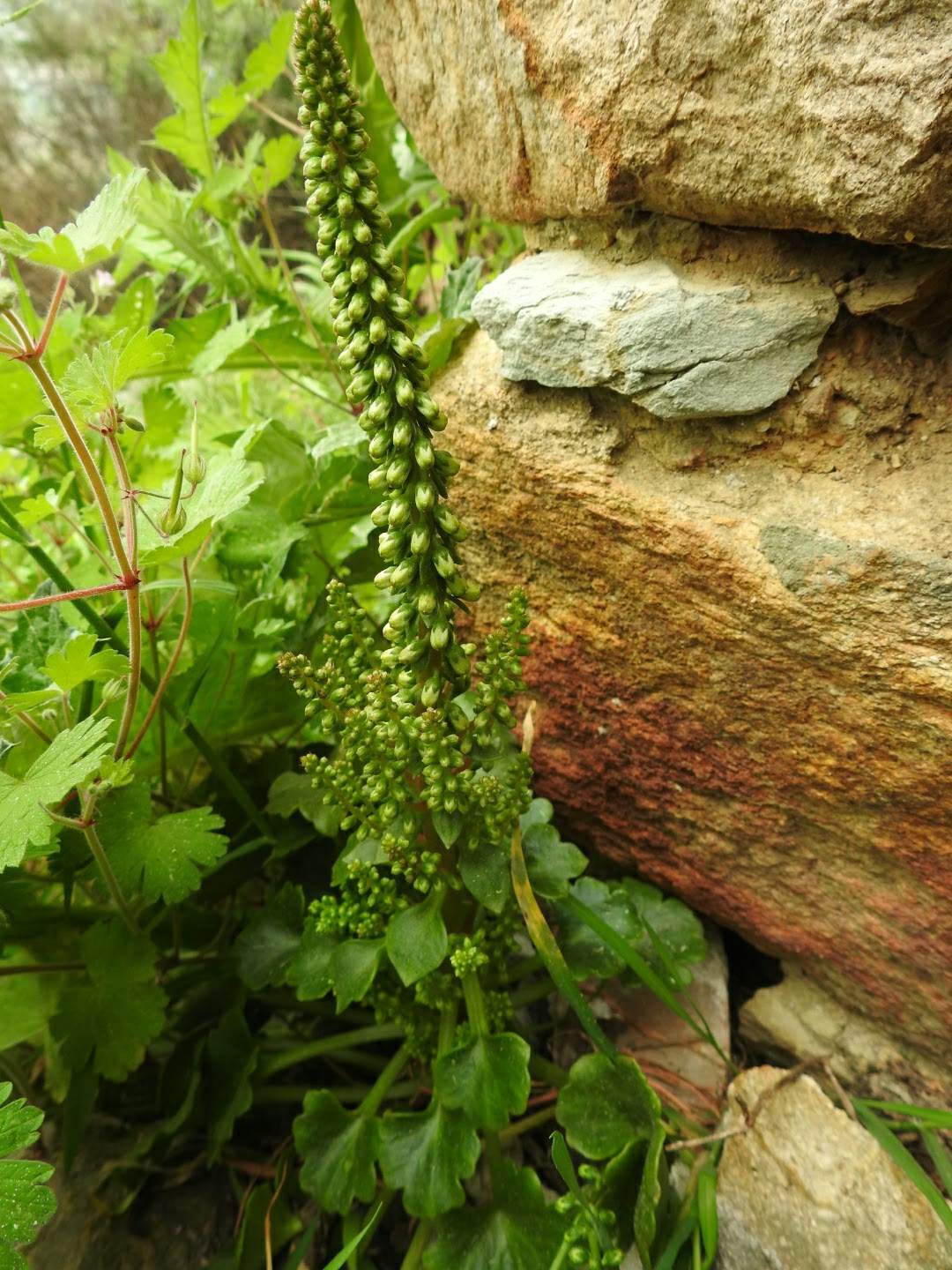
Perennial herbaceous plant, with a subglobose tuberous rhizome that constitutes the perennial organ, from which the stem and leaves emerge every year. The stem is erect, cylindrical, glabrous and generally unbranched, 10 to 60 cm tall, sometimes up to 50 cm, with the flowering part occupying more than half up to three quarters of its length. The stem surface is smooth and hairless.
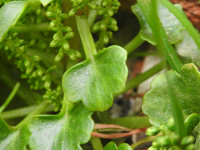
The leaves are succulent, fleshy and leathery, with a crenate-dentate margin. The basal ones have an orbicular and peltate blade (shield-shaped with the petiole inserted in the center), with a diameter ranging from 2 to 6 cm, often concave towards the center (navel-like), supported by a petiole 4 to 20 cm long, about 2-3 times the length of the blade itself. The cauline leaves progressively reduce in size and shape, ranging from spatulate to lanceolate and cuneate with dentate margins, until becoming linear or lanceolate scales towards the apex of the stem.
The inflorescence is a simple, linear and generally unilateral raceme, extending over most of the stem (from half to three quarters), rarely branched at the base. The bracts are linear and equal or longer than the peduncles, which are 3-9 mm long and bear pendulous flowers. The flowers, hermaphroditic and sessile, are 7-10 mm long, with a tubular or sub-campanulate corolla formed by five triangular-ovate and mucronate lobes, fused for about four times the length of the calyx. The corolla color varies from straw yellow to greenish-white, sometimes with pink or reddish shades, or with spots. The calyx consists of five ovate and subacute lobes, fused at the base. The stamens are ten, inserted on the tubular corolla, while the ovary is superior with five free carpels and a single short style.
The fruit is a follicle composed of five distinct follicles, containing numerous small, ovoid or elliptical seeds, dark brown in color.
The root system consists of a deep tuberous rhizome, which allows the plant to survive during unfavorable periods.
The plant is evergreen and has an erect habit.
Habitat and distribution
Navelwort prefers rocky habitats, growing mainly on poor siliceous soils and lithosols, in cool, humid, shady and mountainous environments up to about 1200 meters altitude. It is common on old walls, rock crevices and rocky cliffs, especially in shaded exposure areas.
The geographic distribution includes much of the Atlantic and Mediterranean coasts, with wide penetration into the inland of western and southern Europe, Asia Minor and North Africa. In Italy it is widespread mainly in the central-southern regions and along the coasts, but is also found in some southern alpine areas such as southern Ticino.
Flowering period
Flowering extends from March to June, with local variations that can slightly anticipate or postpone the period depending on climatic conditions. In the milder Mediterranean climates, flowering is generally observed between May and July.
Ecology and pollination
The plant is hermaphroditic and reproduces through flowers that attract pollinating insects, essential for pollination. The pendulous flowers of yellow-greenish or straw color, sometimes with pink shades, are suitable for attracting small pollinating insects that perch on the long and thin peduncles. The reproductive strategy is based on entomogamous pollination (by insects), while seed dispersal occurs through follicles that open releasing small light seeds, promoting the propagation of the species in rock crevices and walls where it grows.
Curiosities and traditional uses
Navelwort is an edible and medicinal plant. The young, fleshy and succulent leaves have historically been used as food, appreciated for their refreshing and diuretic properties. In the past, the poultice obtained by crushing the leaves was applied locally to soothe minor burns, scalds and skin irritations, exploiting the plant's refreshing and calming effect.
The common name “Navelwort” refers to the characteristic shape of the leaves, concave in the center like a navel, while the association with Venus evokes the beauty and delicacy of the plant.
It is important to emphasize that medicinal and food uses are to be considered traditional and informative, and do not replace medical advice or official indications.
Etymology
The scientific name of the genus derives from the Latin umbilicus, meaning “navel”, referring to the particular shape of the basal leaves, orbicular and centrally depressed, similar to a navel. The specific epithet rupestris indicates the ecology of the plant, typical of rocky environments (“rupestris” means “living among rocks”).
The Italian common name “Navelwort” recalls the shape of the leaves and the Roman goddess Venus, symbol of beauty, emphasizing the elegance and uniqueness of the plant.
Sources
- Prof. S. Pignatti, Flora d’Italia
- Acta Plantarum – Flora delle regioni italiane (scheda di Giuliano Salvai)
- Tela Botanica / H. Coste, Flore descriptive et illustrée de la France
- World Flora Online (WFO)
Characteristics
Scheda botanica
| Famiglia | Crassulaceae |
|---|---|
| Fioritura | marzo – giugno |
| Forma biologica | Bulbous |
| Habitat | edible plant, with yellow flowers, succulent plant |
| Uso alimentare | Commestibile |
Domande frequenti
- Quando fiorisce Navelwort?
- Navelwort fiorisce marzo – giugno.
- È commestibile Navelwort?
- Navelwort è considerata commestibile. Verifica sempre le parti eduli e la preparazione corretta prima del consumo.
- Che tipo di pianta è Navelwort?
- Navelwort è una Geophytes (Bulbous) secondo la classificazione di Raunkiaer.
- A quale famiglia appartiene Navelwort?
- Navelwort appartiene alla famiglia botanica Crassulaceae.
Where I found it (2 sightings)
Classification
- Kingdom
- Plantae
- Family
- Crassulaceae
- Full name
- Umbilicus rupestris (Salisb.) Dandy
- Synonyms
- Cotyledon rupestris Salisb.
- Life form
- Geophytes bulbous
Similar species
Search for species with similar characteristicsFurther reading
Noticed an error in the identification? Write to me
Other species of the same family
Crassulaceae
Explore
Other species of Crassulaceae