Botanical species
Sempervivum tectorum
L.
House-Leek
Description
Morphological description
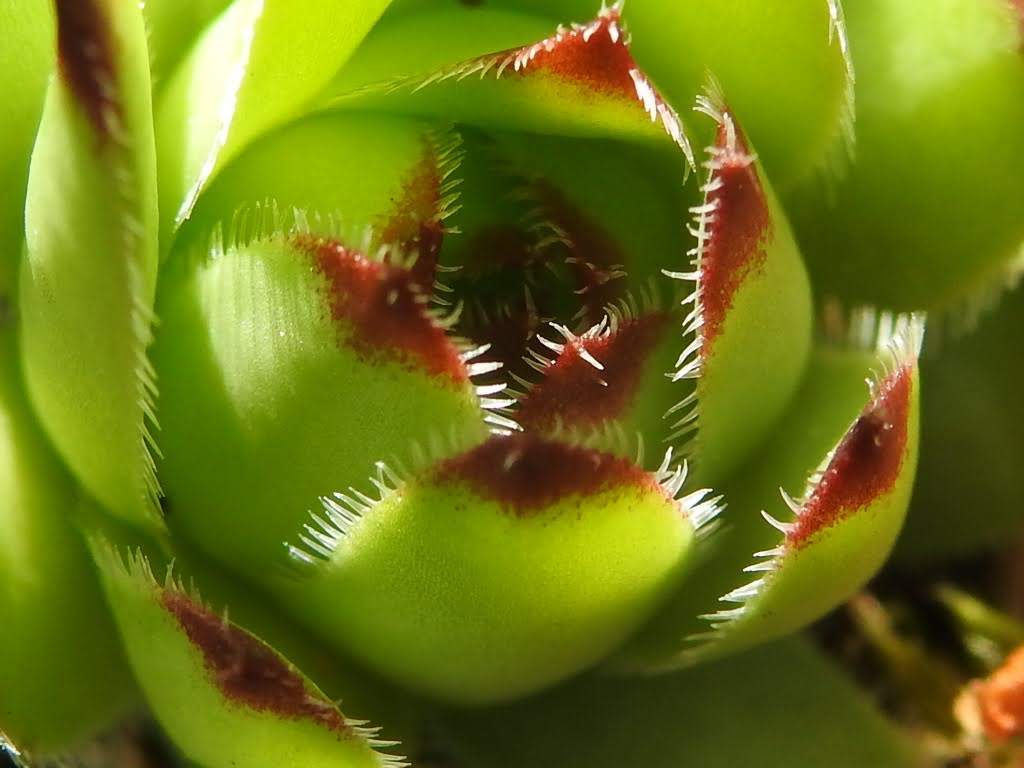
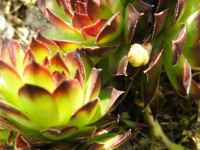
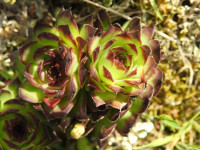
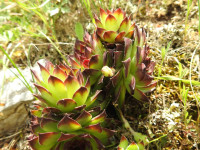
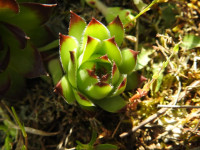
It is a succulent perennial herbaceous plant, characterized by a basal rosette habit with very fleshy leaves that serve as water reserves. The rosettes have a diameter ranging from 3 to 8 cm, but can also reach larger sizes depending on environmental conditions. The plant produces robust stolons that connect the daughter rosettes to the mother one, allowing rapid colonization of the substrate.
The leaves are lanceolate-spatulate or obovate in shape, generally 20 to 40 mm long and 8-15 mm wide, with an acute, mucronate, and spiniform apex. The leaf margin is equipped with patent cilia, while the surfaces are generally glabrous, although some populations show slight pubescence or glandular hairs, particularly in the varieties of the central-southern Apennines. The leaves can have a green or glaucous coloration, sometimes with reddish tips.
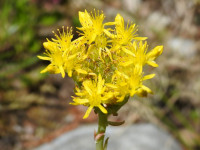
The floral scape is erect, can reach a height between 10 and 60 cm, and bears numerous flowers (from 10 up to over 40) arranged in rather compact cymes or scorpioid cymes. It is covered along its entire length by thinner and lanceolate leaves, slightly tomentose. The flowers are hermaphroditic, regular, and pink or purple in color, with a diameter of about 2-3 cm. The petals, generally 12, are 9-12 mm long, strongly reflexed at anthesis, and are 2.5 to 4 times longer than the sepals. The petal margins are entire and the lower surface of the petals is pubescent.
The androecium is composed of stamens in a number double that of the petals, often 13, with filaments and anthers of purple color. The gynoecium includes free carpels, as many as the petals, each equipped with a simple or bifid nectar scale with numerous ovules. The fruit is formed by free follicles, corresponding to the carpels, each topped by a persistent style and containing numerous minute seeds.
The root system is typical of succulent plants, developed to anchor the plant on rocky or sandy substrates and to absorb water in often arid environments.
Habitat and distribution
This species is typical of orophilous environments, widespread especially in the mountainous and hilly areas of southeastern Europe. In Italy it is mainly present in the eastern Alps, from the Karst to Liguria, and in the central-southern Apennines, from Abruzzo to Pollino. Its distribution also extends from the Iberian Peninsula, through the Alps and the Balkans, to the Caucasus and Anatolia.
It prefers rocky habitats, old walls and stone roofs, slopes and dry sunny meadows, often with sandy or calcareous substrates. It grows from hill altitudes up to alpine ones, colonizing environments exposed to full sun and characterized by poor and well-drained soils. Its high survival capacity in conditions of aridity and poor soils makes it a typical species of harsh mountain environments.
Flowering period
Flowering mainly extends through the summer months, from May to August, with some variation related to altitude and latitude. In higher and cooler areas flowering tends to concentrate between June and July, while in warmer and lower environments it can start already in May and continue until August.
Ecology and pollination
The species is mainly pollinated by pollinating insects, attracted by the colorful flowers and the nectar produced by the nectar scales present on the carpels. The arrangement of the flowers in compact cymes facilitates access to pollinating insects, which can thus visit numerous flowers in a short time.
The plant produces numerous minute seeds contained in follicles, favoring effective dispersal in the immediate vicinity of the mother plant, although vegetative reproduction through stolons is very important for its local expansion.
Curiosities and traditional uses
The genus name Sempervivum derives from Latin and means “always alive”, alluding to the extraordinary capacity of survival and resilience of the plant even in hostile and arid environments. The specific epithet tectorum refers to the traditional habit of cultivating this plant on house roofs, especially in rural contexts, where it was believed to have protective properties against lightning and other calamities.
The succulent leaves have traditionally been used for medicinal purposes: they contain resins, tannins, mucilages, malic and formic acid with their calcium salts. They were used in poultices for the treatment of insect bites, burns, and skin ulcers, and in infusions as eye drops to relieve ocular inflammations. The leaf juice, for internal use, acts as a refresher and astringent.
In times of economic hardship, young rosettes were preserved in vinegar and consumed as food. Numerous legends are linked to this plant: it was believed that spontaneous flowering on a house roof was an omen of misfortune, while it was thought that mute people who touched the plant could improve their communication ability.
Etymology
The scientific name Sempervivum derives from the Latin “semper” (always) and “vivus” (alive), indicating the ability of this plant to remain green and vital even in adverse conditions. The specific epithet tectorum means “of the roofs”, referring to the ancient custom of cultivating this plant on the roofs of houses to protect them from lightning and storms.
The Italian common name “House-Leek” precisely recalls this popular tradition.
Sources
- Prof. S. Pignatti, "Flora d'Italia"
- Acta Plantarum - Flora delle regioni italiane (scheda di Giuseppe Trombetti)
- World Flora Online (WFO)
Characteristics
Where I found it (6 sightings)
Classification
- Kingdom
- Plantae
- Family
- Crassulaceae
- Full name
- Sempervivum tectorum L.
- Synonyms
- Sempervivum tectorum L. subsp. schottii auct. Fl. Ital.
- Life form
- Camefite succulente
Similar species
Search for species with similar characteristicsFurther reading
Noticed an error in the identification? Write to me
Other species of the same family
Crassulaceae
Explore
Other species of Crassulaceae