Botanical species
Sedum sexangulare
L.
Tasteless Stonecrop
Description
Morphological description
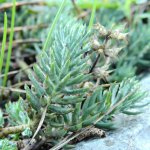
It is a perennial herbaceous plant, glabrous and succulent, with a prostrate-ascending habit and thin, twisted, and branched stems especially in the apical part. The height generally varies between 5 and 15 cm. The stems lack basal rosettes and have a tufted but sparse form, often forming sparse grassy mats.
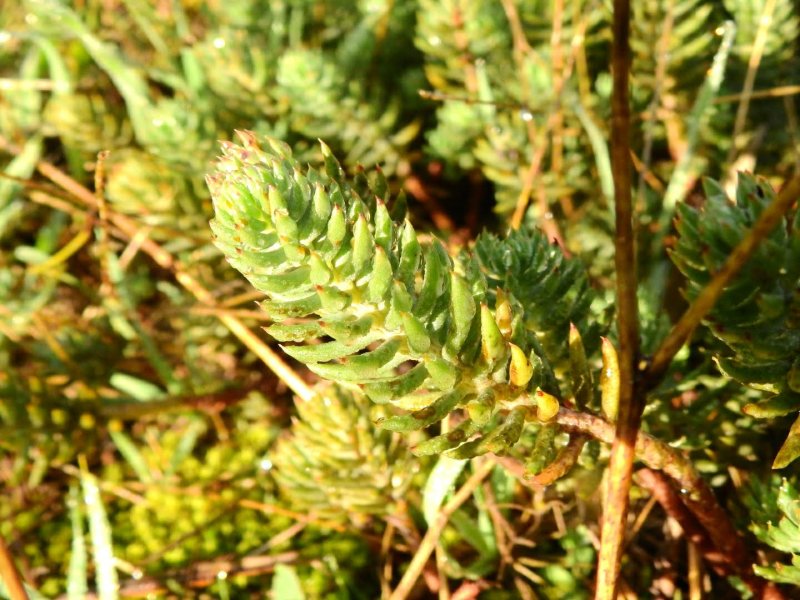
The leaves are fleshy, glabrous, bright green in color, and arranged in whorls of three, which follow each other along the stem in a spiral arrangement, creating six well-defined ribs. This characteristic is the origin of the specific name "sexangulare". The leaves of sterile shoots are cylindrical, about 6 mm long and 1 mm wide, slightly flattened on the upper side, and have at the base a short spur about 0.3 mm long; those of flowering shoots have a wider base. The succulent texture allows the plant to store water, thus adapting to dry environments.
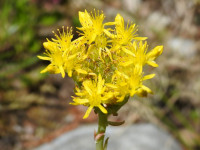
The inflorescence appears as an elongated cyme, with golden yellow flowers borne on very short peduncles (about 1 mm). The calyx consists of 5 cylindrical, obtuse sepals about 1 mm long, similar to the leaves. The corolla is star-shaped and slightly concave, with five lanceolate, acuminate, and spreading petals about 4 mm long, i.e., twice the length of the calyx. There are ten stamens, five positioned between the petals and five between one petal and another; the filaments are yellow, filiform, and erect, slightly shorter than the petals, while the anthers are yellow and ovoid. The stigmas are acute and elongated.
The fruits are follicles, five per flower, divergent and star-shaped when open, yellow in color, close together and fusiform in shape. The seeds are oblong-ovoid, about 0.8-1 mm, brown and equipped with tiny papillae on the surface.
The root system is not described in detail in the consulted sources, but as with many succulent plants of arid environments, it is presumed to be well developed to anchor the plant in rocky soils and rapidly absorb water.
Habitat and distribution
This species is typical of Central European regions and extends throughout temperate Europe, from France to Ukraine, with confirmed presence in Italy. In Italy it mainly grows on walls, cliffs, rocky places, and dry meadows, from the plains up to submontane and montane altitudes, up to about 2050 meters above sea level. It prefers well-drained and sunny substrates, often in exposed and nutrient-poor environments, typical of calcareous or stony soils.
In the Mediterranean basin, the plant adapts to dryness and heat conditions typical of xerophilous habitats, and is often found in association with other pioneer species of rocky environments and walls, where competition is limited.
Flowering period
Flowering mainly occurs from April to July, with a possible extension into the early summer months depending on local climatic conditions. No significant variations in flowering period are reported among different distribution areas, but in more northern or higher altitude zones flowering may start later.
Ecology and pollination
The plant relies on entomogamous pollination, i.e., mediated by pollinating insects attracted by the golden yellow color of the flowers, their star-shaped structure, and the presence of nectar. The main visitors are probably bees, hymenopterans, and other pollinating insects typical of arid and rocky environments.
Seed dispersal occurs through anemochory (wind dispersal), facilitated by the follicle structure that opens star-shaped, favoring dispersal even in open and windy environments.
Curiosities and traditional uses
No specific traditional medicinal or food uses are reported for this species. The Italian common name “borracina insipida” refers to the lack of pronounced taste, unlike related species such as Sedum acre, known for its acrid taste. The plant is therefore not known for particular officinal or culinary properties.
However, the genus Sedum is generally known for some species used in traditional medicine for their anti-inflammatory and soothing properties, but this specific species does not seem to have a significant role in such uses.
Etymology
The genus name Sedum probably derives from the Latin sedere (to sit) or sedare (to calm), alluding both to the low and compact habit of the plant and to the calming properties attributed to some species of the genus.
The specific epithet sexangulare indicates the leaf arrangement that forms six angles and six parallel rows on the stems, a distinctive and easily recognizable morphological trait.
The common name “borracina insipida” recalls the similarity to “borracina acre” (Sedum acre), from which it mainly differs by the lack of acrid taste, thinner leaves, and smaller flowers.
Sources
- Acta Plantarum - Flora delle regioni italiane (actaplantarum.org)
- Acta Plantarum - Flora delle regioni italiane, scheda di Giuliano Salvai
- World Flora Online (WFO)
Characteristics
Scheda botanica
| Famiglia | Crassulaceae |
|---|---|
| Fioritura | aprile – luglio |
| Forma biologica | Succulents |
| Habitat | with yellow flowers, plant with a prostrate-ascending habit |
Domande frequenti
- Quando fiorisce Tasteless Stonecrop?
- Tasteless Stonecrop fiorisce aprile – luglio.
- Che tipo di pianta è Tasteless Stonecrop?
- Tasteless Stonecrop è una Chamaephyte (Succulents) secondo la classificazione di Raunkiaer.
- A quale famiglia appartiene Tasteless Stonecrop?
- Tasteless Stonecrop appartiene alla famiglia botanica Crassulaceae.
Where I found it (7 sightings)
Classification
- Kingdom
- Plantae
- Family
- Crassulaceae
- Full name
- Sedum sexangulare L.
- Synonyms
- Sedum boloniense Loisel.
- Life form
- Chamaephyte succulents
Similar species
Search for species with similar characteristicsNoticed an error in the identification? Write to me
Other species of the same family
Crassulaceae
Explore
Other species of Crassulaceae