Botanical species
Sedum dasyphyllum
L.
Thick-Leaved Stonecrop
Description
Morphological description
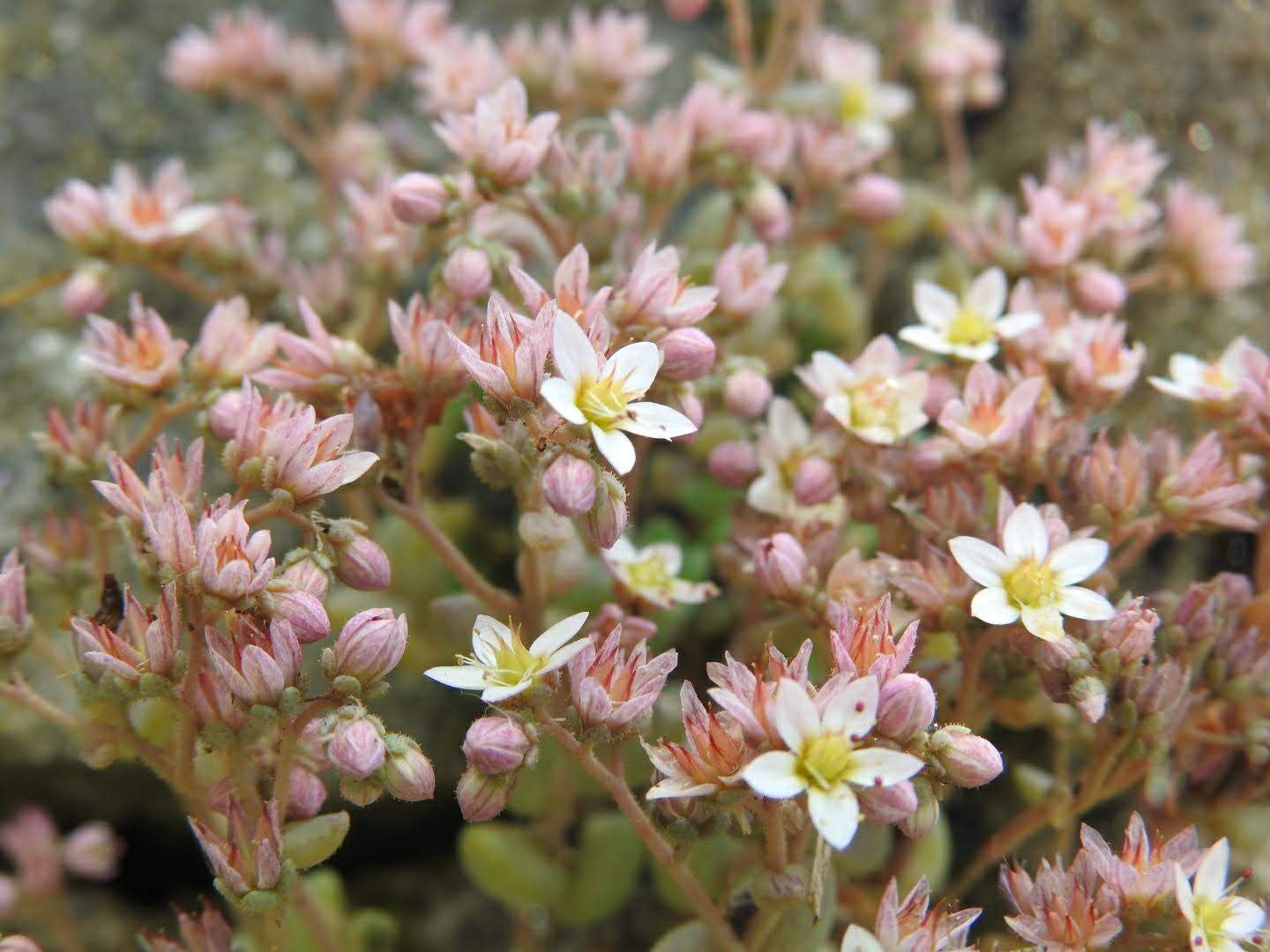
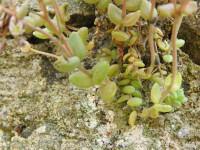
Perennial herbaceous plant belonging to the Crassulaceae family, characterized by a tufted and creeping habit, with woody stems at the base, slender and highly branched, developing from the ground up to a height between 5 and 15 cm. The stems are gray-green with a ashy tone, often with violet or reddish hues, and sometimes have a surface covered by glandular hairs, especially in the upper part, giving the plant a slightly sticky or glossy appearance.
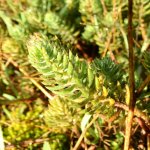
The leaves are fleshy, thick, and succulent, arranged oppositely along the stem. They have an ovate or suborbicular shape, generally measuring between 2.5 and 7 mm in length. The upper surface is almost flat, while the lower surface is slightly convex and swollen laterally at the base. The leaves have an obtuse apex and often present small groups of punctiform pits along the margin and towards the tip, peculiar characteristics of the species. The texture is fleshy and greasy, typical of succulent plants, allowing water storage in the tissues.
The flowers are small, gathered in short and few-flowered cymes, i.e., with few flowers per inflorescence. They are generally pentamerous or hexamerous (with 5 or 6 petals), white in color, sometimes with pinkish or yellowish shades. The petals, about 3-5 mm long, are ovoid, subobtuse, and have a more pronounced central vein often purplish or reddish on the outside. The sepals are oval or lanceolate, fleshy, and smaller than the petals (1.5-2 mm). The stamens, from 10 to 12 per flower, have whitish filaments and protruding anthers, purplish in color. The style persists even after flowering.
The fruit is a polyfollicle composed of 5-6 erect, pointed follicles, yellow-green in color. The seeds are numerous, small, apiculate, with vertical ribs and a sharp apex, adapted for dispersal by abiotic agents such as wind or water.
The root system is generally fibrous and superficial, suitable for stabilizing the plant on poor and rocky substrates, often with the ability to root from creeping stems.
Habitat and distribution
Thick-Leaved Stonecrop is a eurymediterranean species with a predominant distribution along the coastal areas of the Mediterranean basin, but it also extends towards more northern and mountainous areas. In Italy, it is present throughout almost the entire territory, except for some areas of the Po Plain and with limited and sporadic presence in the Alps, where it is mainly found in dry valleys. It prefers mountainous and hilly environments up to about 1800 meters of altitude.
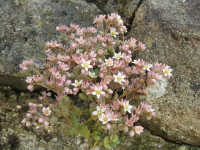
It grows mainly on siliceous substrates, favoring poor, rocky, or stony soils, such as walls, rocks, crevices, and stony places. It is a typical species of rocky walls and walls, often exposed to full sun or very sunny and dry environments. Its tolerance to drought conditions and very poor soils makes it highly adaptable and capable of colonizing extreme habitats where other species struggle to survive.
Based on the presence of glandular hairs, the species presents two main varieties in Italy: one with sparser glandularity, prevalent in cool and mountainous stations, and one with greater glandularity on stems and leaves, more common in southern regions and in drier and sunnier environments.
Flowering period
The flowering period of Thick-Leaved Stonecrop extends from spring to summer, mainly between April and July. In some areas, especially in warmer and sunnier Mediterranean environments, flowering can begin as early as April, while in cooler or mountainous areas it tends to last until July. The geographical variability of the flowering period is linked to local climatic conditions and altitude.
Ecology and pollination
The species shows an ecological adaptation typical of succulent plants in arid environments: perennial buds placed at low height from the ground (no more than 20 cm), leaves and stems modified to store water, and a reduced and fleshy leaf surface to limit water loss through evapotranspiration.
The flowers, star-shaped and small in size, are mainly pollinated by pollinating insects, attracted by the light color and the evident veins of the petals, as well as by the presence of purplish anthers and numerous stamens. Among the pollinating insects are bees, wasps, and other small pollinating insects that visit the flowers to collect nectar and pollen.
Seed dispersal occurs mainly through wind and surface water, thanks to their small size, apiculate shape, and the presence of ribs that facilitate transport. The plant thus rapidly colonizes fissures and cracks in rocky substrates or walls, where it finds favorable conditions for growth.
Curiosities and traditional uses
Thick-Leaved Stonecrop is a plant that, due to its habit of growing on walls and roofs, has traditionally been considered a protective plant in popular cultures. According to folklore, it was believed that this species could protect houses from fire and lightning, thus attributing to it a symbolic value of domestic protection.
From an ethnobotanical point of view, no significant food or medicinal uses are known for this species in Italy, although the genus name recalls a possible calming or refreshing use, probably linked to the properties of the fleshy leaves once used as traditional remedies by some Mediterranean cultures.
Etymology
The genus name derives from the Latin sēdēre, meaning "to sit," referring to the prostrate habit of the plant, which seems to lie down and adhere to the ground or rocks, or with the meaning of "to soothe" or "to calm," recalling the supposed calming properties of the leaves.
The specific name dasyphyllum derives from the Greek dasýs (hairy) and phýllon (leaf), referring to the presence of more or less abundant glandular hairs on the leaves and stems, a characteristic that distinguishes some varieties of the species.
The Italian common name "borracina cenerina" refers to the gray-ashy color of the stems and leaves, while the term "borracina" is an ancient popular name used for various Sedum species.
Sources
- Prof. S. Pignatti, "Flora d'Italia"
- Acta Plantarum - Flora delle regioni italiane (sheet by Giuliano Salvai)
- World Flora Online (WFO)
Characteristics
Scheda botanica
| Famiglia | Crassulaceae |
|---|---|
| Fioritura | aprile – luglio |
| Forma biologica | Succulents |
| Habitat | with white flowers, creeping plant, succulent plant |
Domande frequenti
- Quando fiorisce Thick-Leaved Stonecrop?
- Thick-Leaved Stonecrop fiorisce aprile – luglio.
- Che tipo di pianta è Thick-Leaved Stonecrop?
- Thick-Leaved Stonecrop è una Chamaephyte (Succulents) secondo la classificazione di Raunkiaer.
- A quale famiglia appartiene Thick-Leaved Stonecrop?
- Thick-Leaved Stonecrop appartiene alla famiglia botanica Crassulaceae.
Where I found it (2 sightings)
Classification
- Kingdom
- Plantae
- Family
- Crassulaceae
- Full name
- Sedum dasyphyllum L.
- Life form
- Chamaephyte succulents
Similar species
Search for species with similar characteristicsFurther reading
Noticed an error in the identification? Write to me
Other species of the same family
Crassulaceae
Explore
Other species of Crassulaceae