Botanical species
Petrosedum rupestre
(L.) P.V.Heath
Reflexed Stonecrop
Description
Morphological description
It is a perennial herbaceous plant, belonging to the family Crassulaceae, characterized by a suffruticose habit at the base and prostrate-ascending, twisted, and glabrous stems, reaching a height between 15 and 30 cm. The sterile stems are shorter (3-8 cm), with short internodes and imbricate leaves, while the fertile ones have longer internodes, are ascending but strongly recurved before flowering.
The leaves are alternate, fleshy, cylindrical-linear in shape with an acute and often mucronate apex, ending with a small spur at the base. The succulent consistency of the leaves and stems allows the plant to accumulate water, adapting to drought conditions.
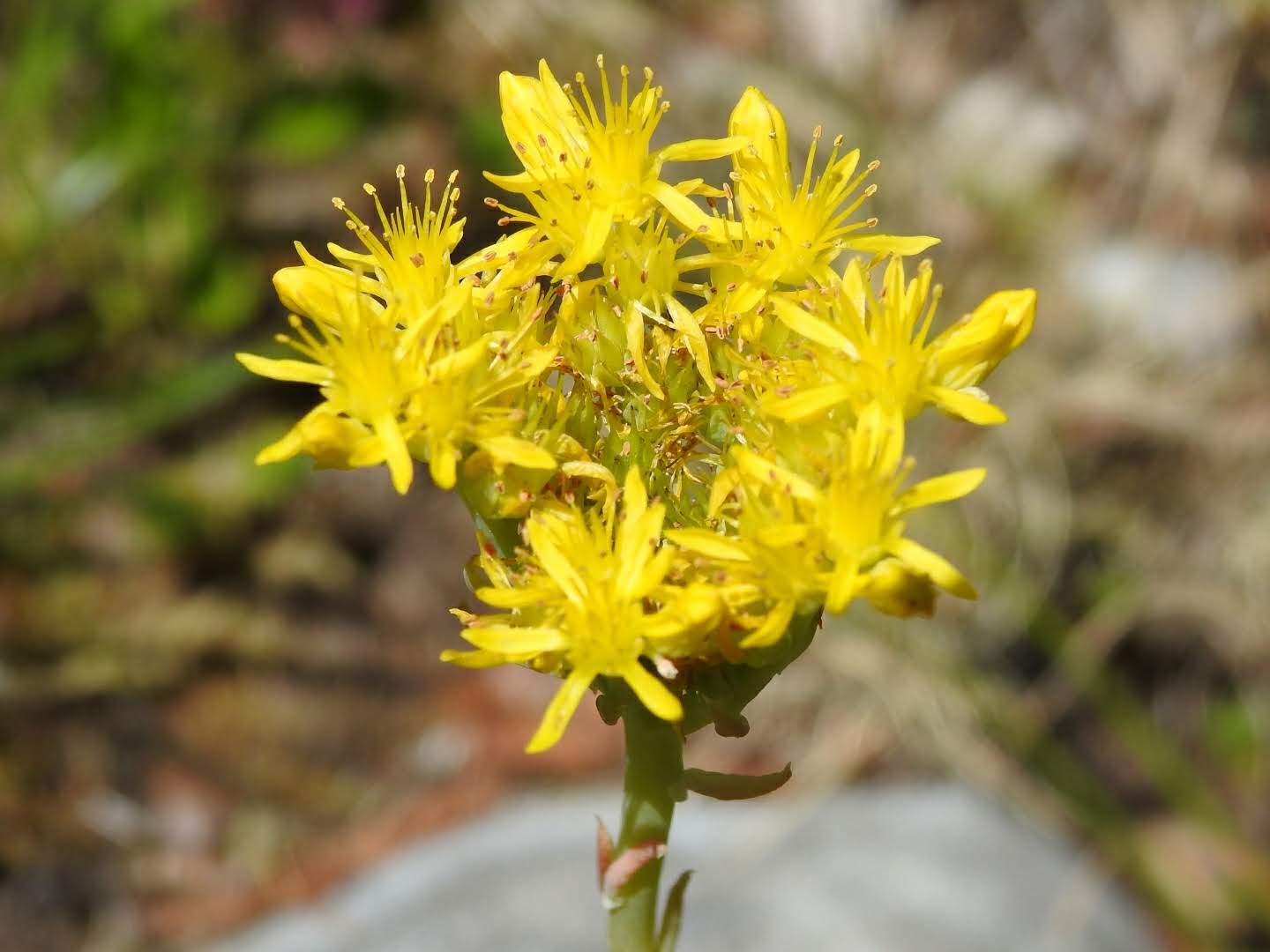
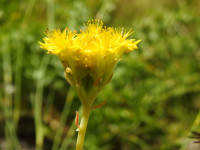
The inflorescence is corymbose and bracted, with slightly concave branches curved outward. The flowers, hermaphroditic and actinomorphic, are generally pentamerous (sometimes hexamerous), with five free, widely arranged petals, acute or acuminate, bright yellow in color and 6-7 mm long, dorsally striped. The calyx is formed by fleshy, green, ovate-triangular sepals shorter than the petals, fused at the base.
The stamens are twice the number of the petals and the carpels, 5 or 6, are slightly fused at the base. The fruits are fusiform follicles, erect or slightly inclined, with persistent styles.
The root system is numerous and well developed, suitable for anchoring the plant in rocky and arid environments.
Habitat and distribution
Reflexed Stonecrop is a typical species of mountainous and sub-mountainous environments, preferring calcareous and rocky soils, such as walls, dry meadows, and cliffs. It grows from the plain up to about 1,200 meters of altitude.
Its distribution is Central European, extending from France to Ukraine, and it is also found in the western Mediterranean areas. In Italy, it is mainly present in mountainous areas and environments characterized by calcareous substrates.
Flowering period
Flowering generally occurs between May and July. No significant variations in the flowering period related to geographical distribution have been reported.
Ecology and pollination
Reflexed Stonecrop is adapted to arid climates thanks to its succulent morphology. The flowering with bright yellow, luminous, and highly visible flowers favors the attraction of pollinating insects, which play the main role in pollination. The hermaphroditic and actinomorphic structure of the flowers facilitates visits by different pollinator species.
The seeds are mainly dispersed through follicles that open, releasing them into the surrounding environment, but no detailed dispersal strategies such as transport by animals or wind are known.
Curiosities and traditional uses
The genus name recalls the calming properties of some species of the group, traditionally used to relieve pain and wounds, although there is no specific documented information on the medicinal use of this particular species.
The common name "borracina" could derive from the fleshy appearance and consistency of the plant, similar to that of other succulent species commonly called "borage" or "borracine" in some regions, but without direct botanical relation.
Etymology
The genus name Petrosedum derives from the Greek "πέτρα" (pétra), meaning "rock," and from the Latin "sedo," meaning "to calm," referring to the leaves of some species traditionally used to relieve wounds or pain. The specific epithet "rupestre" indicates its typical habitat, linked to cliffs and rocky places. The Italian common name "borracina rupestre" also refers to the rocky habitat of the plant.
Sources
- Acta Plantarum - Flora delle regioni italiane (scheda di Giuliano Salvai)
Characteristics
Scheda botanica
| Famiglia | Crassulaceae |
|---|---|
| Fioritura | maggio – luglio |
| Forma biologica | Succulents |
| Habitat | with yellow flowers, succulent plant, Perennial plant |
Domande frequenti
- Quando fiorisce Reflexed Stonecrop?
- Reflexed Stonecrop fiorisce maggio – luglio.
- Che tipo di pianta è Reflexed Stonecrop?
- Reflexed Stonecrop è una Chamaephyte (Succulents) secondo la classificazione di Raunkiaer.
- A quale famiglia appartiene Reflexed Stonecrop?
- Reflexed Stonecrop appartiene alla famiglia botanica Crassulaceae.
Where I found it (11 sightings)
Classification
- Kingdom
- Plantae
- Family
- Crassulaceae
- Full name
- Petrosedum rupestre (L.) P.V.Heath
- Synonyms
- Sedum rupestre L.
- Life form
- Chamaephyte succulents
Similar species
Search for species with similar characteristicsFurther reading
Noticed an error in the identification? Write to me
Other species of the same family
Crassulaceae
Explore
Other species of Crassulaceae