Botanical species
Sedum caeruleum
L.
Baby-blue Stone-crop
Description
Morphological description
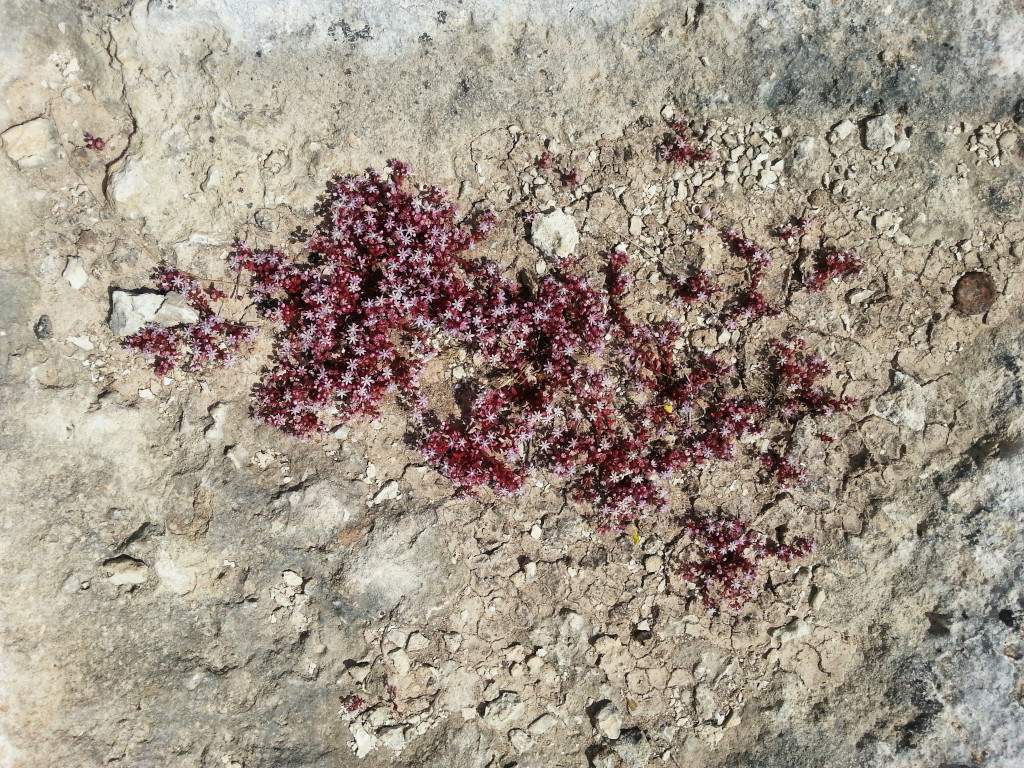
Baby-blue Stone-crop is an annual succulent plant reaching a height between 10 and 20 cm. The stem, erect or ascending, is fleshy, often reddish, and shows branching mainly in the upper part. The surface of the stem is sometimes slightly pubescent or glandular on the apical branches.
The leaves are arranged alternately along the stem. They are fleshy, subcylindrical with a rounded apex, with variable dimensions around 1.5 x 3.5-4 mm. The leaf color can range from green with reddish spots to a more marked red, contributing to the characteristic appearance of the plant.
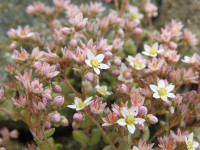
The inflorescence consists of a subcorymbose panicle, with flowers borne on short capillary peduncles. The flowers are generally 6-7-merous (rarely 9-merous), with a corolla composed of 6-7 lanceolate petals, about 2.5 mm long, of a blue-violet color, sometimes pale blue-white. The petals have a blunt and hooded shape. The anthers are blue. The sepals are about 0.7-1 mm long. The plant has about 14 stamens.
The fruits are follicles that open at maturity and appear patent, progressively tapering into a long style. The root system is thin and slender.
Habitat and distribution
Baby-blue Stone-crop is a species typical of the southwestern Mediterranean areas. In Italy, it is mainly present in Sardinia, Sicily, and some minor islands. It is also found in Corsica, Malta, Tunisia, and Algeria.
It prefers rocky and stony habitats, such as walls, rocks, and cliffs, generally from sea level up to about 800 meters altitude. It favors sunny exposures and well-drained substrates, often calcareous or stony, typical of coasts and arid or semi-arid Mediterranean environments.
Flowering period
Flowering occurs mainly between April and June, with possible variations related to altitude and latitude. In Sardinia, Sicily, and warm Mediterranean areas, flowering tends to concentrate in late spring, favoring pollination and reproduction before the drier summer.
Ecology and pollination
The plant, thanks to its blue-violet flowers, attracts specialized and generalist pollinating insects, particularly bees and other pollinators active in spring. The presence of blue anthers is a distinctive trait that may contribute to attracting pollinators.
The reproductive strategy is based on entomogamous pollination and seed dispersal through follicles that open at maturity, facilitating spread in rocky and challenging environments.
Curiosities and traditional uses
No specific ethnobotanical or medicinal uses are documented for this species, nor particular folkloric traditions linked to Baby-blue Stone-crop. The genus name sometimes recalls calming or refreshing properties attributed to other Sedum species, but there are no certain data regarding this species.
Etymology
The genus name "Sedum" probably derives from the Latin sedeo, "I sit," referring to the often prostrate or appressed habit of many species in the genus. Another possible origin is from the Latin sedo, meaning to calm or soothe, linked to the refreshing and soothing properties attributed to some species.
The specific epithet caeruleum refers to the characteristic blue color of the flowers, which represents the main visual peculiarity of the species.
The Italian common name "borracina azzurra" specifically recalls the sky-blue shade of its flowers, while "borracina" is a traditional term referring to small succulent or fleshy plants.
Sources
- Prof. S. Pignatti, Flora d'Italia
- Acta Plantarum – Flora delle regioni italiane (scheda di Giuliano Campus)
- Tela Botanica / H. Coste, Flore descriptive et illustrée de la France
Characteristics
Scheda botanica
| Famiglia | Crassulaceae |
|---|---|
| Fioritura | febbraio – maggio |
| Forma biologica | Scapose |
| Habitat | with red flowers, with blue flowers, annual plant |
Domande frequenti
- Quando fiorisce Baby-blue Stone-crop?
- Baby-blue Stone-crop fiorisce febbraio – maggio.
- Che tipo di pianta è Baby-blue Stone-crop?
- Baby-blue Stone-crop è una Therophytes (Scapose) secondo la classificazione di Raunkiaer.
- A quale famiglia appartiene Baby-blue Stone-crop?
- Baby-blue Stone-crop appartiene alla famiglia botanica Crassulaceae.
Where I found it (1 sightings)
Classification
- Kingdom
- Plantae
- Family
- Crassulaceae
- Full name
- Sedum caeruleum L.
- Life form
- Therophytes scapose
Similar species
Search for species with similar characteristicsFurther reading
Noticed an error in the identification? Write to me
Other species of the same family
Crassulaceae
Explore
Other species of Crassulaceae