Botanical species
Ranunculus sardous
Crantz
Hairy Buttercup
Description
Morphological description
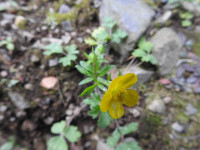
The Hairy Buttercup is an annual herbaceous plant, classified as a scapose therophyte, reaching a height between 5 and 45 cm. Its habit is variable, with stems that can be prostrate, ascending, or erect, very branched and striated, with patent hairs that give a slight pubescence to the surface. The stems do not thicken at the base and have a leafy structure.
The root system is fasciculate, with roots 2 to 3 mm in diameter, suitable for supporting the plant in the moist conditions typical of its habitat.
The leaves are of two types: the basal leaves, arranged in a rosette, are long-petiolate and pinnatisect, divided into 2-3 segments up to 6 mm wide with crenate or lobed margins; they measure about 2-6 cm both in width and length. The cauline leaves, arranged alternately along the stem, are progressively smaller and less divided, with the lower ones petiolate and the upper ones sessile. The segments of the upper leaves are narrow laciniate, 2-3 mm wide.
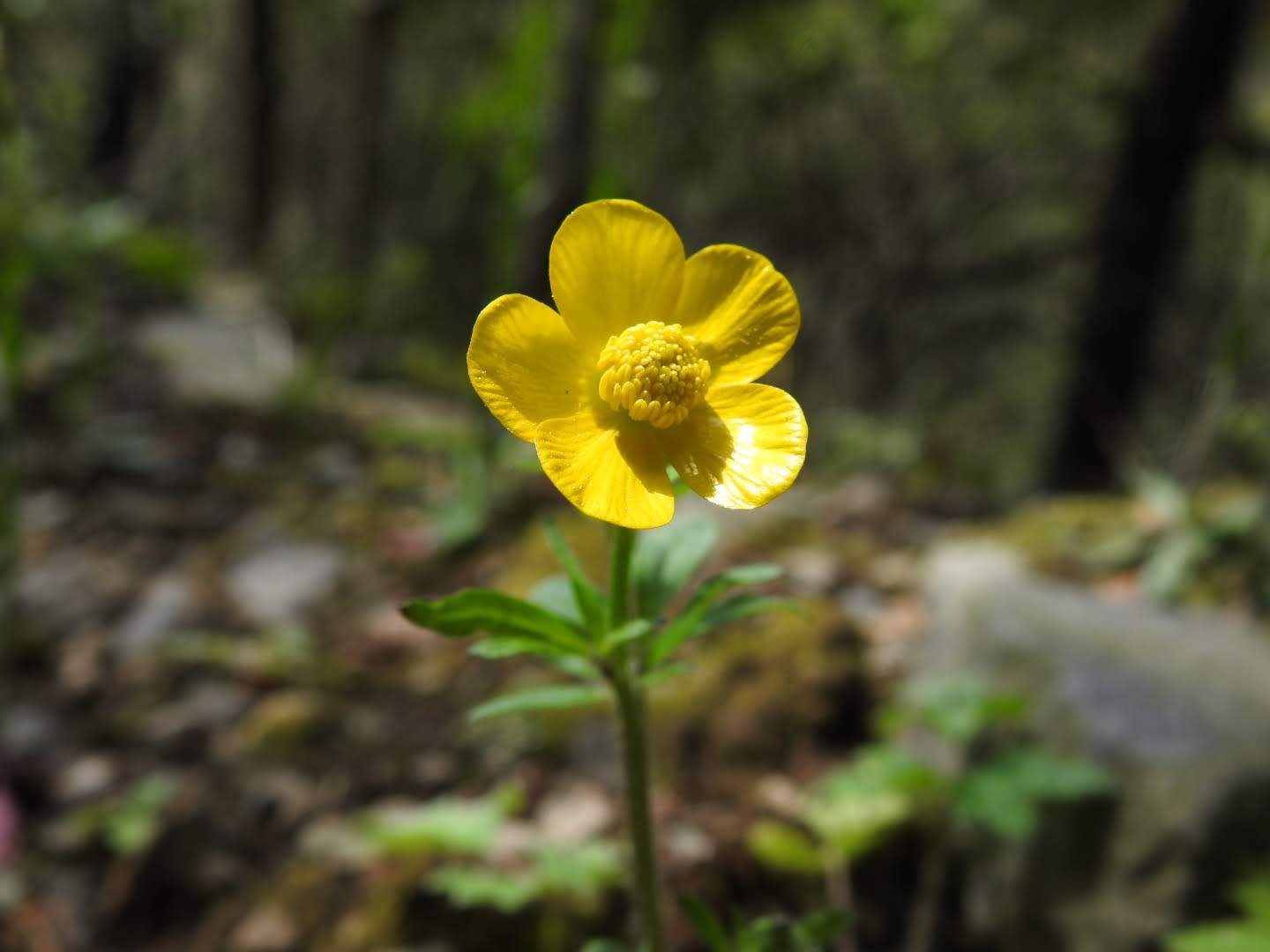
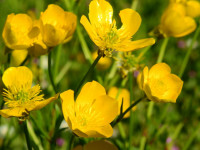
The flowers are solitary, placed in the axil of the upper leaves on striated peduncles 2-4 cm long, which rise above the foliage. The flower diameter varies from 10 to 15 mm. The calyx is composed of five yellowish sepals, short (about 2 mm), hairy and pendulous, arranged imbricately and bent downward. The corolla consists of five intensely yellow petals, spatulate and twice as long as the sepals (4-8 mm), with about 15 longitudinal veins visible at the base. At the inner base of the petals there are nectariferous pits, which attract pollinating insects.
The androecium is formed by an indefinite number of stamens, shorter than the petals, with yellow bilocular anthers that open laterally. The gynoecium is apocarpous, consisting of 20-30 free uniovulate carpels, inserted spirally on a hairy receptacle. The ovules are erect and ascending.
The fruit is an aggregate of achenes (polyachene) forming a spherical or ovoid head 5-8 mm long and 6-7 mm wide. Each achene is elliptical, smooth or slightly wrinkled, 1.5-3 mm long, with a straight or slightly curved apical beak 0.4-0.7 mm long.
Habitat and distribution
The Hairy Buttercup is widespread throughout the Italian territory, commonly present especially in plains and hilly areas. In the mountains it is found up to 1000 meters altitude, frequenting hilly and partly mountainous areas, especially in southern regions. Beyond Italy, the species is present in the Mediterranean basin, in the eastern Alps (southern France, Switzerland, Austria, Slovenia), in the Massif Central and in the Pyrenees. It is also reported in North Africa (Algeria, Morocco, Tunisia) and in some temperate regions of Asia, North America, and Australia, where it is naturalized.
It prefers wet and muddy habitats such as temporary pools, margins of watercourses, hygrophilous meadows and pastures, cultivated fields and disturbed areas. It favors both calcareous and siliceous substrates, with neutral pH and medium fertility values, under conditions of constant moisture. It is often found in open vegetation on subacid soils, such as communities of the Stellarietea mediae class or ephemeral consortia of the Isoeto-Nanojuncetea.
Flowering period
The flowering of the Hairy Buttercup extends from February to October, with the peak flowering between May and July. Geographic variations can influence the start and end of flowering, anticipating it in southern regions and delaying it in northern or mountainous ones.
Ecology and pollination
The Hairy Buttercup is a hermaphrodite plant, whose reproductive system is based on entomogamous pollination, i.e., mediated by pollinating insects. Bees and flies are the main visitors of the flowers, attracted by the nectar present in the pits at the base of the petals. The flower structure, with anthers that open laterally and project outward after opening, favors pollen dispersal and reduces the risk of self-pollination.
Reproduction occurs exclusively sexually, with the formation of seeds contained in the aggregated achenes. Being an annual plant, each new individual arises from the seed produced in the previous season.
Curiosities and traditional uses
The specific name "sardous" derives from an ancient association with the "sardonic rice," a poisonous plant mentioned by Virgil, today probably identified with Oenanthe crocata. This link highlights the toxic characteristic of the species, which contains irritating substances typical of Ranunculaceae, discouraging its use as food.
There are no significant medicinal uses or traditional food uses for this species, probably due to its toxicity. The common name "Hairy Buttercup" refers to its presence or presumed origin in Sardinia, although its distribution is much wider.
Etymology
The genus Ranunculus derives from the Latin "ranunculus," diminutive of "rana," itself a translation of the Greek "batrachion." This name refers to the ecological preferences of many species of the genus, which grow in wet environments, similar to frog habitats.
The specific epithet "sardous" is connected to the "sardonic rice," a poisonous plant cited in antiquity, probably a misidentification that led to naming the species thus. The scientific binomial Ranunculus sardous was proposed in 1763 by the botanist Heinrich Johann Nepomuk von Crantz.
Sources
- Acta Plantarum - Flora delle regioni italiane (actaplantarum.org)
- Wikipedia
Characteristics
Scheda botanica
| Famiglia | Ranunculaceae |
|---|---|
| Fioritura | gennaio – settembre |
| Forma biologica | Scapose |
| Habitat | with yellow flowers |
| Tossicità | Tossica — non consumare |
Domande frequenti
- Quando fiorisce Hairy Buttercup?
- Hairy Buttercup fiorisce gennaio – settembre.
- È tossica Hairy Buttercup?
- Hairy Buttercup è una pianta tossica o velenosa. Non consumare nessuna sua parte senza aver consultato un esperto.
- Che tipo di pianta è Hairy Buttercup?
- Hairy Buttercup è una Therophytes (Scapose) secondo la classificazione di Raunkiaer.
- A quale famiglia appartiene Hairy Buttercup?
- Hairy Buttercup appartiene alla famiglia botanica Ranunculaceae.
Where I found it (6 sightings)
Classification
- Kingdom
- Plantae
- Family
- Ranunculaceae
- Full name
- Ranunculus sardous Crantz
- Synonyms
- Ranunculus sardous Crantz subsp. subdichotomicus Gerbault
- Life form
- Therophytes scapose
Similar species
Search for species with similar characteristicsNoticed an error in the identification? Write to me
Other species of the same family
Ranunculaceae
Explore
Other species of Ranunculaceae