Botanical species
Ranunculus muricatus
L.
Rough-fruited Buttercup
Description
Morphological description
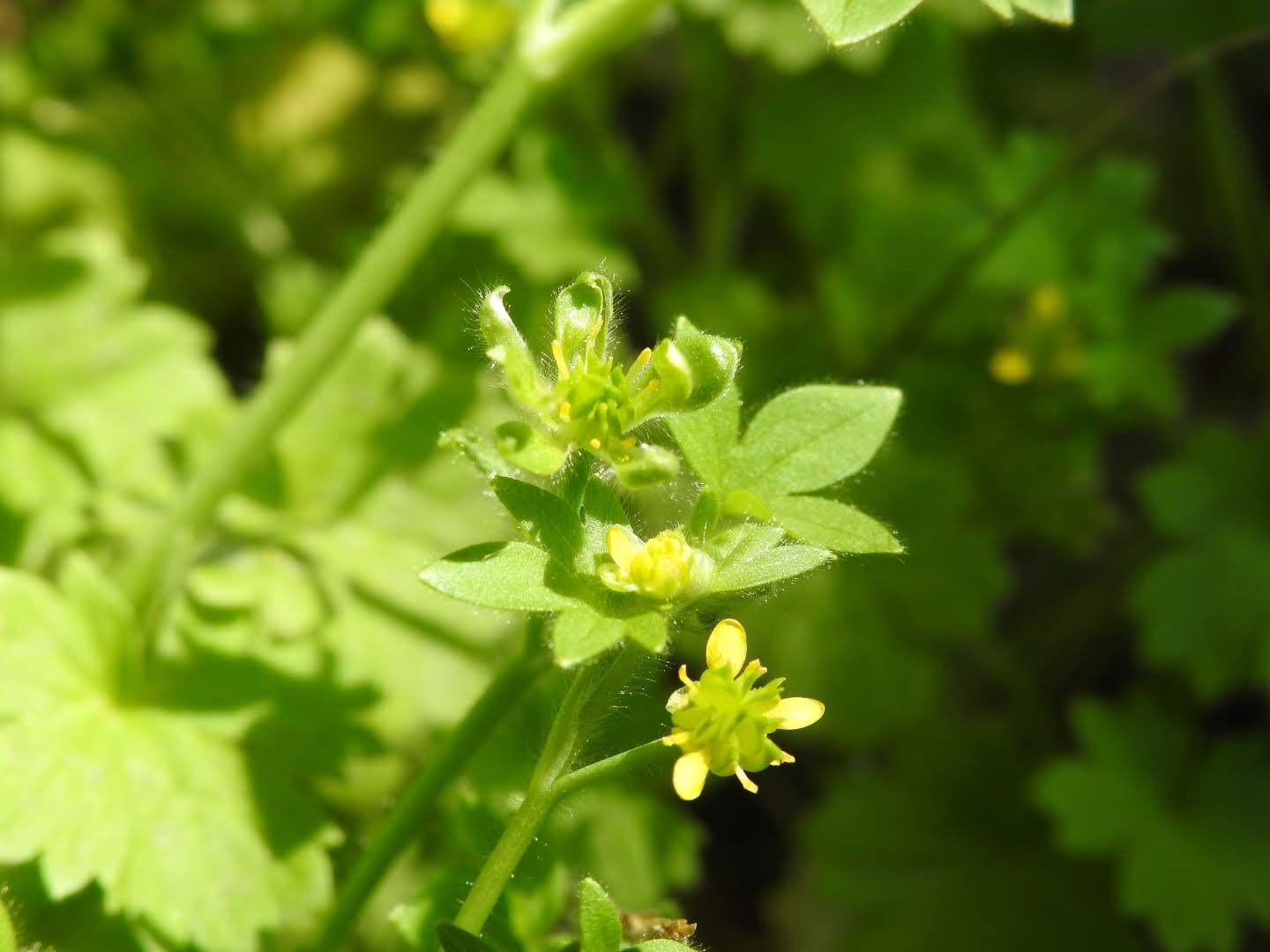
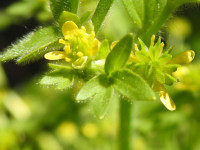
Annual herbaceous plant, the Rough-fruited Buttercup reaches a variable height between 5 and 35 cm, with erect, robust, tubular stems about 2-3 mm in diameter at the base. The habit is bushy and branched, with multiple stems often appearing in small cymes. The stem surface is generally glabrous or sparsely hairy.
The leaves are both basal and cauline. Basal leaves are long-petiolate (from 3 up to 15 cm in the longest cases), with a blade shape varying from oval-rounded to broadly truncate at the base, typically measuring 15-25 mm wide and 25-40 mm long. These leaves are deeply trilobed or sometimes with 3-5 lobes, with a dentate and crenate margin, often with calli at the tip of each tooth. Upper leaves tend to become progressively smaller, cuneate or lanceolate with 3 lobes and with a shorter petiole. Leaf surfaces can be glabrescent or weakly hairy.
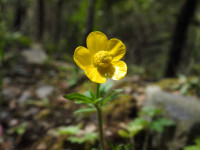
The flowers, pale yellow in color, are small, with a diameter ranging from 8 to 15 mm. They appear solitary or in small groups on the stems, supported by long erect and grooved peduncles in fruit. The petals are 5-6, spatulate, about 5-8 mm long and slightly longer or sometimes shorter than the calyx. The receptacle may be slightly rough or almost glabrous. The sepals are ovate, membranous, often reflexed or open, almost the same length as the petals, and sometimes slightly hairy on the underside.
The fruits are numerous achenes (from 12 up to 30), arranged in a globose or hemispherical head. The achenes measure about 3-8 mm in length, with a swollen and flattened beak 2-6 mm long. The surface of the achenes is muricate, that is covered with numerous sharp or spiny tubercles, short, curved or hooked, giving them a distinctive spiniform appearance. The margin is keeled and grooved. The receptacle hosting the achenes is pubescent.
The root system is fibrous, with thin and adventitious roots, allowing the plant to anchor in moist or seasonal soils.
Habitat and distribution
This species is typical of wet environments, such as uncultivated lands, wet meadows, edges of ponds and watercourses. In Italy it mainly grows in Mediterranean climate regions, with frequent reports along coasts and in wet lowland and hill areas up to 700 m altitude. It is common along the coasts of the Mediterranean Sea and extends northwards to the Po Plain, with documented occurrences in Liguria, Emilia-Romagna (Pineta di Ravenna, Bologna), Tuscany (Lucca, Sarzana) and sporadic locations in Friuli Venezia Giulia, Veneto, Piedmont and Istria. Its range more generally extends throughout the eurymediterranean area, with a fragmented distribution towards northern regions.
The Rough-fruited Buttercup prefers moist soils, often temporarily flooded or marshy, with exposure to sun or in areas of diffuse light. It is not found in closed forest environments but is associated with disturbed or anthropized habitats, such as uncultivated lands and edges of wet crops.
Flowering period
Flowering typically extends from February to April, with possible variations related to latitude and altitude. In milder climates flowering can begin already at the end of winter, while in cooler areas it can continue until late spring.
Ecology and pollination
The plant is hermaphroditic and reproduces mainly through entomophilous pollination, attracted by the bright yellow color of the flowers. The main pollinating insects are bees, flies and other small pollinating insects that visit the flowers to collect nectar and pollen. The arrangement of the achenes in globose heads, with fruits bearing spiny tubercles, favors mechanical dispersal by adhesion to animal fur or human passage, facilitating colonization of new wet environments.
Curiosities and traditional uses
The Rough-fruited Buttercup is a toxic plant, like many species of the genus Ranunculus, due to the presence of compounds irritating to the skin and mucous membranes. No significant traditional food or medicinal applications are known, probably due to its toxicity. The Italian common name "Ranuncolo con frutti spinosi" derives precisely from the particular morphology of the achenes, which have short and sharp spines, a distinctive characteristic of the species.
Etymology
The generic name Ranunculus derives from Latin and means “little frog”, referring to the wet and marshy habitats in which these plants grow, environments frequently frequented by frogs. The specific epithet muricatus means “with short and sharp points”, recalling the particular spiny structure of the achenes that characterizes this species. The Italian common name directly refers to this morphological characteristic of the fruits.
Sources
- Acta Plantarum - Flora delle regioni italiane (actaplantarum.org)
- Acta Plantarum - Flora delle regioni italiane (scheda di Mirna Medri)
- World Flora Online (WFO)
Characteristics
Scheda botanica
| Famiglia | Ranunculaceae |
|---|---|
| Fioritura | febbraio – aprile |
| Forma biologica | Scapose |
| Habitat | with yellow flowers, toxic plant, annual plant |
| Tossicità | Tossica — non consumare |
Domande frequenti
- Quando fiorisce Rough-fruited Buttercup?
- Rough-fruited Buttercup fiorisce febbraio – aprile.
- È tossica Rough-fruited Buttercup?
- Rough-fruited Buttercup è una pianta tossica o velenosa. Non consumare nessuna sua parte senza aver consultato un esperto.
- Che tipo di pianta è Rough-fruited Buttercup?
- Rough-fruited Buttercup è una Therophytes (Scapose) secondo la classificazione di Raunkiaer.
- A quale famiglia appartiene Rough-fruited Buttercup?
- Rough-fruited Buttercup appartiene alla famiglia botanica Ranunculaceae.
Where I found it (12 sightings)
Classification
- Kingdom
- Plantae
- Family
- Ranunculaceae
- Full name
- Ranunculus muricatus L.
- Life form
- Therophytes scapose
Similar species
Search for species with similar characteristicsNoticed an error in the identification? Write to me
Other species of the same family
Ranunculaceae
Explore
Other species of Ranunculaceae