Botanical species
Nigella damascena
L.
Love-in-a-mist
Description
Morphological description
Annual herbaceous plant, Love-in-a-mist has an erect habit, generally with a height between 20 and 45 cm, sometimes reaching 60 cm. The stem is single, glabrous, thin, often striated and can be straight or slightly bent at the base; in some cases it branches in the upper part.
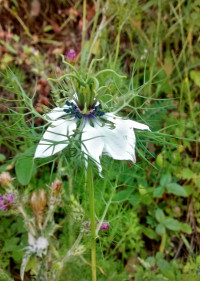
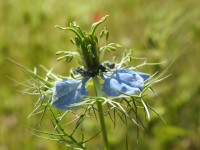
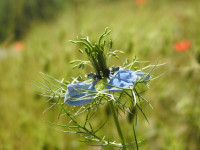
The leaves are alternate and characterized by a bipinnatisect division, that is deeply divided into linear and acute lobes. The basal leaves are petiolate and often form a rosette at the base, while the cauline leaves are sessile or subsessile, with denticulate margins and a rough surface to the touch. The upper leaves take on a bracteiform shape, wrapping the flower with an involucre of 3-4 spreading and laciniate bracts, resembling a sort of thin and delicate “net”.
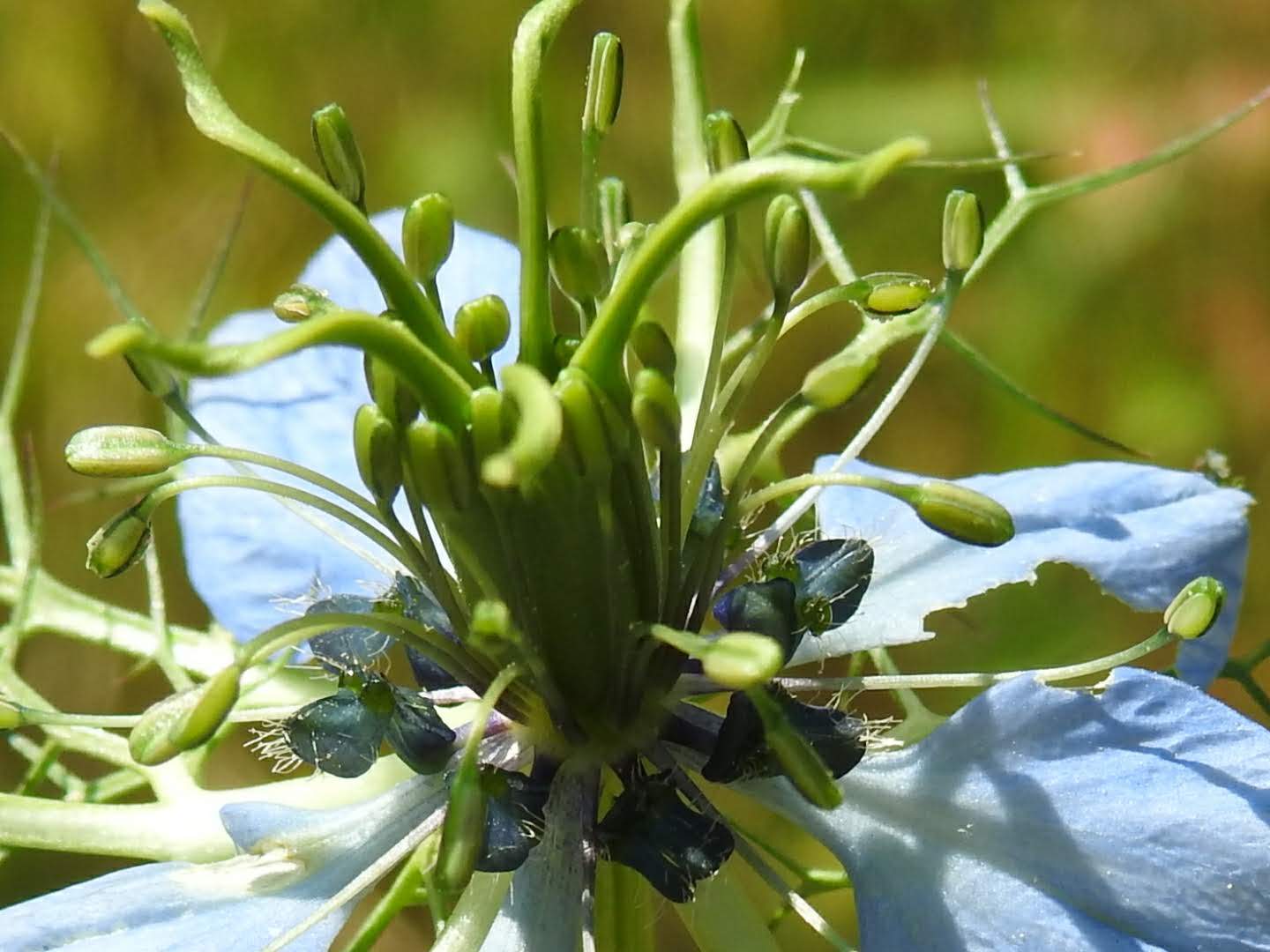
The flowers are solitary, positioned at the apex of the stem or branches. The calyx consists of 5 petaloid sepals, generally white, pale blue or violet in color, 2-3 cm long, with a short claw and a wider limb that can have entire, incised or slightly lobed margins. The petals are small, dark and reduced to nectariferous structures with two lips, the lower one being bilobed or bifid. The numerous stamens have erect filaments and anthers without appendages.
The fruit is a globose capsule, smooth and ribbed, about 2-3 cm in diameter, composed of 5 follicles completely fused together up to the base of the 5 persistent and elongated styles. At maturity, the capsule opens at the top to release numerous black, triangular, wrinkled and aromatic seeds. The root system consists of a taproot, which allows the plant to anchor effectively to the soil.
Habitat and distribution
This species has a predominantly Mediterranean range, extending along the coasts of southern Europe and North Africa, with extensions northwards and eastwards to temperate areas. In Italy it is common in regions with Mediterranean and sub-Mediterranean climates, also present in more northern areas such as the Po Valley and the Alps, although more rarely.
It prefers open and sunny habitats, such as dry uncultivated land, path edges, vineyards, fields and dry meadows. It grows on well-drained soils, often calcareous or sandy, up to an altitude of about 800 meters above sea level.
Flowering period
Flowering mainly occurs between April and May, with a possible extension until July in more temperate areas or under favorable conditions. The duration of the flowering period may vary slightly depending on altitude and latitude.
Ecology and pollination
Love-in-a-mist is mainly pollinated by pollinating insects, attracted by the delicate colors of the petaloid sepals and the presence of nectar. The involucre of bracts that wraps the flower helps protect it and facilitate pollination, creating a favorable microhabitat for insects.
Seed dispersal occurs through the dehiscence of the capsules, which open at the top releasing the black and wrinkled seeds to the ground, favoring germination in the immediate vicinity of the parent plant. The light and wrinkled structure of the seeds may facilitate some secondary transport by wind or animals.
Curiosities and traditional uses
Love-in-a-mist is a species known since ancient times, even mentioned in the Bible and widely used in traditional Quranic medicine. The seeds contain a toxic alkaloid called damascenine and, despite their toxicity, have historically been used for their emmenagogue, tonic, narcotic and aphrodisiac properties. They were used to relieve migraines, toothaches and to stimulate menstruation, as well as to treat cases of frigidity.
Externally, powdered seeds were used as sneezing powders to clear the respiratory tract. Today they are mainly used ornamentally, thanks to their aesthetic characteristics, especially in dried floral arrangements, where the globose and colorful capsules offer considerable decorative value.
In cooking, especially in India and the Middle East, the seeds are still used as a spice with a delicate aroma, used to flavor ice creams, liquors, candies and flatbreads. Additionally, traditionally they were placed in linens to keep moths and insects away.
Etymology
The genus name "Nigella" derives from the Latin nigra (black), referring to the dark color of the seeds. The specific epithet "damascena" refers to the city of Damascus, from which the plant was originally known or introduced into Europe.
The Italian common name “Love-in-a-mist” refers to the delicate and “disheveled” appearance of the bracts that wrap the flower, similar to a “love-in-a-mist” with loose or messy hair.
Sources
- Prof. P.V. Arrigoni, "Flora analitica della Toscana" e "Flora dell'Isola di Sardegna"
- Acta Plantarum - Flora delle regioni italiane (scheda di Giuliano Salvai)
- Tela Botanica / H. Coste, "Flore descriptive et illustrée de la France"
- World Flora Online (WFO)
Characteristics
Scheda botanica
| Famiglia | Ranunculaceae |
|---|---|
| Fioritura | aprile – maggio |
| Forma biologica | Scapose |
| Habitat | with white flowers, toxic plant, with purple flowers |
| Tossicità | Tossica — non consumare |
Domande frequenti
- Quando fiorisce Love-in-a-mist?
- Love-in-a-mist fiorisce aprile – maggio.
- È tossica Love-in-a-mist?
- Love-in-a-mist è una pianta tossica o velenosa. Non consumare nessuna sua parte senza aver consultato un esperto.
- Che tipo di pianta è Love-in-a-mist?
- Love-in-a-mist è una Therophytes (Scapose) secondo la classificazione di Raunkiaer.
- A quale famiglia appartiene Love-in-a-mist?
- Love-in-a-mist appartiene alla famiglia botanica Ranunculaceae.
Where I found it (13 sightings)
Classification
- Kingdom
- Plantae
- Family
- Ranunculaceae
- Full name
- Nigella damascena L.
- Life form
- Therophytes scapose
Similar species
Search for species with similar characteristicsFurther reading
Noticed an error in the identification? Write to me
Other species of the same family
Ranunculaceae
Explore
Other species of Ranunculaceae