Botanical species
Anemone apennina
L.
Blue Anemone
Description
Morphological description
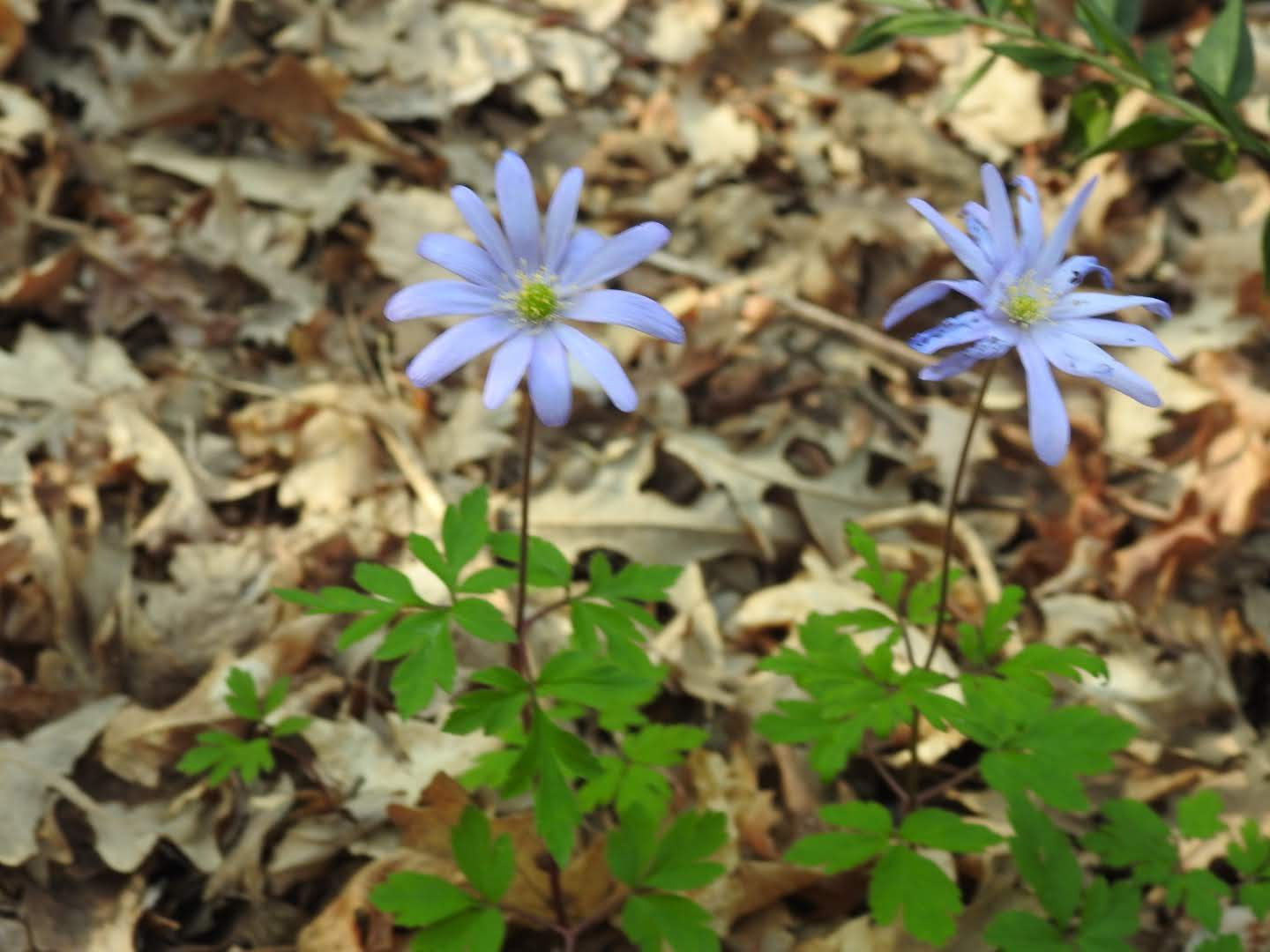
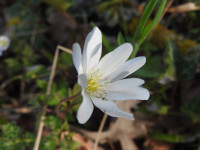
Perennial herbaceous plant, with an erect habit and height varying between 10 and 25 cm, Anemone dell’Appennino has a fragile and pubescent stem, characterized by a reddish coloration in the lower part. The stem is generally bare, but bears around the middle a whorl composed of three cauline leaves.
The basal leaves are arranged on petioles 5 to 15 cm long and have a triangular blade, approximately 8x6 cm, divided into three subequal and pinnatifid segments. The secondary segments are asymmetric, about 13-25 mm long and present one to three deep lobes on each side. The cauline leaves, smaller (about 4x3.5 cm), are also divided into three segments with dimensions between 8-15 mm by 15-25 mm.
The flower is solitary (rarely two flowers per specimen can be observed) and has a diameter of 3-4 cm, supported by a peduncle 6-9 cm long. The perianth is composed of 8-12 petaloid sepals, linear with an obtuse apex, which can vary from white to light blue, sometimes with slight shades of pink or blue on the outer side. These sepals are slightly pubescent on the lower part. The number of “petals” (actually petaloid sepals) varies from 16 to 23, with the larger ones measuring about 4x24 mm. In the center of the flower there are numerous stamens, with yellow or sometimes whitish oval-shaped anthers.
The ovary is uniovulate and gives rise to a rostrate achene containing a single seed. The plant has a dark rhizomatous root system, from which stems and leaves develop annually.
Habitat and distribution
Anemone dell’Appennino is a typical species of broadleaf forests, particularly of holm oaks, beeches, and oaks. It grows mainly in cool and shady environments, such as edges of paths and roads within wooded areas. It prefers forest-type substrates with moderate shade exposure.
Its distribution in Italy is mainly concentrated in the Apennine area, with historical records ranging from the central-southern regions up to areas such as Tuscany, Umbria, and the Pavia Apennines (although in the latter it has not been recently found). It is also present in northeastern Sicily, Corsica, and the Tuscan Archipelago. Geographically it extends towards southeastern Europe and the Carpathian-Danubian region.
Flowering period
Flowering occurs between February and May, with possible variations related to altitude and latitude. Generally, the plant flowers at the beginning of spring, taking advantage of the available light before the complete development of the tree canopy in the forests.
Ecology and pollination
The plant relies mainly on insect pollinators for sexual reproduction. The flowers, with their numerous stamens and clearly visible anthers, attract a variety of pollinating insects, drawn both by the blue-white color of the petaloid sepals and by the yellow pollen.
Seed dispersal occurs through rostrate achenes, which can be transported by abiotic factors such as wind or by animals, although the specific details of dissemination are not widely documented.
Curiosities and traditional uses
The genus name derives from the Greek "anemos", meaning wind, referring to the ease with which the flower can be carried away by the wind, symbolizing its transience. Traditionally, no widespread food or medicinal uses are known for this species, and any reported pharmaceutical applications should be considered purely informational, without official therapeutic indications.
Etymology
The scientific name reflects its main distribution along the Apennines ("apennina"). The Italian common name, Anemone dell’Appennino, derives precisely from its prevalent presence in this mountain range. The origin of the name "anemone" is associated with the short duration of the flower, which disperses easily at the slightest breeze, as already noted in ancient writings such as those of Theocritus.
Sources
- Prof. S. Pignatti, "Flora d'Italia"
- Acta Plantarum - Flora delle regioni italiane (scheda di Marinella Zepigi)
- World Flora Online (WFO)
Characteristics
Where I found it (13 sightings)
Classification
- Kingdom
- Plantae
- Family
- Ranunculaceae
- Full name
- Anemone apennina L.
- Life form
- Geofite rizomatose
Similar species
Search for species with similar characteristicsNoticed an error in the identification? Write to me
Other species of the same family
Ranunculaceae
Explore
Other species of Ranunculaceae