Botanical species
Cerastium alpinum
L.
Alpine Mouse-Ear
Description
Morphological description
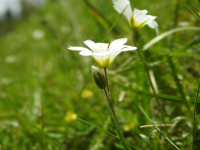
Perennial plant of modest height, generally between 6 and 30 cm, with a scapose habit and ascending or prostrate-ascending stems. The stem is branched, hirsute and tomentose, covered with twisted woolly hairs, often also with glandular hairs. The leaves are sessile, opposite, elliptic-ovate, oblanceolate or lanceolate in shape, with variable dimensions from about 3-5 mm in width up to 12-18 mm in length. Both surfaces of the leaves are hairy, with twisted woolly hairs and pointed at the apex, giving a herbaceous and sometimes slightly grayish or green-grayish surface. The basal rosettes have more tomentose, almost whitish leaves, while the cauline ones are greener.
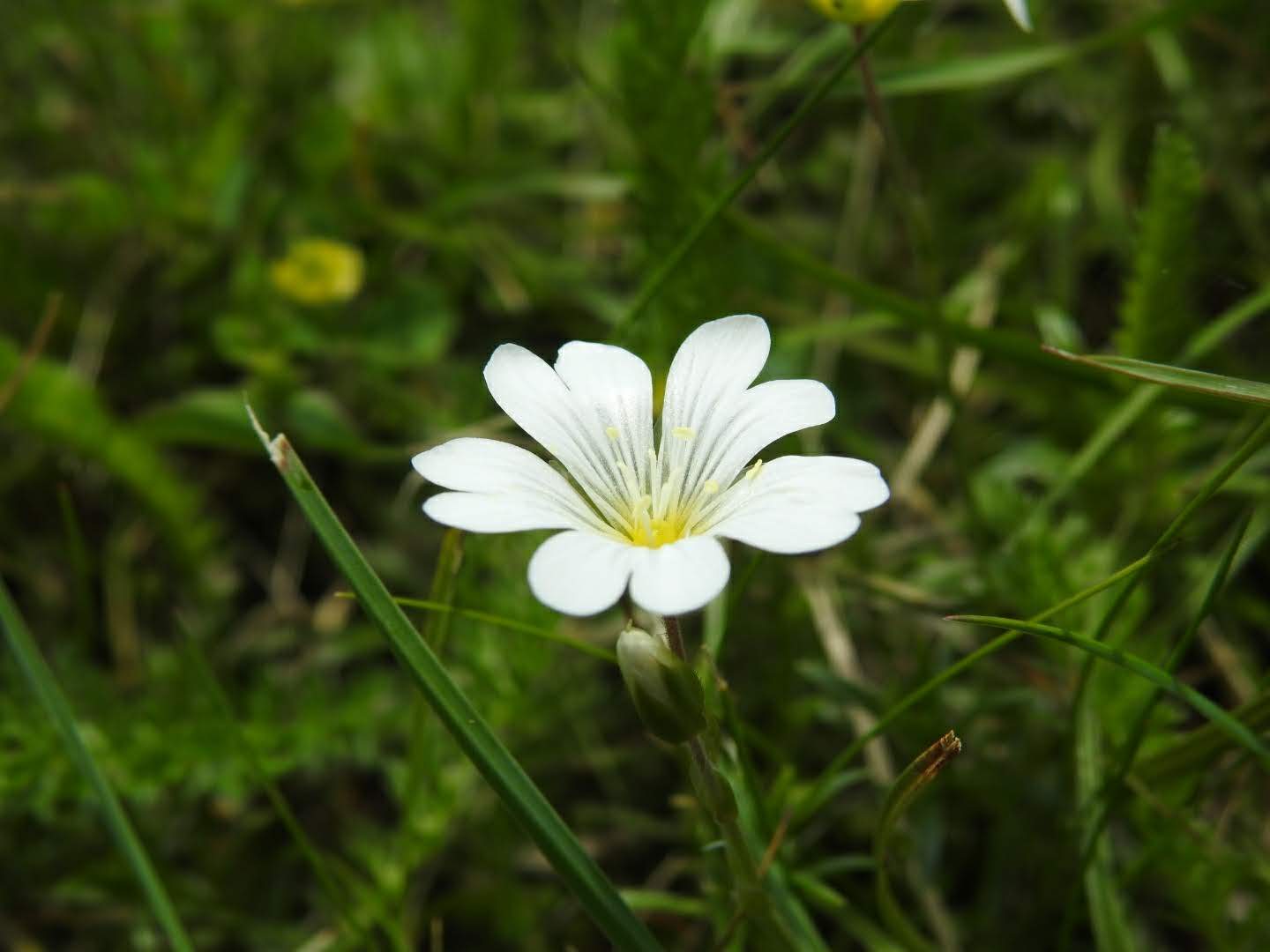
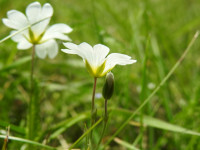
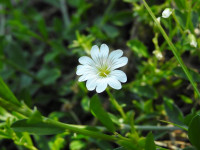
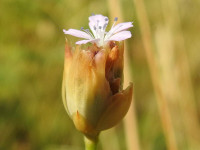
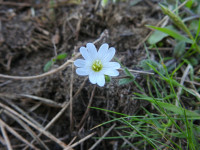
The flowers are white, pentamerous, with five bilobed or incised petals, 1.5 to 2 times the length of the sepals, which measure between 6 and 9 mm. The calyx is composed of five elliptic-lanceolate sepals, often with sharp tips and sometimes with slight violet shades, covered by a dense pubescence of both long non-glandular hairs and short glandular hairs. The flowers are arranged in sparsely flowered inflorescences, generally with 1-5 flowers per head, with bracts similar to the leaves or sepals, lanceolate and scarious, often pubescent. The flower peduncles, 5 to 30 mm long, are thin, straight or often curved and densely pubescent.
The fruits are cylindrical capsules, 8 to 16 mm long, slightly curved, with ten erect teeth with convoluted margins. They contain very small brown seeds (about 1-1.4 mm), sharply tuberculate and wingless, with a non-swollen head. The root system is rhizomatous, with buds at ground level allowing perennation.
Habitat and distribution
The species is typical of mountainous and subalpine environments, widespread in the Italian Alps and Apennines, particularly from the Carnic Alps to Lombardy and in the submontane Apennine areas. It grows at altitudes ranging from 1,200 to 3,000 meters above sea level. It prefers rocky, calcareous or gravelly substrates, and is commonly found in humified alpine pastures, elfin woods and on exposed cliffs. It is a circumpolar and arctic-alpine species, also present in the high mountains of Eurasia and North America.
In Italy it is considered relatively rare and can be easily confused with other species of the genus Cerastium such as Cerastium uniflorum and Cerastium carinthiacum, from which it is mainly distinguished by its particular woolly and felted hairiness.
Flowering period
Flowering generally extends from May to July, with variations related to altitude and latitude. At higher elevations flowering may be shorter and concentrated in the summer months.
Ecology and pollination
The plant develops in open and sunny environments, typical of alpine pastures and rocky ridges, with a preference for weakly acidic or neutral substrates. The white flowers, with bilobed and visible petals, attract various pollinating insects, particularly bees and other hymenopterans, which facilitate fertilization. Seed dispersal occurs through capsules that open by dehiscence, releasing small tuberculate seeds that can be carried by the wind or moved by animal agents.
Curiosities and traditional uses
In some folk traditions, Alpine Mouse-Ear has been used as a medicinal plant for the treatment of inflammations and gastrointestinal disorders, although there are no detailed and widespread data on specific uses. Young leaves can be consumed as food in some cultures, but extreme caution is recommended when collecting wild plants to avoid confusion with similar potentially toxic species.
Etymology
The genus name Cerastium derives from the Greek "κεράστης" (kerastēs), meaning "horned", referring to the elongated "horn"-shaped fruit capsules. The specific epithet alpinum indicates its typical presence in alpine mountain ranges, although the species grows in other high mountains worldwide. The Italian name "Peverina alpina" refers to its distribution in alpine environments and the characteristic delicate and "peppery" appearance of the plant.
Sources
- Prof. S. Pignatti, "Flora d'Italia"
- Acta Plantarum - Flora delle regioni italiane (scheda di Piera Pellizzer)
- World Flora Online (WFO)
Characteristics
Scheda botanica
| Famiglia | Caryophyllaceae |
|---|---|
| Fioritura | maggio – agosto |
| Forma biologica | Scapose |
| Habitat | with white flowers, edible plant, Perennial plant |
| Uso alimentare | Commestibile |
Domande frequenti
- Quando fiorisce Alpine Mouse-Ear?
- Alpine Mouse-Ear fiorisce maggio – agosto.
- È commestibile Alpine Mouse-Ear?
- Alpine Mouse-Ear è considerata commestibile. Verifica sempre le parti eduli e la preparazione corretta prima del consumo.
- Che tipo di pianta è Alpine Mouse-Ear?
- Alpine Mouse-Ear è una Hemicryptophytes (Scapose) secondo la classificazione di Raunkiaer.
- A quale famiglia appartiene Alpine Mouse-Ear?
- Alpine Mouse-Ear appartiene alla famiglia botanica Caryophyllaceae.
Where I found it (7 sightings)
Classification
- Kingdom
- Plantae
- Family
- Caryophyllaceae
- Full name
- Cerastium alpinum L.
- Synonyms
- Cerastium alpinum L. subsp. lanatum (Lam.) Ces.; Cerastium lanatum Lam.
- Life form
- Hemicryptophytes scapose
Similar species
Search for species with similar characteristicsFurther reading
Noticed an error in the identification? Write to me
Other species of the same family
Caryophyllaceae
Explore
Other species of Caryophyllaceae