Botanical species
Iris lutescens
Lam.
Crimean Iris
Description
Morphological description
Perennial herbaceous plant, equipped with a superficial and rhizomatous rhizome, of modest size with a height generally reaching 20-30 cm. The stem is cylindrical, usually shorter than the leaves, and bears one or rarely up to three flowers. The leaves are lanceolate-falcate, slightly curved, with a width varying from 5 to 15 mm, sometimes even wider, and ovate-lanceolate in shape.
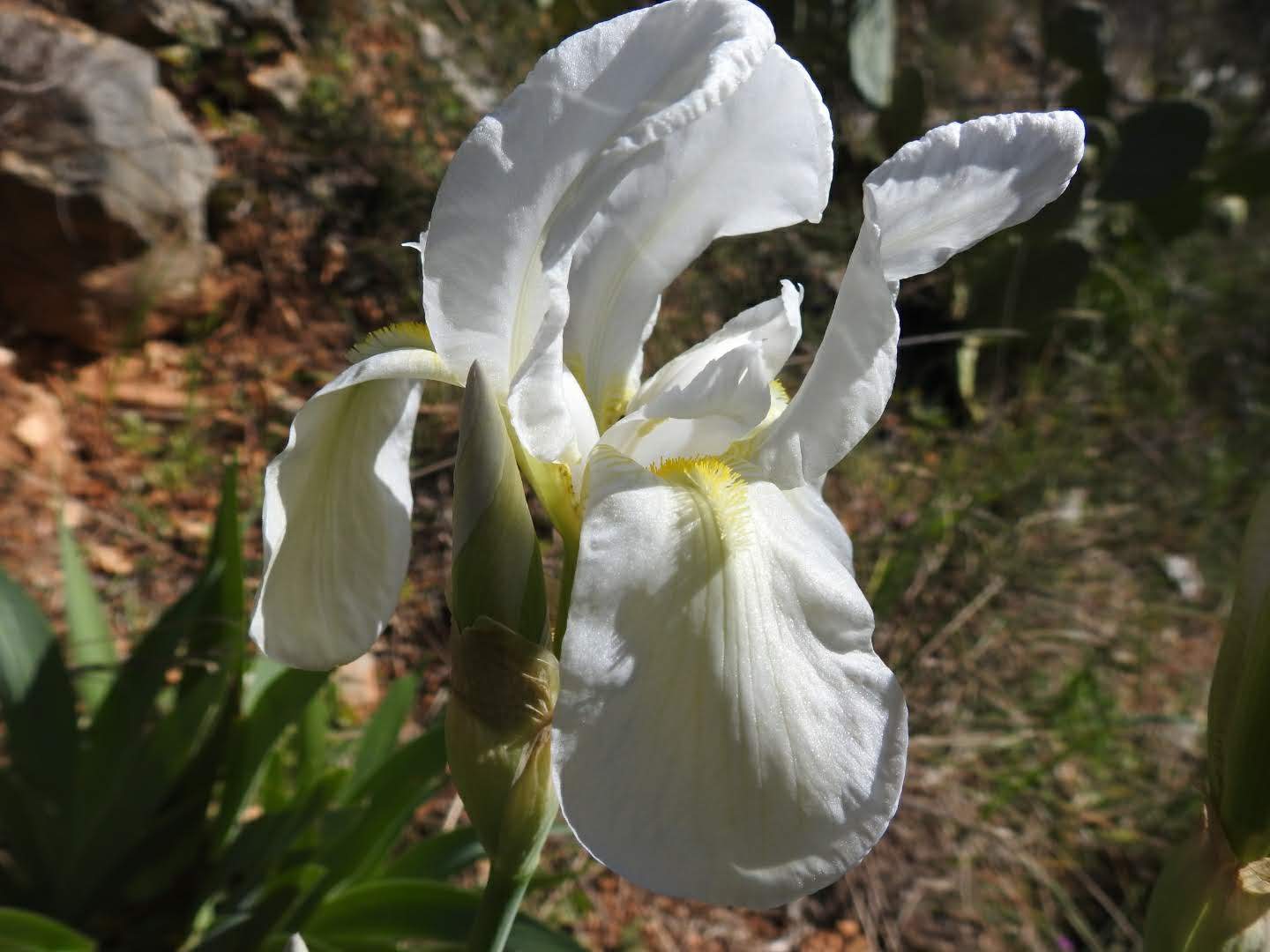
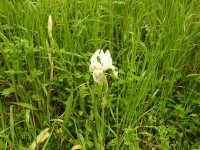
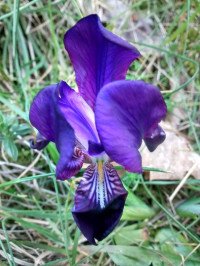
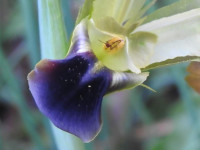
The flowers are characterized by a perigonium ranging from yellow to violet, with specimens rarely white. The outer tepals are about half as wide as the inner ones and feature a central line of yellow hairs, called the "beard". The flower structure includes a tube that is 1.5 to 2 times the length of the ovary and completely enveloped by the spathe, while the style lobes end with two sharp points. The inflorescence is composed of one or two flowers, sometimes up to three.
The fruit is a trilocular loculicidal capsule, with six well-defined ribs, measuring between 30-70 mm in length and 15-38 mm in width. The seeds are globose or pyriform and take on a reddish-brown coloration at maturity.
The root system consists of a superficial rhizome, which allows vegetative reproduction and expansion of the plant in its habitat.
Habitat and distribution
Species of Mediterranean origin, the Crimean Iris is mainly present in the coastal regions of western Italy, from Liguria to Tuscany, and more generally along the western Mediterranean area, including Spain. Its presence is reported in thermo-xerophilous environments, i.e., with warm and dry climate. It preferably grows in sunny clearings of Mediterranean scrub or in garrigues, often on ophiolitic substrates, but not exclusively.
It is generally found at altitudes between 100 and 1400 meters above sea level, favoring sunny exposures and well-drained soils, often rocky or stony, characteristic of coastal and sub-mountain areas.
Flowering period
Flowering occurs in spring, between April and May. Possible geographic variations in the flowering period may depend on altitude and local climatic conditions, but generally the species maintains this time frame for flower production.
Ecology and pollination
The Crimean Iris reproduces both sexually, through seeds produced in the fruit capsules, and vegetatively, through the superficial rhizome. Pollination is mainly carried out by pollinating insects, which are attracted by the showy yellow or violet flowers, often with a "beard" of yellow hairs that can serve as a visual guide for pollinators. Seed dispersal occurs with the dehiscence of the capsule, which opens to release the seeds into the surrounding soil, thus promoting the propagation of the species.
Curiosities and traditional uses
Although the Crimean Iris does not have a widely documented tradition of use due to its rarity and limited distribution, it can be hypothesized that its rhizome contains principles similar to those of some related species of the genus Iris, such as I. florentina, I. pallida, and I. germanica, from which a drug is obtained consisting of the dried and peeled rhizome with spasmolytic, expectorant, and diuretic properties. In the past, this powder was also used for cosmetic purposes. However, there is no evidence that the Crimean Iris has ever been significantly used for medicinal or cosmetic purposes.
From a cultural point of view, the genus Iris is historically linked to legends and symbolism: for example, it is believed that the symbol of the French monarchy, commonly mistaken for a lily, was actually an iris. According to tradition, Louis VII, after a military victory, adopted this flower as an emblem, from which the term “fleur de Louis” which, by assonance, became “fleur de lys”. A similar error occurred in the Medici coat of arms of Florence during the Renaissance.
Etymology
The generic name "Iris" derives from the Greek Ἶρις (iris), meaning "rainbow", referring to the variety and vividness of the tones of the flowers belonging to this genus. The specific epithet "lutescens" derives from the Latin "luteus", meaning "yellow", recalling the predominant color of the flowers of this species.
The Italian common name "giaggiolo tirrenico" refers to the main geographic area of distribution, the Tyrrhenian region, and to the resemblance to the giaggiolo, a traditional term used for some Iris species.
Sources
- Acta Plantarum - Flora delle regioni italiane (actaplantarum.org)
- Acta Plantarum - Flora delle regioni italiane (scheda di Patrizia Ferrari)
- World Flora Online (WFO)
Characteristics
Scheda botanica
| Famiglia | Iridaceae |
|---|---|
| Fioritura | aprile – maggio |
| Forma biologica | Rhizomatous |
| Habitat | with white flowers, with yellow flowers, with purple flowers |
Domande frequenti
- Quando fiorisce Crimean Iris?
- Crimean Iris fiorisce aprile – maggio.
- Che tipo di pianta è Crimean Iris?
- Crimean Iris è una Geophytes (Rhizomatous) secondo la classificazione di Raunkiaer.
- A quale famiglia appartiene Crimean Iris?
- Crimean Iris appartiene alla famiglia botanica Iridaceae.
Where I found it (10 sightings)
Classification
- Kingdom
- Plantae
- Family
- Iridaceae
- Full name
- Iris lutescens Lam.
- Synonyms
- Iris chamaeiris Bertol.; Iris italica Parl.; Iris lutescens Lam. var. statellae (Tod.) Baker; Iris neglecta Parl.; Iris statellae Tod.; Iris virescens Redouté var. statellae (Tod.) Nyman
- Life form
- Geophytes rhizomatous
Similar species
Search for species with similar characteristicsNoticed an error in the identification? Write to me
Other species of the same family
Iridaceae
Explore
Other species of Iridaceae